




We may not have the course you’re looking for. If you enquire or give us a call on +44 1344 203 999 and speak to our training experts, we may still be able to help with your training requirements.
Advantages and Disadvantages of R programming
ByRichard HarrisLast updated on: 21 September 2026
The advantages and disadvantages of R programming provide deeper insight into its statistical capabilities and challenges for Data Scientists and Analysts. R was created in the early 1990s and is widely used in data science, academia, finance and healthcare due to its rich ecosystem and strong community support.

Keep This in Mind
1. R provides extensive capabilities for statistical computing, modelling and Data Analysis.2. Its packages extend the language across numerous specialised analytical tasks.3. R supports flexible data visualisation and reproducible research workflows.4. Performance, memory usage, debugging and package management can present challenges.5. Whether R is suitable depends on the project's analytical requirements, scale and development goals.
Ever looked at a huge dataset and wondered, "Where do I even start?" That's exactly the kind of challenge R programming was built to tackle. From uncovering hidden patterns to turning complex numbers into clear visual stories, R gives Data Scientists, Analysts and Researchers powerful ways to make sense of data.
But powerful doesn't always mean perfect. R simplifies complex analysis, yet its learning curve, memory demands and package ecosystem can pose challenges. Exploring the advantages and disadvantages of R programming will show where R shines, where it may fall short and whether it fits your data toolkit.
What are the Advantages of the R Programming Language?
Here are the main advantages of R programming language:
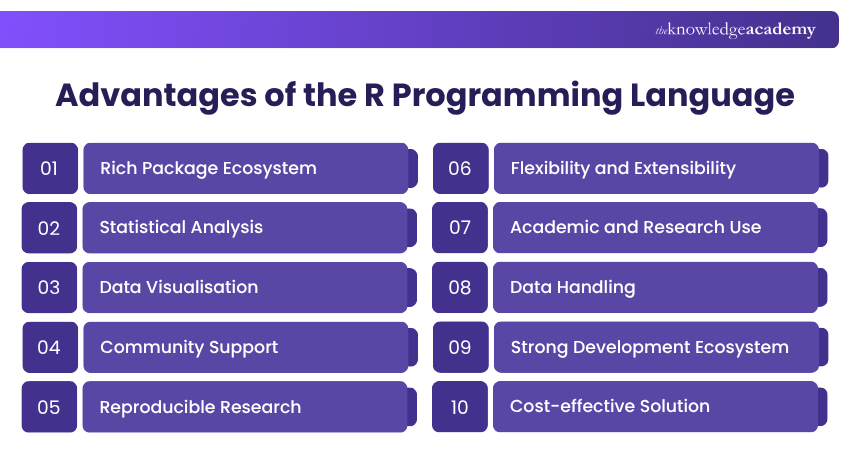
1) Rich Package Ecosystem: R has an extensive package ecosystem through CRAN and Bioconductor, with many packages also hosted on GitHub. These resources support a wide range of Data Analysis and statistical tasks, offering ready-to-use functions for complex methods.
Pro Tip
Before relying on a package for an important project, review its documentation, dependencies and maintenance status to determine whether it suits your requirements.
2) Statistical Analysis: R has a strong foundation in statistics and supports linear and nonlinear modelling, time-series analysis, hypothesis testing and many other statistical techniques. Its built-in functions and specialised packages support both standard and advanced analytical tasks.
3) Data Visualisation: R's visualisation libraries, particularly ggplot2, offer a highly flexible and elegant way to create various data visualisations. You can generate publication-quality plots, charts and graphs to communicate insights from the data effectively.
4) Community Support: R benefits greatly from an active community of users, developers and researchers. This community encourages collaboration, knowledge-sharing and the continuous development of new packages and functionality.
5) Reproducible Research: R Markdown and knitr support reproducible research by combining code, analysis results and explanations in a single document. This makes research findings easier to reproduce, verify and share.
6) Flexibility and Extensibility: R's flexible nature allows users to create custom functions and tailor analyses to specific requirements. It can also work with other programming languages and tools, further extending its capabilities.
7) Academic and Research Use: R is widely used in academia and research because of its statistical capabilities, open-source nature and extensive analytical tools. Researchers can use it to analyse data, develop statistical models and create reproducible research workflows.
8) Data Handling: R provides extensive data handling capabilities that allow users to import, clean, transform and manipulate data efficiently. This flexibility is useful when working with real-world datasets that require preprocessing and transformation.
9) Strong Development Ecosystem: R is supported by development environments and notebook tools that make coding, analysis and workflow management easier. RStudio provides an integrated environment for working with R, while notebook environments such as Jupyter support interactive analytical workflows.
10) Cost-effective Solution: As an open-source language, R is free to use and redistribute. This makes it an accessible option for individuals and organisations seeking powerful data analysis capabilities without software licensing costs for R itself.

What are the Disadvantages of the R Programming Language?
Like every programming language, R also has its disadvantages. Some of these disadvantages are listed below:
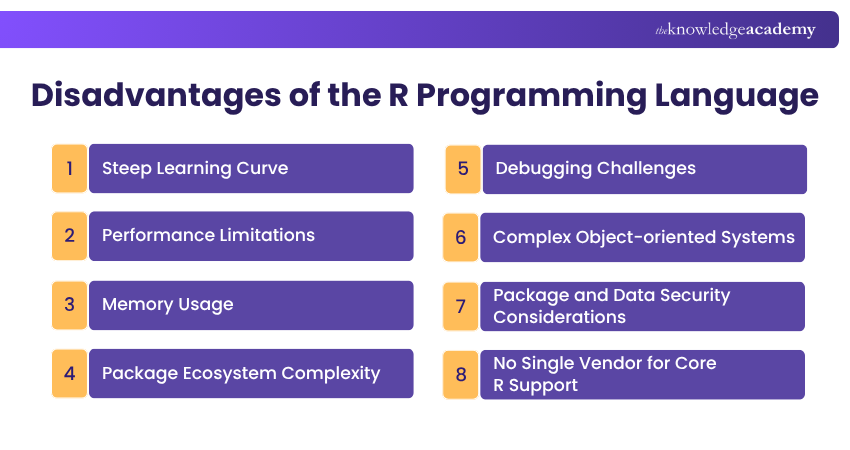
1) Steep Learning Curve: R's syntax and programming conventions can initially feel unfamiliar to beginners, particularly those without experience in statistics or programming. Its extensive package ecosystem can also take time to navigate.
2) Performance Limitations: R can be slower or more resource-intensive for certain large-scale or computation-heavy tasks, particularly when code is not optimised. However, specialised packages, parallel processing and integration with compiled languages can help improve performance.
Trainer Insight
Avoid viewing R as universally slow. Its performance can depend on the task, implementation, package selection, data size and workflow design.
3) Memory Usage: Some R workflows can consume substantial memory when processing large datasets, especially when multiple copies of data objects are created during analysis. Memory-efficient packages, database-backed workflows and alternative processing approaches can help manage this limitation.
4) Package Ecosystem Complexity: R's large package ecosystem includes tools with similar purposes, different interfaces and varying maintenance levels. This variety can make it harder for users to identify the most appropriate and reliable package for a particular task.
5) Debugging Challenges: Debugging R code can be challenging for beginners, particularly when errors originate from complex functions or third-party packages. Understanding R's debugging tools and error messages can make troubleshooting easier.
6) Complex Object-oriented Systems: R supports multiple object-oriented programming systems, including S3 and S4. However, having different OOP approaches can make its object model less straightforward for developers accustomed to languages with a more unified class-based system.
7) Package and Data Security Considerations: Like other programming ecosystems that rely on third-party packages, R requires appropriate package and data security practices. Organisations should use trusted repositories, review dependencies and apply suitable access controls when working with sensitive data.
8) No Single Vendor for Core R Support: As an open-source project, core R does not have a single vendor responsible for providing comprehensive commercial support. However, organisations can obtain professional support for R-related platforms and enterprise tools from third-party providers.
9) Package Dependency Management: R projects often depend on multiple packages and specific versions. Updating R, a package or one of its dependencies can sometimes affect existing workflows, so version and environment management are important for reproducibility and long-term projects.
10) Less Suited to General-purpose Software Development: R is primarily designed for statistical computing, graphics and data analysis. While it can be used for broader programming tasks, other languages may be more suitable for many general-purpose software development applications.
Pro Tip
For larger datasets, consider memory-efficient packages or database-backed workflows instead of unnecessarily keeping all data in memory.
Blend the power of R programming and data science to get the best out of your data with our Data Science With R Training – Sign up now!
Why Should You Use R Programming Language?
There are several reasons why you should choose R programming language, particularly in domains like data analysis, statistics, and research. Here are some reasons:
1) Statistical Capabilities: R was specifically designed for statistics. It offers a broad array of statistical tests, models, and analyses, making it an essential tool for statisticians and Data Analysts.
2) Graphics and Visualisation: R is renowned for its capabilities in data visualisation. Users can create high-quality, customisable plots and visualisations with libraries like ggplot2, lattice, and base graphics.
3) Comprehensive Package Ecosystem: The Comprehensive R Archive Network (CRAN) houses thousands of user-contributed packages that extend R's capabilities. This means that for almost any analytical task, there's likely a package that already implements it.
4) Open Source: Being open-source means R is free to use, and its codebase can be examined and modified. This fosters a collaborative environment where tools and packages are continuously developed and improved by the community.
5) Active Community: R's active and vibrant community ensures that you have access to plenty of tutorials, forums, workshops, and online courses. This makes it relatively easier to find answers to questions or solutions to problems.
6) Flexibility: R can integrate with other languages (like C++, Python, and SQL) and tools, making it versatile for various applications, from web apps to reporting.
7) Data Manipulation Tools: Packages like dplyr, tidyr, and data.table provides robust tools to manipulate data efficiently. This allows you to reshape, aggregate, filter, and transform data easily.
8) Reproducibility: R, combined with tools like RMarkdown, allows for creating reproducible research documents that combine code, output, and narrative in a single document. This is invaluable in academic, scientific, and business reporting.
Checklist: What to Consider Before Choosing R
Before selecting R for a project, consider the following:
□ Does the project involve statistical analysis or modelling?□ Do you need specialised analytical packages?□ Is Data Visualisation an important requirement?□ Does the workflow require reproducible analysis or reporting?□ Can R efficiently handle the expected data size?□ Have you considered memory and performance requirements?□ Are the required packages actively maintained and suitable?□ Does your team have the necessary R skills?□ Is the project primarily analytical rather than general-purpose Software Development?
Master coding and find endless opportunities in the digital world with our Programming Training - Sign up now!

Richard Harris creates technically detailed yet accessible content on full-stack development, software architecture and modern development frameworks. His knowledge of frontend and backend technologies helps developers understand how scalable, efficient and high-performing applications are designed and built.
View Detail

 If you wish to make any changes to your course, please


