




We may not have the course you’re looking for. If you enquire or give us a call on 01344203999 and speak to our training experts, we may still be able to help with your training requirements.
Advantages and Disadvantages of Nanotechnology: A Complete Guide
ByNilotpal SarmahLast updated on: 02 October 2026
Explore the key advantages and disadvantages of nanotechnology to understand its potential benefits, practical challenges and associated risks.
Are you fascinated by the potential of nanotechnology to revolutionise our world? Imagine creating materials stronger than steel yet lighter than plastic. This isn’t just science fiction; it’s the incredible promise of nanotechnology.
Whether you're thrilled by medical breakthroughs or concerned about ethical issues, understanding the advantages and disadvantages of nanotechnology is essential. So, let’s embark on this journey to uncover the true potential and challenges of this tiny yet mighty technology.
Advantages of Nanotechnology
Nanotechnology offers a multitude of benefits across various fields, pushing the boundaries of what’s possible and revolutionising industries with its innovative applications. Let's explore the remarkable advantages this cutting-edge technology brings to the table:
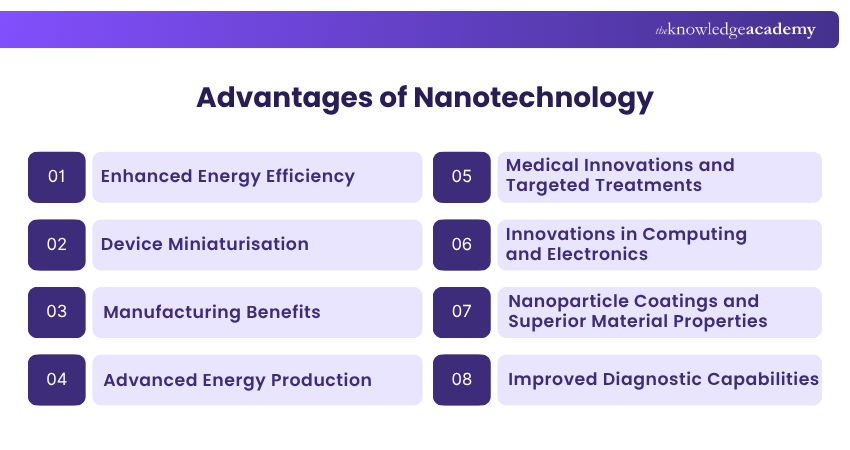
1) Enhanced Energy Efficiency
Nanotechnology has revolutionised energy efficiency in numerous sectors. Nanomaterials can create more efficient solar cells, energy storage systems, and fuel cells. For instance, nanoparticles can improve the surface area of electrodes in batteries, leading to higher energy storage capacities and faster charging times.
2) Device Miniaturisation
One of the most significant advantages of nanotechnology is the miniaturisation of electronic devices. This technology allows for the formation of smaller, faster, and more efficient components. Smartphones, computers, and other gadgets continue to shrink in size while increasing in power and functionality.

3) Manufacturing Benefits
Nanotechnology can improve the properties of materials used in manufacturing. Depending on the material and application, nanotechnology-enabled materials can be stronger, lighter, more durable or possess other useful properties compared with conventional alternatives. These characteristics can help improve product performance and durability.
4) Advanced Energy Production
Nanotechnology is very important for making new ways to produce energy. It’s used to make solar panels and wind turbines that work better. These help us get more energy from the sun and wind, which can contribute to reducing reliance on fossil fuels.
5) Medical Innovations and Targeted Treatments
Nanotechnology could change how we prevent and treat diseases. Tiny particles can be designed to carry medicines to tissues or biological targets, potentially improving drug delivery and reducing unwanted effects in suitable applications. This has important potential in areas such as cancer treatment, where targeted delivery is an active area of nanotechnology research and application.
Trainer’s Insight
Targeted drug delivery does not mean nanoparticles automatically reach only diseased cells or eliminate all side effects. Their performance depends on the material, formulation, biological behaviour and intended application.
6) Innovations in Computing and Electronics
Nanotechnology has spurred significant innovations in computing and electronics. Quantum dots, nanowires, and other nanomaterials are paving the way for the next generation of computers and electronic devices. These advancements promise increased processing speeds, greater storage capacities, and enhanced overall performance.
7) Nanoparticle Coatings and Superior Material Properties
Nanoparticle coatings provide enhanced protection and functionality by making surfaces more resistant to scratches, water, and environmental factors. Materials engineered at the nanoscale can also be stronger, lighter, and more flexible than conventional materials, making them valuable for applications ranging from aerospace to consumer electronics.
8) Improved Diagnostic Capabilities
Nanotechnology has advanced diagnostic tools through nanosensors and other nanoscale technologies that enable sensitive detection of biological targets and disease-related markers, potentially supporting earlier diagnosis. It also shows promise for point-of-care diagnostics, although accessibility and availability depend on the specific technology and healthcare setting.
Step beyond binary and into the quantum era by joining the Quantum Computing Training today!
Disadvantages of Nanotechnology
While nanotechnology presents numerous benefits, it also comes with its share of challenges and risks. It's important to consider these disadvantages to fully understand the complexities and implications of this advanced technology. Let’s look at them below:
1) Health Concerns
Nanotechnology, while beneficial, poses health risks. Nanoparticles are so tiny that they can enter our bodies by being breathed in, swallowed, or through skin contact. Inside the body, they might interact with cells in ways we don’t fully understand, which could cause health problems.
2) Practical Challenges
Scaling up nanotechnology comes with its own set of hurdles. Creating and handling materials at the nanoscale needs advanced tools and know-how, which makes it hard to keep things consistent and reliable when making lots of them.
3) Safety Issues
There are safety concerns associated with the production and handling of some engineered nanomaterials. Depending on the material and process, appropriate controls may be required to manage occupational exposure during manufacturing, research or other activities.
4) High Costs
The money needed for nanotechnology research, development, and putting it to use can be quite high. The initial costs can make adoption difficult for some companies and industries, particularly where specialised equipment, expertise or manufacturing processes are required.
5) Regulatory Challenges
Regulating nanotechnology is complex due to its multidisciplinary nature and rapid advancements. Developing appropriate regulations and standards to ensure safety and efficacy while fostering innovation is a challenging task for policymakers.
6) Poorly Understood Long-term Effects
The long-term effects of some engineered nanomaterials and applications are still not fully understood. Continued research is needed to better understand potential long-term impacts on health and the environment.
7) Potential Environmental Impact
Nanotechnology can have a negative environmental impact if not managed properly. The production and disposal of some nanomaterials may create environmental risks. Strategies to assess and mitigate these risks are necessary to support environmental sustainability.
Pro Tip
Consider nanotechnology across the full material and product lifecycle, including manufacturing, use and disposal. Potential environmental impact depends on the material and how exposure or release occurs.
8) Potential Economic and Workforce Disruption
Advances in nanotechnology may reshape markets and traditional production methods, requiring industries to adapt to new technologies and manufacturing approaches. These changes can shift workforce needs, increasing demand for specialised technical skills while reducing some traditional roles and creating a greater need for employee retraining.
Explore emerging tech and expand what is possible with the Advanced Technologies Courses – Sign up now!

Nilotpal Sarmah is a Senior Content Writer with 11+ years of overall experience spanning engineering, operations and content development. His technical knowledge and extensive writing experience enable him to simplify specialised topics across IT and Tech, Business Skills, Project Management, Health and Safety, and ISO and Compliance.
View Detail

 If you wish to make any changes to your course, please


