




We may not have the course you’re looking for. If you enquire or give us a call on 01344203999 and speak to our training experts, we may still be able to help with your training requirements.
Home
 Resources
IT Security & Data Protection
What are the Advantages and Disadvantages of Cyber Security?
Resources
IT Security & Data Protection
What are the Advantages and Disadvantages of Cyber Security?
Resources
IT Security & Data Protection
What are the Advantages and Disadvantages of Cyber Security?
What are the Advantages and Disadvantages of Cyber Security?
ByNilotpal SarmahLast updated on: 23 September 2026
This blog explores the advantages and disadvantages of cyber security and what they mean for organisations implementing data protection.

In today's internet world, data has become one of the most prized targets for hackers. Hackers may target sensitive and valuable data for financial gain or other malicious purposes. As a result, cyber security plays an important role in helping businesses safeguard their systems, networks, and information from cyber threats.
As businesses increasingly rely on connected devices, cloud services, and digital systems, securing them against potential cyber threats becomes increasingly important. Understanding the advantages and disadvantages of cyber security can help organisations make informed decisions about their security strategies and investments. Let's get started!
Advantages of Cyber Security for Businesses
Businesses and organisations can benefit significantly by implementing cyber security in their strategy. Whether it's about reducing downtime, minimising security costs or preventing cyber-attacks, cyber security can do that and much more. Let's look at some of the key advantages of cyber security for business:
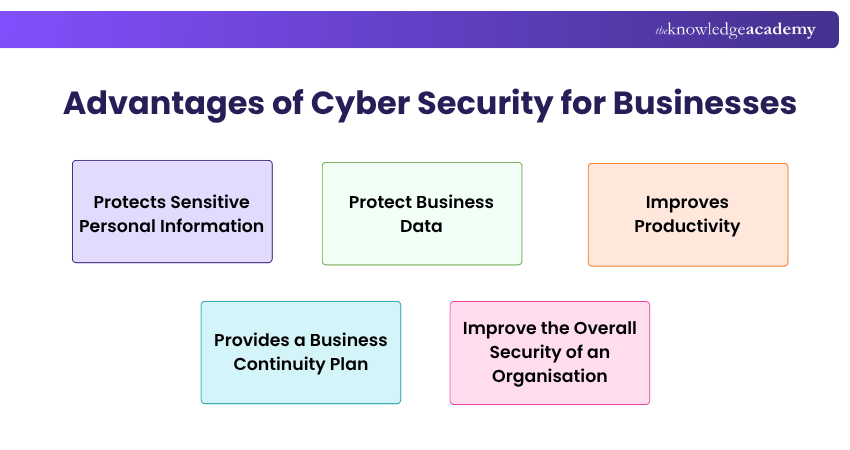
1) Protects Sensitive Personal Information
Data has become a precious commodity these days, and data containing personal information is in high demand. Hackers can illegally gain access to a person's data using malware and other tools to either extort money or damage the person's reputation. Cyber security measures can help reduce the risk of such attacks by identifying vulnerabilities, strengthening protection, and detecting suspicious activity.

2) Protect Business Data
Cyber security is a complete security package that can protect businesses and organisations from various threats. For example, companies must protect their sensitive data like Intellectual Property (IP), trade secrets and other private information like their internal communication logs. Cyber security measures such as access controls, encryption, monitoring, and threat detection can help organisations protect sensitive business information.
3) Improves Productivity
One of the most devastating consequences of a cyber-attack is downtime. Unnecessary downtime leads to decreased productivity. An effective cyber security strategy can give an early warning on when to expect attacks and provide suggestions on how to respond. This kind of early, automated warning is something conventional, non-digital security approaches generally can't offer.
4) Provides a Business Continuity Plan
Cyber security can support business continuity by helping organisations prepare for, respond to, and recover from cyber incidents. Incident response and recovery planning can help minimise disruption and restore affected systems and services more effectively.
5) Improve the Overall Security of an Organisation
A comprehensive cyber security programme enhances the effectiveness of traditional cyber security solutions by providing real-time threat detection and automated responses. It brings together protection across an organisation's entire digital footprint, from external attacks to internal vulnerabilities, and can do so more cost-effectively than relying on multiple disconnected conventional security measures.
Trainer Insight
Cyber security is not a one-time implementation. Threats, technologies, and vulnerabilities continue to evolve, so organisations need to regularly review their controls, update systems, monitor risks, and strengthen employee awareness.
Disadvantages of Cyber Security
Cyber security implementation and maintenance also come with certain challenges. Understanding these disadvantages can help organisations plan their security strategies more effectively and balance protection with cost, complexity, and operational requirements. Let's learn about them below:
1) Regular Updates
Businesses need to regularly update their software, hardware, and security strategy to stay one step ahead of attackers. Falling behind on updates can leave known vulnerabilities exposed even after a fix has been made available.
2) Needs Continuous Learning
Threats are constantly evolving, so keeping up requires ongoing learning rather than a one-off training session. Security teams and employees alike need to stay current, since yesterday's best practices can quickly become outdated.
3) Complex to Set Up
Setting up security architectures and tools like a firewall can be complicated and time-consuming. This complexity often means organisations need specialist expertise just to configure systems correctly from the start.
4) Potential Performance Impact
Some security tools and processes can consume system resources or add processing overhead. Their impact depends on the technology, configuration, and environment in which they are deployed, so poorly optimised tools can slow down everyday operations.
5) Constant Monitoring
An effective cyber security strategy involves continuously monitoring for new threats, since it's the only way to detect issues well in advance. This also allows an organisation to assess the threat level and develop a response quickly, though sustaining this level of vigilance requires dedicated time and resources.
6) Skills Shortage
Cyber security requires expertise across multiple disciplines, and organisations can struggle to find or develop the skills needed to manage evolving technologies and threats. This shortage can leave critical roles understaffed or filled by generalists rather than specialists.
7) Implementation and Ongoing Costs
Implementing cyber security can be expensive, as it's an ongoing process requiring consistent investment in tools, training and staffing. This makes it particularly challenging for small businesses operating with limited budgets.
Pro Tip
Organisations do not necessarily need to address every cyber security risk with the same level of resources. Prioritise critical systems, sensitive data, high-risk vulnerabilities, and threats with the greatest potential business impact.
Identify risks before they become threats by joining the Cyber Security Risk Management Training now!
Impacts of Cyber Security
Cyber security has a significant impact on how organisations protect their digital assets, manage risks, and respond to evolving threats. Its effects extend beyond technology itself, shaping trust, compliance and day-to-day business operations. Let's learn about them below:
1) Business Reputation and Customer Trust: A strong cyber security posture reassures customers, partners and stakeholders that their data is handled responsibly. Conversely, a breach can damage trust quickly, sometimes causing longer-lasting harm to the business than the direct financial cost of the incident itself.
2) Regulatory Compliance: Cyber security directly shapes an organisation's ability to meet legal and industry requirements, such as data protection laws. Falling short can result in fines, legal action or restrictions on how a business can operate.
3) Operational Continuity: Effective cyber security reduces the frequency and severity of disruptions caused by attacks, helping organisations keep critical systems and services running. This has a knock-on effect on productivity, revenue and the reliability customers expect.
4) Financial Performance: Beyond the direct cost of an attack, cyber security affects insurance premiums, investor confidence and the resources a business must allocate to protection versus growth. Strong security can reduce long-term costs, while poor security can create ongoing financial exposure.
5) Employee Behaviour and Culture: Cyber security shapes how employees work day to day, from password practices to how cautiously they treat emails and links. Over time, a strong security culture becomes part of how an organisation operates, not just a set of rules imposed on staff.

Nilotpal Sarmah is a Senior Content Writer with 11+ years of overall experience spanning engineering, operations and content development. His technical knowledge and extensive writing experience enable him to simplify specialised topics across IT and Tech, Business Skills, Project Management, Health and Safety, and ISO and Compliance.
View Detail

 If you wish to make any changes to your course, please


