




We may not have the course you’re looking for. If you enquire or give us a call on +43 720 115337 and speak to our training experts, we may still be able to help with your training requirements.
Advantages and Disadvantages of Big Data
ByThe Knowledge AcademyLast updated on: 22 September 2026
Benefits of Big Data include better customer insights, personalised marketing and cost reduction while its drawbacks include privacy and security concerns and data overload.
Consider this scenario:
A customer searches for running shoes↓Views three products↓Leaves without buying↓Returns two days later↓Makes a purchase↓Leaves a review
For the customer, these are separate actions. But for a business, they are data points. When millions of such signals are analysed together, organisations can uncover patterns, understand behaviour and make more informed decisions. That is where the Advantages and Disadvantages of Big Data begin to emerge.
Big Data empowers businesses to uncover valuable insights, predict trends, and boost customer experiences through advanced analytics. However, alongside its immense potential come challenges such as data privacy concerns, security risks and high implementation costs.
What is Big Data?
Big Data can be defined as the collection of vast amounts of data that are exponentially growing over time. This data is so vast that traditional data processing software is incapable of managing it. Although the term is new, the concept has been in use since the 1990s because of the Benefits of Big Data. With data sizes ranging from a few dozen Terabytes (TB) to many Zettabytes (ZB), the need for a robust Big Data Platform has become essential to manage such massive and complex data sets.

How Does Big Data Create Business Value?
Big Data creates business value when organisations turn large and varied datasets into a support system for practical action. Consider an example of Big Data reducing product stockouts:
Business ProblemPopular products frequently run out of stock↓Collect Relevant DataSales history + inventory levels + seasonal demand + customer orders↓Analyse PatternsIdentify when and where demand increases↓Generate InsightCertain products are likely to experience higher demand next week↓Take ActionAdjust stock levels and replenishment schedules↓Business OutcomeFewer stockouts + better inventory planning + improved customer experience↓Create Business ValueLower lost-sales risk and more efficient inventory use
In this example, analysing sales and inventory patterns helps a retailer anticipate demand rather than simply reacting when products run out.
Top 10 Benefits of Big Data for Your Business
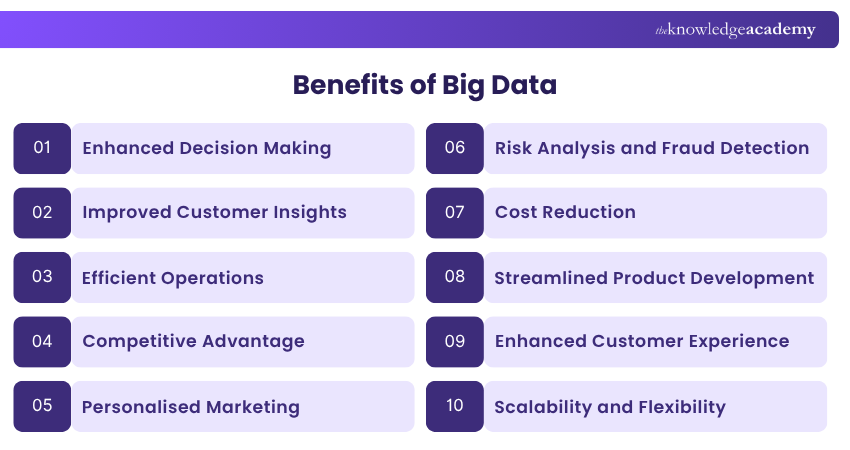
Big Data drives the modern digital landscape in unprecedented ways. Let's explore the biggest benefits Big Data can bring to any business:
1) Enhanced Decision Making
This is one of the primary Benefits of Big Data. Big Data empowers businesses to make informed and strategic decisions. By analysing big volumes of structured and unstructured data, companies can identify patterns, trends, and correlations that were previously hidden. With better insights, businesses can optimise their strategies and adapt quickly to changing market conditions.
2) Improved Customer Insights
Understanding customer behaviour and preferences is crucial for businesses to tailor their products and services effectively. Big Data Analytics provides valuable insights into customer preferences, purchasing patterns, and sentiment analysis.
By leveraging this information, businesses can personalise their offerings, craft targeted marketing campaigns and improve customer satisfaction and loyalty. With enhanced customer insights, businesses can create customer-centric strategies, optimise customer experiences, and build stronger relationships with their target audience.
Fuel your Data Analytics skills with the power of AI. Sign up for our Certified Artificial Intelligence for Data Analysts Training now!
3) Efficient Operations
Big Data can optimise business operations by streamlining processes and identifying areas for improvement. By analysing operational data, organisations can identify bottlenecks, optimise supply chains, and enhance overall efficiency. For example, in manufacturing, Big Data can enable predictive maintenance, reducing downtime and improving productivity.
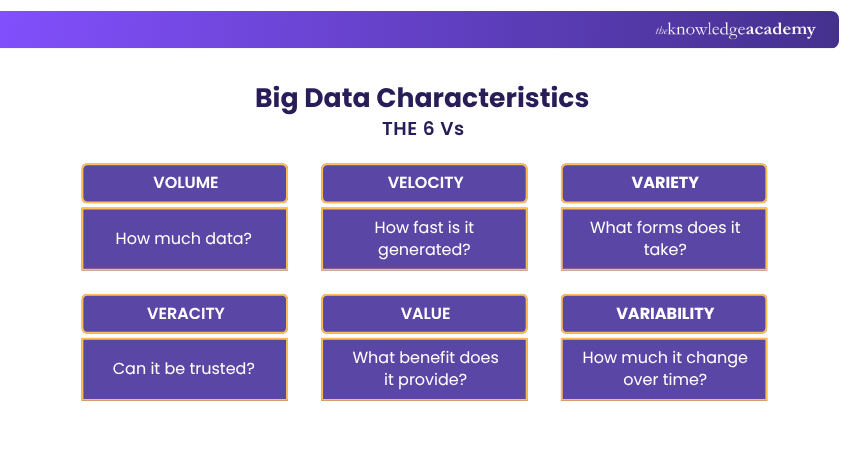
In logistics, real-time data analysis can optimise routes and reduce delivery times. By harnessing the power of Big Data, businesses can streamline their operations, reduce costs, and achieve higher productivity levels. It’s important to note that Big Data is characterised by the six Vs: Volume, velocity, variety, veracity, value and variability.
4) Competitive Advantage
In today's highly competitive business landscape, gaining an advantage is vital for success. Big Data Analytics helps businesses gain insights into market trends, their competitors' strategies and customer preferences. By leveraging this information, organisations can make data-driven decisions that give them a competitive edge, helping them stay ahead of the curve.
One of the biggest benefits of Big Data in the retail industry is its ability to analyse competitor pricing, identify market gaps, and develop targeted marketing campaigns. These insights are derived from processing vast amounts of data efficiently.
Unlock the power of Big Data Analysis and elevate your skills with our comprehensive Big Data and Analytics Training - Sign up now!
5) Personalised Marketing
Big Data allows businesses to deliver personalised marketing campaigns that resonate with their target audience. By analysing customer data, businesses can understand customer preferences, purchase history and online behaviour. For example, e-commerce platforms can use Big Data Marketing to provide personalised product recommendations based on customers' browsing and purchase history.
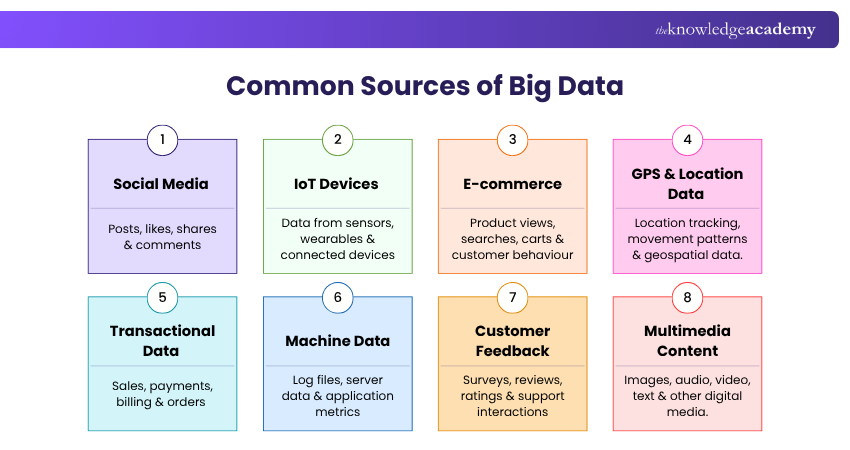
In case you are wondering where Big Data comes from, check out these common sources:
6) Risk Analysis and Fraud Detection
Identifying and mitigating risks is a top priority for businesses. Big Data Analytics can assist in risk analysis by identifying potential threats and detecting fraudulent activities. For instance, financial institutions can utilise Big Data Analytics to identify fraudulent transactions, monitor suspicious activities, and protect customers' financial information.
7) Cost Reduction
Cost reduction is a big objective for businesses across industries. Big Data Analytics can help identify cost-saving opportunities by analysing operational data, supply chain efficiencies, and resource utilisation, which can help minimise Big Data Cost.
For example, in healthcare, Big Data analysis can identify opportunities to reduce medical errors, optimise inventory management, and streamline patient care processes. The role of Big Data in Healthcare has become increasingly vital, helping medical institutions improve patient outcomes.
8) Streamlined Product Development
Big Data plays a substantial role in product development and innovation. Businesses can receive insights into customer needs and preferences by analysing customer feedback, market trends, and competitor offerings. For example, technology companies can use Big Data to analyse user behaviour, identify pain points, and develop new features and functionalities that tends to their target audience.
KEY INSIGHT:
The global Big Data Analytics market size is projected to grow to £871 billion by 2034.
9) Enhanced Customer Experience
Delivering a special customer experience is essential for business success. Big Data enables businesses to understand customer behaviour, preferences, and pain points. For example, e-commerce platforms can use Big Data to offer personalised recommendations, provide proactive customer support, and optimise website interfaces based on user preferences.
10) Scalability and Flexibility
As businesses grow and generate more data, Big Data technologies allow for seamless scalability. Organisations can handle and analyse massive volumes of data without sacrificing performance. Additionally, Big Data solutions offer flexibility in terms of data sources. Businesses can integrate diverse data sets from various sources.
Popular Technologies Used in Big Data
Some of the popular technologies used to manage and analyse Big Data include Apache Hadoop, Apache Spark, NoSQL Databases, Apache Kafka, ElasticSearch and Data Lakes & Warehouses.
Develop the skills to design high-performance streaming architectures with Apache Kafka in our Apache Kafka Training - Sign up now!
Disadvantages of Big Data
Despite its exciting range of benefits, there are some challenges associated with Big Data you need to consider before you take up a Data Analytics project:
1) Privacy and Security Concerns
The accumulation and examination of extensive data sets raise privacy and security concerns. Organisations must implement good data protection measures to secure sensitive information and comply with relevant regulations to ensure individuals’ privacy is maintained.
2) Data Quality and Reliability
Big Data poses challenges related to data quality and reliability. The volume, as well as a variety of data sources can result in issues such as incomplete or inconsistent data, which may affect the accuracy and validity of analysis.
3) Data Overload and Complexity
Handling exhaustive volumes of data can be overwhelming. Managing and processing large datasets requires advanced infrastructure, tools, and expertise. The complexity of Big Data can make it challenging to extract meaningful insights efficiently.
4) High Implementation and Maintenance Costs
Implementing Big Data Vs Small Data solutions can be costly for organisations. Investments in infrastructure, technology, and skilled personnel are required, which may pose challenges, especially for small and medium-sized businesses.
Expert Tip
Start With the Business ProblemDon’t collect data simply because it is available. Define the business problem first, then identify the data needed to solve it.
5) Ethical Considerations
Using Big Data raises ethical concerns regarding privacy, consent, and the potential misuse of personal information. Organisations must establish ethical frameworks, transparency, and governance practices to ensure responsible data usage.
6) Data Governance and Compliance
Big Data introduces challenges as per data governance and compliance with regulations. Organisations need to navigate complex data governance frameworks and make sure that they comply with data protection laws and industry-specific regulations.
7) Data Bias and Discrimination
Big Data analysis can be susceptible to biases and discrimination. Biases within the data or the algorithms used in Big Data Jobs might lead to unfair outcomes or reinforce existing inequalities. Careful consideration and monitoring are necessary to mitigate these risks.
8) Lack of Skilled Professionals
The demand for skilled data professionals can often exceed the supply, resulting in a shortage of talent in the field of Big Data Analytics. Organisations may struggle to find qualified personnel to manage and analyse their data effectively.
9) Legal and Regulatory Challenges
Big Data raises legal and regulatory challenges, especially in areas such as data ownership, data sharing, and cross-border data transfers. Organisations should navigate these complexities to ensure compliance with applicable laws and regulations.
Big Data Analytics Readiness Checklist
Before you analyse Big Data, check:
☐ Clear Goal: Is there a specific business problem to solve?☐ Relevant Data: Are you collecting data that supports that goal?☐ Data Quality: Is the data accurate, complete and consistent?☐ Data Security: Are appropriate safeguards and access controls in place?☐ Privacy & Compliance: Is the data being collected and used responsibly?☐ Right Tools: Can your technology handle the volume, variety and velocity of the data?☐ Skilled Team: Do you have the expertise to process, analyse and interpret the data?☐ Actionable Insights: Can findings be translated into practical decisions or actions?☐ Measurable Value: Can you track whether the analysis improves business outcomes?

The Knowledge Academy develops accessible learning content across Project Management, IT, Cybersecurity, Data Science, Business Analysis, HR, Accounting and Finance, Leadership and Health and Safety. Its resources combine subject research with clear explanations to help professionals build practical knowledge across a wide range of disciplines.
View Detail

 If you wish to make any changes to your course, please


