


 Top Rated Course

We may not have the course you’re looking for. If you enquire or give us a call on 01344203999 and speak to our training experts, we may still be able to help with your training requirements.
Key Benefits of Better Business Cases
The Knowledge Academy 28 August 2026Better Business Cases supports structured, evidence-based business case development using the Five Case Model. Explore its benefits for decision-making, value assessment, accountability, risk consideration and delivery planning.

Training Outcomes Within Your Budget!
We ensure quality, budget-alignment, and timely delivery by our expert instructors.
Table of Contents

Key Takeaways
1. Better Business Cases provide a structured approach to evaluating investments and supporting informed decisions.2. They help ensure proposed initiatives align with strategic objectives and organisational priorities.3. They support value for money by systematically comparing costs, benefits, risks and alternative options.4. They improve stakeholder alignment, accountability, transparency, and resource allocation.5. Regularly reviewing the Business Case helps ensure an investment remains viable, affordable, and worthwhile throughout its lifecycle.
Would you invest £1 million in an idea simply because it sounds promising? Probably not. You would want to know whether it solves the right problem, delivers real value, carries manageable risks, and can actually be delivered.
That is where Better Business Cases make a difference. They help organisations challenge assumptions, compare options, assess costs and benefits, and build stronger evidence for investment decisions. Let’s explore the key benefits they bring!
What are Better Business Cases?
Better Business Cases (BBC) is a structured approach to developing and assessing business cases for projects, programmes, and investments. It helps organisations evaluate whether a proposal is strategically necessary, offers value for money, is commercially viable, financially affordable, and realistically achievable.

What are the Five Cases in Better Business Cases?
The Better Business Cases approach uses the Five Case Model to examine an investment from five different perspectives. Let’s explore them below:
1) Strategic Case
The Strategic Case explains why the investment or change is needed. It establishes the case for change by considering the current situation, strategic objectives, desired outcomes, existing problems, and potential benefits.
2) Economic Case
The Economic Case identifies the preferred option that delivers the best value for money. It involves identifying and comparing realistic options by considering their costs, benefits, risks, and wider impacts to determine the preferred approach.
3) Commercial Case
The Commercial Case considers whether the preferred option can be successfully procured and delivered through suitable commercial arrangements. It examines areas such as procurement strategy, supplier capability, contractual arrangements, and risk allocation.
4) Financial Case
The Financial Case determines whether the proposed investment is affordable. It considers funding requirements, budgets, cash flow, capital and operating costs, and the overall financial implications of implementing the preferred option.
5) Management Case
The Management Case considers how the preferred option will be implemented and managed. It covers areas including governance, project planning, risk management, benefits realisation, monitoring and contingency planning.
Five Case Health Check
You can quickly test a proposal by asking one question against each case:
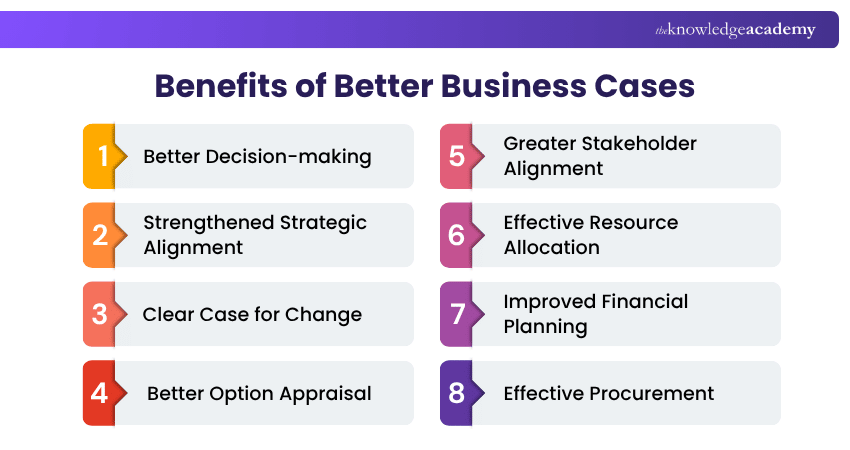
1) Better Decision-making
Better Business Cases provide decision-makers with clear and structured information about the need for change, available options, costs, benefits, risks, and expected outcomes. This makes it easier to assess a proposal based on evidence rather than assumptions.
The approach also enables decision-makers to compare alternatives and understand the consequences of proceeding, modifying, delaying, or rejecting an investment.
2) Strengthened Strategic Alignment
A strong Business Case establishes a clear connection between a proposed investment and the organisation's strategic objectives and priorities. This helps prevent resources from being committed to initiatives that offer limited strategic value.
It can also show how an investment contributes to wider programmes, policies, services, or organisational goals, giving stakeholders a clearer understanding of why the proposal matters.
3) Clear Case for Change
Better Business Cases help organisations clearly establish why an intervention or investment is required. This includes defining the existing problem, desired outcomes, constraints, and consequences of maintaining the status quo.
A well-defined case for change creates a stronger foundation for evaluating potential solutions and helps stakeholders understand why action may be necessary.
Trainer’s Insight:
Treat assumptions as questions that still need answers. The more important the assumption, the stronger the evidence needed to support it.
4) Better Option Appraisal
Rather than immediately selecting a preferred solution, Better Business Cases encourage organisations to identify and assess realistic alternatives. This allows teams to compare options based on factors such as:
a) Costs and benefits
b) Risks and constraints
c) Strategic fit
d) Deliverability
e) Expected outcomes
As a result, the preferred option can be supported by a clearer rationale.
5) Greater Stakeholder Alignment
Business Case development can bring together sponsors, finance teams, operational teams, Subject-Matter Experts (SMEs), procurement specialists, and other stakeholders around a common proposal.
By documenting objectives, requirements, options, responsibilities, and expected outcomes, the Business Case can reduce misunderstandings and create a consistent view of what the investment is intended to achieve.
Build practical business case skills with Better Business Cases™ Foundation Training and approach proposals confidently.
6) Effective Resource Allocation
Organisations usually have limited budgets, people, and time. Better Business Cases provide information that helps decision-makers determine which investments deserve priority and where resources may create the greatest value.
This is particularly useful when several projects or programmes compete for the same funding or organisational capacity.
7) Improved Financial Planning
A Better Business Case considers the financial implications and affordability of a proposed investment, rather than looking only at its expected benefits. This can include:
a) Funding requirements
b) Capital and operating costs
c) Budget implications
d) Cash-flow considerations
e) Financial risks
It gives decision-makers a clearer understanding of whether the proposal can realistically be funded and sustained.
8) Effective Procurement
Where external suppliers are required, Better Business Cases help organisations establish what needs to be procured and how the commercial approach should support the desired outcomes.
Considering commercial arrangements early can help organisations assess market capability, procurement routes, contractual considerations, supplier risks, and how responsibilities should be allocated.
9) Reduced Optimism Bias
Project proposals can sometimes be influenced by overly positive assumptions about costs, schedules, benefits, or implementation difficulty. A structured Business Case encourages these assumptions to be challenged.
Using evidence, risk analysis, option appraisal, and realistic estimates can create a more balanced picture of what an investment is likely to require and achieve.
Business Case Red Flag Detector
How many warning signs can you spot in your Business Case?
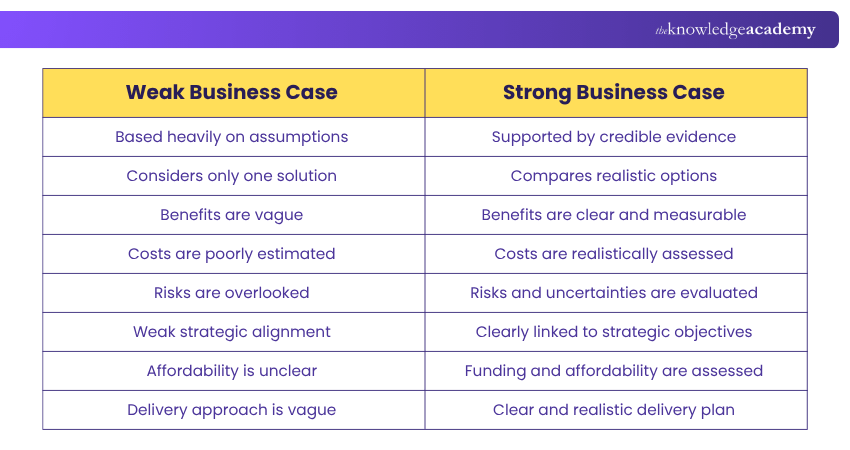
1. Only one option has been considered2. Benefits are unclear or difficult to measure3. Costs rely heavily on assumptions4. Key risks lack mitigation plans5. Strategic alignment is unclear6. Affordability hasn't been fully assessed7. No clear owner for benefit realisation8. Delivery capability hasn't been demonstrated
Develop stronger appraisal skills with Better Business Cases™ Practitioner and evaluate proposals effectively.
10) Improved Benefits Realisation
A Business Case should not stop being useful once funding is approved. It establishes the expected benefits and outcomes against which an investment can later be monitored.
Organisations can use these expectations to track whether benefits are being delivered, identify gaps, and take corrective action when actual outcomes differ from what was originally anticipated.
11) Enhanced Transparency
Better Business Cases make investment decisions more visible and traceable, helping stakeholders understand the evidence and reasoning behind the preferred option. This transparency helps organisations:
a) Clearly document decision rationale
b) Show how options were evaluated
c) Improve stakeholder accountability
d) Support governance and scrutiny
12) Increased Risk Management
Better Business Cases help organisations identify and assess risks, uncertainties, dependencies, and assumptions before significant resources are committed. This allows potential challenges to be considered early rather than after implementation begins. It can help organisations:
a) Identify significant risks early
b) Test key assumptions and uncertainties
c) Plan appropriate mitigation measures
d) Prepare for potential delivery challenges
One Question Before ApprovalBefore a proposal moves forward, ask:Which of the five cases currently has the weakest supporting evidence?The weakest case may reveal assumptions, evidence gaps or delivery issues that need further investigation before approval.
Conclusion
The Benefits of Better Business Cases come from examining proposals through a structured, evidence-based approach. By connecting strategic need with value for money, commercial viability, affordability and deliverability, the Five Case Model helps decision-makers challenge assumptions, compare credible options and determine whether a proposal should progress.
Learn how to justify investments and prioritise projects with Better Business Cases™ Training – Join now!
Frequently Asked Questions
Are Better Business Cases Only Used for Projects?

No, Better Business Cases are not limited to projects. They can also support programmes, policy initiatives, service improvements, procurement decisions, and strategic investments. The framework helps organisations evaluate options, justify spending, and demonstrate value before committing resources.
What Does a Good Business Case Include?
A good Business Case should clearly explain the case for change, objectives, available options, costs, expected benefits, risks, commercial considerations, affordability, and delivery approach. It should provide sufficient evidence to support informed and transparent decision-making.
How Long Should a Business Case be?
There is no fixed length for a Business Case. It should be proportionate to the scale, complexity, cost, and risk of the proposal. Smaller investments may need concise documentation, while complex investments generally require more detailed analysis.

The Knowledge Academy


Global Training Provider
The Knowledge Academy is a world-leading provider of professional training courses, offering globally recognised qualifications across a wide range of subjects. With expert trainers, up-to-date course material, and flexible learning options, we aim to empower professionals and organisations to achieve their goals through continuous learning.


 If you wish to make any changes to your course, please


