


We may not have the course you’re looking for. If you enquire or give us a call on 01344203999 and speak to our training experts, we may still be able to help with your training requirements.
Benefits of NLP Training for Personal and Professional Growth
ByThe Knowledge AcademyLast updated on: 17 September 2026
NLP training introduces techniques centred on communication, observation, goal setting, and perspective-taking. Explore how these techniques can be used for personal development, workplace interactions, coaching, leadership, and everyday communication.
Have you ever left a conversation wondering why your message did not land the way you intended? Sometimes the difference lies not in what we say, but in how we listen, interpret responses, and adjust our communication.
This is one area Neuro-Linguistic Programming (NLP) training explores. Through structured exercises involving language, observation, goal setting, and perspective-taking, it encourages people to examine how they communicate and respond in different situations.
This blog explores the potential benefits of NLP training across both personal and professional development.
What is NLP Training?
NLP training introduces concepts and techniques associated with Neuro-Linguistic Programming, an approach developed in the 1970s around ideas about language, behavioural patterns, subjective experience and communication.
Training may cover techniques such as rapport building, reframing, questioning, modelling, goal setting, and observing verbal and non-verbal responses. Its emphasis is generally practical, with delegates using exercises and structured conversations to examine how they communicate and approach particular situations.
NLP should, however, be distinguished from evidence-based psychological or medical treatment. Research supporting many of its broader theoretical and therapeutic claims remains limited, and NLP as a whole has not been scientifically validated as a clinical treatment.

Benefits of NLP Training
The value individuals gain from NLP training can depend on their goals, context and how the techniques are applied. Because the evidence base for NLP as a complete system remains limited, the following benefits are best understood as potential areas of personal and professional development rather than guaranteed outcomes.
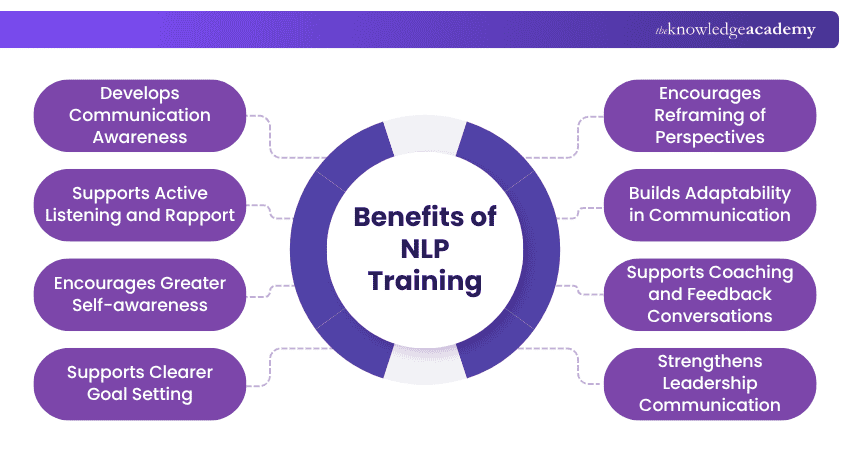
1) Develops Communication Awareness
NLP training encourages people to pay closer attention to the words, questions, tone, and communication patterns used during conversations. Greater awareness can make it easier to recognise when a message needs clarification or when a different approach may be more appropriate.
NLP Communication Lens
Before responding in an important conversation, ask yourself:
1. What did I actually hear?2. What am I assuming?3. What could I clarify?4. How might the other person interpret my response?
2) Supports Active Listening and Rapport
Exercises involving observation, questioning, and rapport can encourage participants to give greater attention to how other people communicate. This may support more attentive conversations by helping individuals check understanding rather than responding primarily from assumptions.
3) Encourages Greater Self-awareness
NLP exercises often invite individuals to examine their habits, internal responses, assumptions, and communication preferences. This reflection can help them recognise recurring patterns and consider whether those patterns continue to serve them effectively.
4) Supports Clearer Goal Setting
Goal-focused NLP exercises can encourage people to define what they want to achieve in more specific terms. Breaking broad ambitions into clearer outcomes and manageable actions can make it easier to decide what needs to happen next and review progress over time.
5) Encourages Reframing of Perspectives
Reframing involves looking at a situation from another angle or considering a different interpretation of what has happened. Practising this approach can encourage individuals to move beyond an immediate reaction and explore alternative ways of understanding a challenge.
6) Builds Adaptability in Communication
Different people and situations rarely respond equally well to one communication style. NLP training can encourage individuals to observe feedback and adjust their wording, questions, pace, or approach when a conversation is not producing the intended understanding.
7) Supports Coaching and Feedback Conversations
Questioning, listening, and outcome-focused techniques associated with NLP can provide additional structure for coaching-style discussions. They may help coaches, mentors, or managers encourage reflection and keep conversations focused on actions rather than simply providing solutions themselves.
8) Strengthens Leadership Communication
Leadership often involves explaining expectations, understanding different viewpoints, giving feedback, and guiding conversations through uncertainty. NLP training can provide opportunities to practise these communication behaviours and consider how different approaches may affect workplace interactions.
Explore communication techniques with Neuro Linguistic Programming Training and apply them across personal and professional situations.
Where Can NLP Skills Be Applied?
NLP-related skills can be explored in situations where communication, reflection, questioning, or goal-focused conversations are important. Their practical use will depend on the context and the needs of the people involved.
1) Personal Applications
In everyday life, NLP techniques may be used as structured prompts for reflecting on goals, communication habits, personal assumptions, and responses to different situations.
Common personal applications can include:
1) Clarifying personal goals and next steps
2) Reflecting on recurring communication patterns
3) Approaching disagreements from alternative perspectives
4) Preparing for important conversations
5) Reviewing how personal assumptions influence responses
2) Professional Applications
In professional settings, NLP concepts may be incorporated into communication-focused activities where understanding another person's perspective and adapting conversations are useful.
Potential professional applications include:
1) Workplace discussions and meetings
2) Leadership conversations
3) Coaching and mentoring sessions
4) Sales and customer interactions
5) Feedback conversations
6) Presentations and public speaking
7) Stakeholder communication
Conversation Reset
When a Conversation Stalls, Try This:
1. Pause: What is preventing progress?2. Check: Have I understood the other person's position correctly?3. Change: What could I ask or explain differently?4. Continue: What would be a useful next step?
Mini Challenge:Think of one recent difficult conversation. Which of these four stages would have helped most?
What to Consider Before Using NLP Techniques
NLP contains techniques that some people find useful for communication and personal development, but its wider claims should be considered carefully. Understanding these boundaries can help individuals use NLP more responsibly.
1) Evidence Remains Limited
Research into NLP has produced some positive findings in specific settings, but the overall evidence base remains limited and does not validate NLP as a whole. A systematic review of health-related NLP interventions found little evidence that NLP improved health outcomes.
Importantly, this reflected both the small amount and the limited quality of available research rather than definitive proof that NLP could never have an effect.
Important Distinction:
Limited evidence does not prove that something has no effect, but it also does not establish that it is effective.
2) Context Matters
A technique that feels useful in one conversation or learning environment may not produce the same result elsewhere. Individual preferences, experience, relationships, and circumstances can influence its usefulness.
3) Avoid Guaranteed Outcomes
NLP techniques should not be presented as certain ways to change another person's behaviour, remove beliefs, control emotions, or guarantee success.
Claims about being able to infer a person’s thoughts reliably from eye movements, preferred sensory systems, or similar cues should also be treated cautiously because several traditional NLP propositions have not received consistent empirical support.
4) Use Ethical Communication
Techniques involving rapport, questioning, or persuasion should respect autonomy and avoid manipulation. Effective communication should support understanding rather than pressure someone towards a predetermined response.
5) Know Its Limits
NLP is not a substitute for qualified medical or mental health support. People dealing with health or psychological concerns should seek appropriate evidence-based professional assistance.
Build practical NLP skills with our NLP Foundation And Practitioner Training and communicate with greater confidence – Join now!

The Knowledge Academy develops accessible learning content across Project Management, IT, Cybersecurity, Data Science, Business Analysis, HR, Accounting and Finance, Leadership and Health and Safety. Its resources combine subject research with clear explanations to help professionals build practical knowledge across a wide range of disciplines.
View Detail

 If you wish to make any changes to your course, please


