


We may not have the course you’re looking for. If you enquire or give us a call on 01344203999 and speak to our training experts, we may still be able to help with your training requirements.
Benefits of Kanban for Teams and Workflows
ByDavid EvansLast updated on: 17 September 2026
This blog explores the key Benefits of Kanban, including greater visibility, stronger focus, smoother flow, better coordination, and continual improvement across teams and workflows.

Imagine walking into a team meeting and seeing a wall covered with urgent tasks. Some are half-finished, some are waiting for approval, and others have been quietly stuck for days.
The team is working hard, yet one question keeps coming up:
“Where is the work actually getting delayed?”
That question is usually a sign of a deeper problem: work that stays invisible until something goes wrong. What these teams need isn't more effort, it's a way to actually see the work as it moves. That's exactly what Kanban provides. It helps teams see every stage of work, spot bottlenecks early and focus on finishing what matters before taking on more.
What is Kanban?
Kanban is a method for managing and improving how work flows through a process, from the moment it starts to the moment it's done. It gives teams a shared way to track progress, spot where work is piling up and decide what to improve based on what's actually happening, not assumptions. Teams commonly use a Kanban board, with cards representing work items and columns showing each stage of the workflow.
Within that board, teams decide how work enters the system, limit how much is in progress at once, and agree on when tasks are ready to move to the next stage. Kanban is a flexible Project Management methodology, so it can be used alongside Scrum, Waterfall or existing operational processes.

Key Benefits of Kanban
Kanban's real value shows up in how it changes day-to-day work, from what teams can see to how smoothly that work actually moves. Here are the benefits that make the biggest difference:
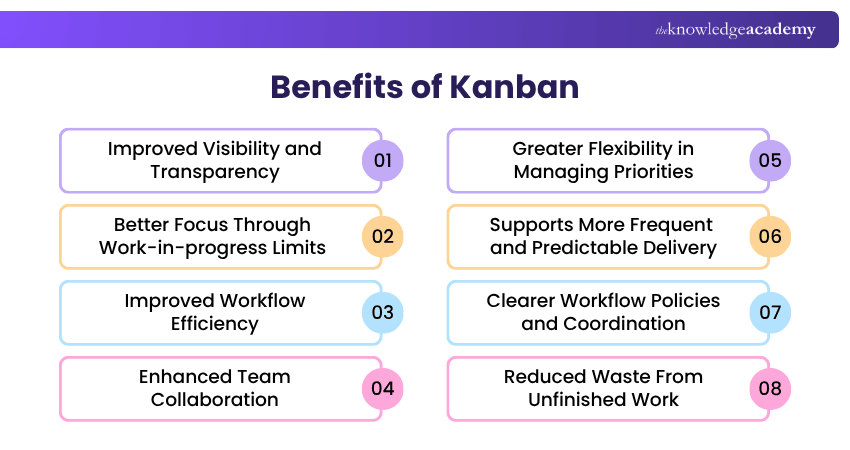
1) Improved Visibility and Transparency
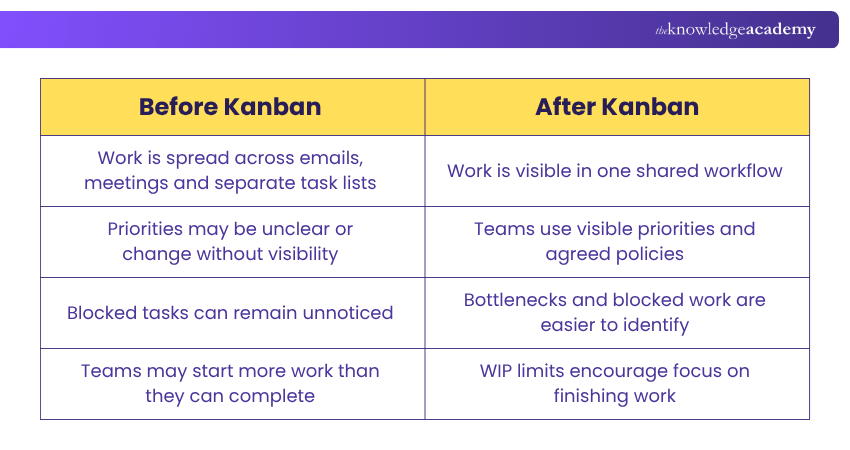
A Kanban board makes work, workflow stages and status visible in a centralised place, showing what has started, what is waiting, what is blocked, and what has been completed. This gives team members and stakeholders alike a shared view of priorities, capacity and delivery risks.
When the board is kept up to date, it becomes a reliable picture of the real state of work, making it easier to understand progress and supporting more open communication across the team.
Before and After Kanban
2) Better Focus Through Work-in-progress Limits
Work-in-progress, or WIP, limits control how much active work can be in a workflow stage at one time. This encourages teams to finish existing work before starting more tasks, helping to reduce multitasking and context switching.
Important Note
WIP limits are not productivity targets and should not be used to measure individual performance. Their purpose is to prevent overload, reduce unnecessary multitasking and help work move through the system more smoothly.
3) Improved Workflow Efficiency
By showing where work waits, slows down or becomes blocked, Kanban helps teams identify inefficiencies in their process. They can then reduce unnecessary hand-offs, duplication and rework to support a smoother flow of work.
4) Enhanced Team Collaboration
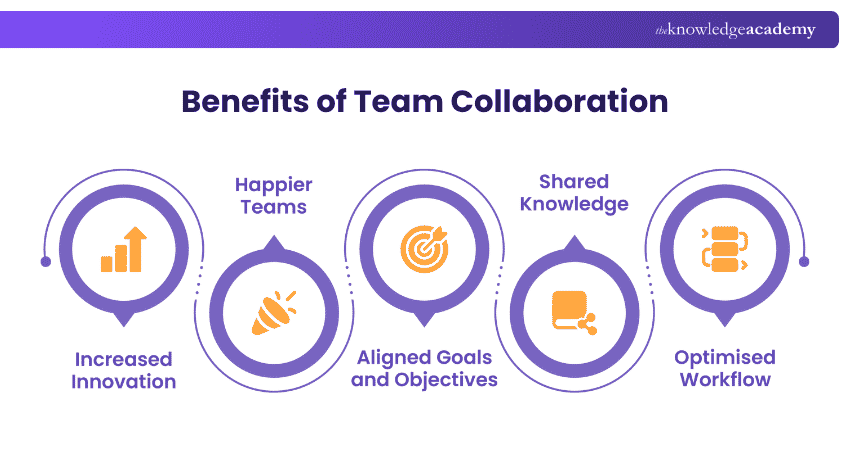
Kanban improves collaboration by making work, priorities and project goals visible to everyone. This shared view encourages open communication, knowledge sharing and peer support across different roles. As teams take collective responsibility for moving work forward, they become better aligned and can achieve stronger project outcomes.
5) Greater Flexibility in Managing Priorities
Kanban allows teams to respond to changing priorities using agreed policies for selecting and handling work. This helps them manage urgent requests without losing sight of current capacity or disrupting the wider workflow unnecessarily.
6) Supports More Frequent and Predictable Delivery
When teams limit WIP and manage flow, they can complete work in smaller and more regular increments. This can make delivery patterns easier to understand and help stakeholders form more realistic expectations, although Kanban does not require continuous delivery.
Learn how to turn workflow chaos into clear progress with the Certified Kanban Foundation Training – Register now!
7) Clearer Workflow Policies and Coordination
Kanban encourages teams to make important workflow policies visible, such as how work is selected, when it can move forward and what “done” means. These shared agreements reduce ambiguity and support more consistent coordination across the workflow.
8) Reduced Waste From Unfinished Work
Kanban can reveal work that has stalled, been abandoned partway through, or sat idle without anyone noticing, unfinished items that tie up capacity without ever delivering value. By making this visible, teams can decide whether to complete, deprioritise, or cancel stalled work rather than letting it quietly accumulate, freeing up capacity for work that will actually get finished.
9) Better Decision-making Through Flow Metrics
Kanban uses measures such as lead time, delivery rate and work in progress to show how a workflow is performing. Lead time, how long a work item takes from commitment to completion, is one of the most useful, helping teams spot delays and forecast more realistically. Together, these metrics support better decisions about capacity, priorities and improvement.
10) Continuous Improvement
Kanban encourages teams to review their workflow regularly, gather feedback and test small changes. This supports gradual improvement over time and helps teams adapt their way of working as customer needs and conditions change.
Trainer Insight
A Kanban board does not improve a workflow on its own. Teams create value when they use the board, WIP limits, policies and flow data to identify problems, discuss possible changes and test improvements over time.
When Should You Use Kanban?
Kanban is useful when teams need to manage and improve a continuous flow of work, especially when priorities can change regularly. Kanban is particularly useful in the following situations:
a) When Work Arrives Continuously: Teams handle incoming requests, cases, changes or operational tasks.
b) When Priorities Change Often: Work needs to be reviewed and reordered without disrupting the full workflow.
c) When Visibility is Limited: Teams need to see task status, bottlenecks and blocked work clearly.
d) When Several Teams Share a Workflow: Different functions need to coordinate work from request through to completion.
e) When Ongoing Service or Knowledge Work is Involved: It can support software development, marketing, customer support, HR, design, product development and education services.
Turn workflow challenges into lasting progress by signing up for the Certified Kanban Foundation and Practitioner Training today!

David Evans creates accessible resources that help professionals understand different approaches to planning and delivering projects. His content addresses changing requirements, collaborative working and the practical demands of contemporary project environments.
View Detail

 If you wish to make any changes to your course, please


