


We may not have the course you’re looking for. If you enquire or give us a call on 01344203999 and speak to our training experts, we may still be able to help with your training requirements.
Benefits of ISO 9001 for Consumers and Businesses
BySubiksha ArulprakashLast updated on: 17 September 2026
This blog explores the Benefits of ISO 9001 for businesses and consumers, including improved quality, efficiency, customer confidence and continual improvement
Imagine a customer receiving a late delivery, an incorrect order or a service that does not match what was promised. They may give the business another chance, but their confidence has already started to slip.
Now imagine the business behind that experience asking:
“How can we make quality more consistent before small problems become bigger ones?”
This is where ISO 9001 becomes relevant. It gives organisations a structured way to manage processes, understand customer requirements and improve how work is carried out.
This blog explores the Benefits of ISO 9001 for consumers and businesses, from reliable products and services to improved efficiency, stronger customer confidence and continual improvement.
What is ISO 9001 Certification?
ISO 9001 Certification confirms that an organisation’s Quality Management System (QMS) meets the ISO 9001:2015 requirements. It is available to organisations of any size or sector and demonstrates a structured approach to managing quality, meeting customer and applicable requirements and improving processes.
Certification is awarded after an independent certification body audits the organisation’s QMS. It does not guarantee error-free products or services, but it provides assurance that processes are controlled, responsibilities are defined, and quality is continually reviewed and improved.
Benefits of ISO 9001 for Businesses and Consumers
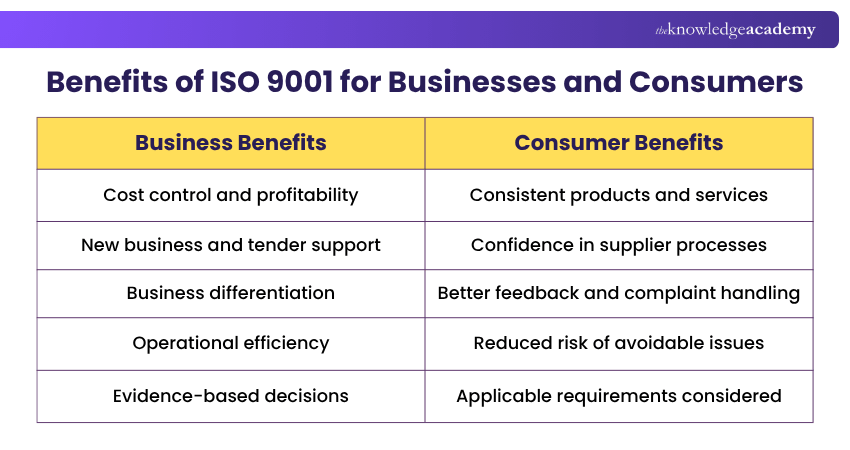
ISO 9001 can help organisations strengthen their approach to quality, improve the consistency of their processes and build confidence among customers. Benefits of ISO 9001 extend to both businesses and consumers through better-managed products, services and customer experiences.
1) Benefits of ISO 9001 for Businesses
Let’s look at the Benefits of ISO 9001 for businesses below:
1) Supports Cost Control and Profitability
ISO 9001 helps organisations identify process errors, duplication and waste. More consistent processes can reduce rework and unnecessary costs, which may support profitability but does not guarantee it.
2) Supports New Business and Tender Opportunities
Some customers and tenders ask suppliers to demonstrate an effective Quality Management System. ISO 9001 Certification can provide independent evidence of this, although contracts also depend on factors such as price, capability and delivery capacity.
3) Differentiates a Business From Competitors
Certification shows that an independent body has assessed the organisation’s QMS against ISO 9001 requirements. This can give customers greater confidence when comparing suppliers with similar products or services.
4) Improves Operational Efficiency
ISO 9001 encourages organisations to define key processes, responsibilities and performance measures. This can reduce variation, clarify how work should be completed and reveal opportunities for greater efficiency.
5) Supports Evidence-based Decision-making
Organisations monitor information such as customer feedback, delivery performance and audit findings. Using this evidence can help leaders identify priorities and make more informed decisions.
6) Clarifies Roles and Responsibilities
A QMS defines who is responsible for activities that affect quality. This can improve accountability, reduce confusion and help employees understand how their work contributes to organisational objectives.
7) Strengthens Risk-based Thinking
ISO 9001 requires organisations to consider risks and opportunities that could affect their intended results. This supports a proactive approach to preventing or reducing the impact of potential issues.
8) Supports Continual Improvement and Long-term Growth
Internal audits, performance reviews and corrective actions help organisations assess what needs to improve. This supports an ongoing cycle of improvement as customer needs and business operations change.
Important Note
ISO 9001 Certification does not guarantee higher profits, perfect products or full legal compliance. It provides confidence that an organisation has a Quality Management System designed to manage quality, meet applicable requirements and improve over time.
2) Benefits of ISO 9001 for Consumers
Let’s look at the Benefits of ISO 9001 for consumers below:
1) More Consistent Products and Services
ISO 9001 encourages organisations to understand customer requirements and control the processes that affect quality. This can help customers receive more reliable products and services.
2) Greater Confidence in Supplier Quality Processes
Certification indicates that an organisation’s QMS has been independently assessed against ISO 9001. It can give customers added confidence in the supplier’s approach to managing and monitoring quality.
3) Better Handling of Feedback and Complaints
ISO 9001 encourages organisations to monitor customer feedback and respond to non-conformities. This can support more structured complaint handling and appropriate corrective action.
4 Reduced Risk of Process Errors and Service Disruption
By identifying risks and planning controls, organisations can reduce the likelihood or impact of avoidable issues. ISO 9001 cannot eliminate all risks or guarantee uninterrupted service.
5) Greater Confidence That Applicable Requirements are Considered
ISO 9001 requires organisations to consider applicable statutory and regulatory requirements related to their products and services. Certification does not prove legal compliance, but it can show that such requirements form part of the QMS.
Quick Self-check Before Pursuing ISO 9001
a) Do we understand the customer and quality requirements that apply to our products or services?b) Have we identified the processes that most affect quality and customer experience?c) Can we allocate time, ownership and resources to maintain and improve the QMS after certification?
Lead audits that strengthen quality systems with the ISO 9001 Lead Auditor Course – Join today!

Subiksha Arulprakash is a Copywriter with 5+ years of experience in content writing, editing, content development and digital marketing. Her experience researching and writing about Business Skills, ISO standards and compliance enables her to produce clear, accessible content for different audiences.
View Detail

 If you wish to make any changes to your course, please


