


We may not have the course you’re looking for. If you enquire or give us a call on +44 1344 203 999 and speak to our training experts, we may still be able to help with your training requirements.
10 Key Benefits of Data Analytics for Businesses
ByThe Knowledge AcademyLast updated on: 31 October 2026
Discover the benefits of data analytics for businesses, including informed decision-making, customer personalisation, operational efficiency, cost management and forecasting.
Quick Preview
1. Data analytics helps organisations make informed decisions using reliable information.2. Analysing customer behaviour enables businesses to personalise products, services and interactions.3. Data analytics helps identify process bottlenecks and opportunities to reduce inefficiencies and improve resource utilisation.4. Analysing patterns and unusual activities supports fraud detection and risk assessment.5. Forecasting and trend analysis help businesses prepare for changing demand and market conditions.
A retail company notices that its sales are declining even though thousands of customers visit its website every day. Is the problem related to pricing, customer preferences or the purchasing process? Instead of relying on assumptions, the company examines its sales records, website activity and customer feedback to understand what might be happening.
By examining this information, the company can begin to understand what is affecting its sales. This is where data analytics becomes valuable. It helps organisations identify patterns, make informed decisions, understand customers and explore growth opportunities. This blog explores ten important benefits of data analytics, along with practical ways to apply them across business operations.
Key Benefits of Data Analytics for Businesses
Data analytics helps businesses transform large volumes of information into insights that support planning, performance improvement and strategic decisions. Let's explore these benefits:
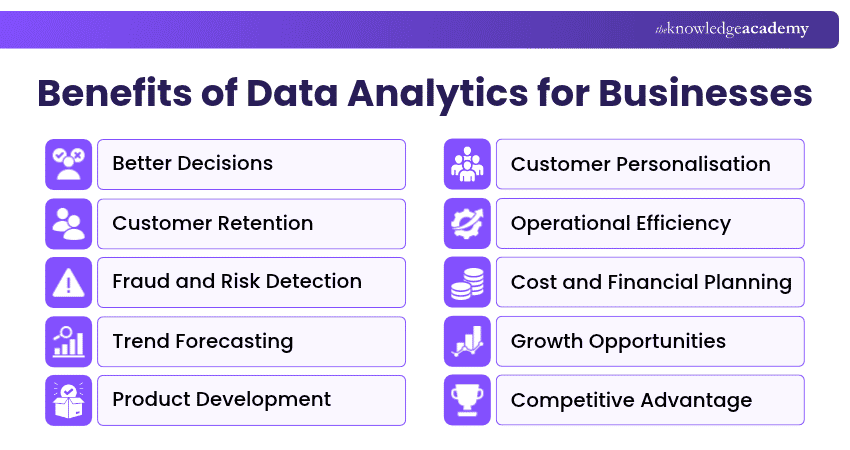
1) Supports Better Decision-making
Data analytics helps organisations make decisions based on evidence rather than relying entirely on assumptions or intuition. By examining historical information, current performance and relevant business indicators, decision-makers can evaluate their options more effectively. It also helps identify patterns and relationships that may not be immediately visible.
For example, a retail business can analyse product sales across different locations to identify which products are performing well and which require adjustments. Better information can reduce uncertainty, although it does not eliminate business risks or guarantee successful outcomes.
Pro Tip
An overall average may hide important differences between regions, customer groups or products. Divide data into meaningful categories and compare their performance before making decisions. Ensure each group contains enough reliable information to support useful conclusions.

2) Delivers Personalised Customer Experiences
By examining customer feedback, purchase histories and other appropriately collected information, companies can identify patterns that inform product recommendations, customer support and marketing activities.
For example, an online retailer may analyse previous purchases and browsing behaviour to recommend products that match a customer's interests. Personalisation should be supported by appropriate privacy safeguards, transparent data practices and relevant legal requirements.
3) Supports Customer Retention and Loyalty
Customer retention involves maintaining relationships with existing customers and encouraging them to continue using a company's products or services. Data analytics can help organisations understand why customers stop purchasing, cancel subscriptions or become less engaged. By examining purchase frequency, customer feedback, service interactions and other relevant indicators, businesses can identify groups that may require additional attention.
For example, a subscription-based company might discover that customers who rarely use a particular feature are more likely to cancel their subscriptions. The company can investigate the reasons and test whether improved onboarding, clearer guidance or better customer support can help address the problem.
4) Enhances Operational Efficiency and Productivity
Data analytics helps businesses evaluate how effectively their processes operate. By analysing workflows, processing times and performance indicators, organisations can identify bottlenecks, repeated activities and inefficient use of resources.
For example, a manufacturing company may analyse production data to identify where delays frequently occur. It can then investigate equipment performance, staffing arrangements or workflow dependencies. Similarly, an organisation that spends considerable time on manual data entry may use process analysis to determine whether automation could reduce repetitive work.
5) Strengthens Fraud Detection and Risk Management
Data analytics supports risk management by identifying unusual patterns, potential warning signs and activities that require further investigation. In financial services, analytical systems can examine transaction histories, account behaviour and transaction characteristics to flag suspicious activity.
For example, a bank may identify a transaction that differs significantly from a customer's usual spending patterns. This can trigger additional verification or review. Data analytics can also support cybersecurity monitoring by examining access logs, system activity and network traffic for anomalies.
Trainer Insight
Unusual activity should be treated as a signal for further investigation rather than immediate evidence of wrongdoing. Review the surrounding context, verify suspicious findings and monitor false alerts to improve detection accuracy and avoid unnecessary action.
6) Supports Cost Reduction and Financial Planning
Data analytics helps organisations understand expenditure patterns and identify opportunities to manage costs more effectively. By examining operational expenses, purchasing records and resource utilisation, businesses can identify areas where money may be spent inefficiently.
For example, a logistics company can analyse delivery routes, fuel consumption and vehicle usage to identify opportunities for reducing transport costs. Similarly, businesses can examine seasonal spending patterns when preparing budgets and allocating resources.
7) Helps Forecast Future Trends
Data analytics can help businesses estimate future outcomes by examining historical patterns and relevant influencing factors. Forecasting techniques can support demand planning, inventory management, staffing decisions and financial preparation. For example, a retailer can analyse previous seasonal sales, promotional activities and purchasing patterns to estimate stock requirements for an upcoming holiday period.
This can help the business prepare for expected demand and reduce the risk of holding excessive or insufficient inventory. However, forecasts are estimates rather than guarantees. Unexpected market changes, incomplete data and changing customer behaviour can affect their accuracy.
8) Identifies Business Growth Opportunities
Data analytics can help organisations identify emerging opportunities by examining customer behaviour, product performance and market trends. Businesses can use these insights to investigate unmet customer needs, evaluate potential markets and identify areas where existing products or services could improve.
For example, a retail company may analyse regional sales trends, customer demand and market conditions to identify potential locations for expansion. These findings could help the business evaluate opportunities to introduce its products in new markets.
Learn how to find the patterns and predict the best possibilities in the Advanced Data Analytics Course – Sign up now!
9) Supports Product and Service Development
Data analytics helps businesses understand how customers use their products and services and identify areas that may require improvement. By examining usage patterns, customer feedback and product performance, organisations can make informed decisions about design changes, new features and service enhancements.
For example, a software company may analyse how users interact with different features to identify where they encounter difficulties or abandon tasks. These findings can help development teams prioritise improvements and test whether the changes make the product easier to use.
10) Can Strengthen Competitive Advantage
Data analytics can support competitive advantage by helping organisations respond more effectively to customer needs, operational challenges and changing market conditions. By combining insights from sales, customer feedback, industry trends and business performance, organisations can identify areas where they may improve their products, services or processes.
For example, a retailer might analyse customer purchasing trends and adjust its product range faster than competitors that rely on less frequent reviews. Similarly, a service provider may use customer feedback analysis to address recurring complaints and improve service delivery.
The Data Analytics Process
Collect (Gather data) → Prepare (Clean & organise) → Analyse (Find patterns) → Interpret (Explain insights) → Act (Make decisions)
How to Maximise the Benefits of Data Analytics?
Although data analytics offers several advantages, realising these benefits requires a structured approach. The following steps can help organisations make better use of their data and analytical findings:
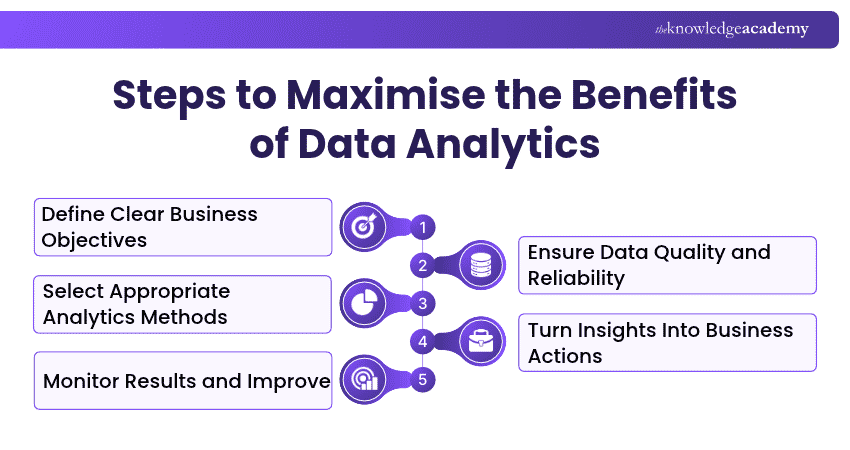
1) Define Clear Business Objectives
Begin by identifying the business problem or question that requires attention. For example, an organisation might want to reduce customer churn, improve delivery times or understand declining sales. A clearly defined objective helps determine which information is required and what successful outcomes should look like.
2) Ensure Data Quality and Reliability
Accurate and relevant information is essential for meaningful analysis. Before analysing a dataset, review missing values, duplicate records, inconsistent formats and possible errors. Organisations should also verify that the information is suitable for the intended purpose and is being handled in accordance with applicable privacy requirements.
Data Readiness Checklist
Is Your Data Ready for Analysis?
□ The dataset is relevant to the business question.□ Missing values and duplicate records have been reviewed.□ Data formats and definitions are consistent.□ The information is sufficiently recent for the intended decision.□ Data collection and use comply with applicable privacy requirements.□ Important findings can be checked against reliable source records.
3) Select Appropriate Analytics Methods
Different business questions require different analytical approaches. For example, descriptive analytics can summarise past performance, while diagnostic analytics helps investigate why a particular outcome occurred.
Predictive analytics can estimate future outcomes, whereas prescriptive analytics can help evaluate potential actions using analytical models. Selecting an appropriate method helps ensure that the analysis addresses the intended business question.
4) Turn Insights Into Business Actions
Data analytics becomes valuable when organisations use its findings to improve decisions or processes. After identifying an important insight, determine the appropriate response, assign responsibility and establish measurable objectives.
For example, if an analysis reveals that customers abandon an online checkout process at a particular stage, the business can investigate potential usability problems and test improvements.
5) Monitor Results and Improve
Once a business change has been implemented, review whether it produced the intended outcomes. Compare relevant performance indicators before and after the change, while considering other factors that may have influenced the results. Where appropriate, use a comparison group or controlled test to assess whether the change contributed to the observed outcome.
For example, a company introducing a new customer retention initiative can monitor cancellation rates, customer feedback and repeat purchases over an appropriate period. Continuous evaluation helps organisations understand what works, identify limitations and improve their future use of data analytics.
Keep This in Mind
Data analytics can reveal valuable patterns, highlight opportunities and support better business decisions. However, its benefits depend on reliable data, appropriate analytical methods and how effectively organisations act on the findings. Analytics provides insights, not guaranteed outcomes.
Learn techniques to interpret complex data and derive actionable insights with our Data Analysis Skills Training – Register now!

The Knowledge Academy develops accessible learning content across Project Management, IT, Cybersecurity, Data Science, Business Analysis, HR, Accounting and Finance, Leadership and Health and Safety. Its resources combine subject research with clear explanations to help professionals build practical knowledge across a wide range of disciplines.
View Detail

 If you wish to make any changes to your course, please


