


 Top Rated Course

We may not have the course you’re looking for. If you enquire or give us a call on 01344203999 and speak to our training experts, we may still be able to help with your training requirements.
Cyber Security Benefits Every Organisation Should Know
John Davies 02 September 2026The Benefits of Cyber Security extend far beyond protecting computers and networks. It helps individuals and organisations safeguard sensitive data, prevent cyberattacks, and reduce financial risks.

Training Outcomes Within Your Budget!
We ensure quality, budget-alignment, and timely delivery by our expert instructors.
Table of Contents
Key Takeaways
Cyber Security helps protect sensitive information, networks and systems from unauthorised access and cyber threats.Effective security measures can reduce cyber risks and support faster detection, response and recovery.Cyber Security can strengthen business continuity, customer trust and compliance efforts.Monitoring privileged accounts and compromised credentials helps identify suspicious activity.Phishing detection and threat hunting provide practical ways to identify and respond to potential threats.
How secure is your organisation when no one is watching? A normal working day can quickly change when a suspicious email is opened, an administrator account behaves unusually or sensitive data is accessed without permission. Ask yourself:
☐ Is sensitive business and customer data properly protected?
☐ Are unusual login attempts and account activities monitored?
☐ Can employees recognise and report suspicious emails?
☐ Are important system and configuration changes tracked?
☐ Are privileged accounts closely monitored?
☐ Is there a clear process for responding to security incidents?
☐ Can critical systems and data be recovered after an incident?
If you cannot confidently tick every box, there may be areas where your Cyber Security approach needs strengthening. This blog explores the key Benefits of Cyber Security in detail to help you bolster your organisation's security stance. Let's dive in!
What is Cyber Security?
Cyber Security is the practice of protecting systems, networks, applications and data against cyber threats, unauthorised access and disruption. It involves a combination of technologies, processes and security practices designed to reduce risks and protect digital assets.
Cyber Security does not only focus on preventing attacks. It also includes identifying suspicious activity, responding to incidents and recovering systems and data when security incidents occur. Together, these measures help organisations maintain the confidentiality, integrity and availability of their information and systems.
Here's a simple scenario to show Cyber Security in action:
Imagine two organisations detect unusual activity on an administrator account.
Organisation A: The activity goes unnoticed because privileged accounts are not regularly monitored.
Organisation B: Security monitoring identifies the unusual behaviour, alerts the security team and enables them to investigate quickly.
The difference shows why Cyber Security is not simply about installing security tools. Effective security also requires monitoring, processes and appropriate responses.

Key Benefits of Cyber Security
Cyber Security provides organisations with multiple layers of protection against digital risks. Effective measures can protect sensitive information, reduce exposure to threats and strengthen an organisation's ability to detect, respond to and recover from security incidents. Here are some of the key benefits:
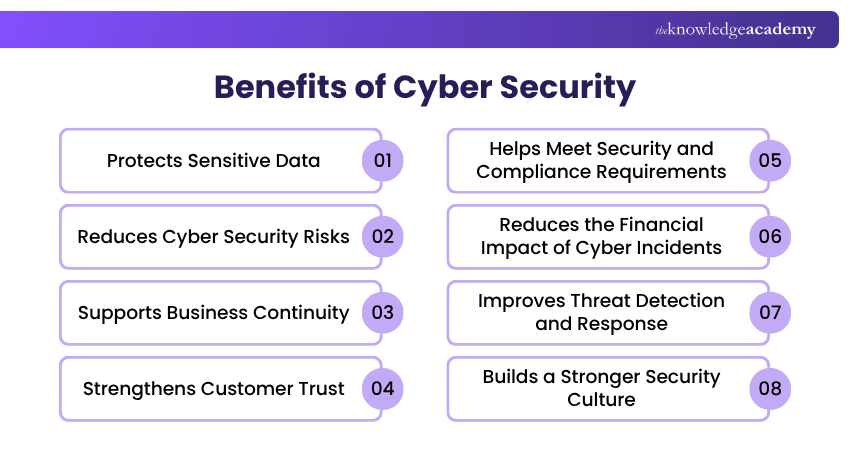
1) Protects Sensitive Data
Organisations store valuable information such as customer details, employee records, financial information and business data. Cyber Security measures help protect this information against unauthorised access, disclosure, alteration and loss. Access controls, encryption, secure authentication and appropriate data protection practices can provide different layers of protection.
2) Reduces Cyber Security Risks
Cyber threats can originate both inside and outside an organisation. External risks may include phishing, malware, ransomware and unauthorised attempts to access systems, while internal risks can arise through mistakes, misuse of access or compromised employee accounts. Security controls can help organisations identify vulnerabilities, reduce opportunities for attacks and limit the potential impact of incidents.
3) Supports Business Continuity
A serious Cyber Security incident can interrupt systems, applications and everyday operations. Appropriate security measures can help organisations prepare for incidents and restore affected services more effectively. Backups, incident response procedures, recovery planning and system monitoring can therefore contribute to organisational resilience.
4) Strengthens Customer Trust
Customers expect organisations to handle their personal and financial information responsibly. Demonstrating appropriate security practices can help build confidence in how an organisation protects information. Strong Cyber Security practices can therefore support customer relationships and organisational reputation.
5) Helps Meet Security and Compliance Requirements
Organisations may need to follow security, privacy and data protection requirements depending on their industry, location and the information they process. Cyber Security controls can support these obligations by helping organisations manage access, protect information, maintain records and establish appropriate security procedures.
Expert Insight
Your Cyber Security exposure can extend to cloud providers, suppliers and other third parties. Understand what they can access and include relevant providers in incident planning.
6) Reduces the Financial Impact of Cyber Incidents
Cyber incidents can result in recovery costs, operational disruption, investigation expenses and other financial consequences. Although implementing Cyber Security controls requires investment, reducing the likelihood or impact of serious incidents can help organisations avoid potentially greater costs associated with recovery.
Cyber threats evolve every day. Make sure your awareness evolves with them. Sign up for our Cyber Security Awareness Training now!
7) Improves Threat Detection and Response
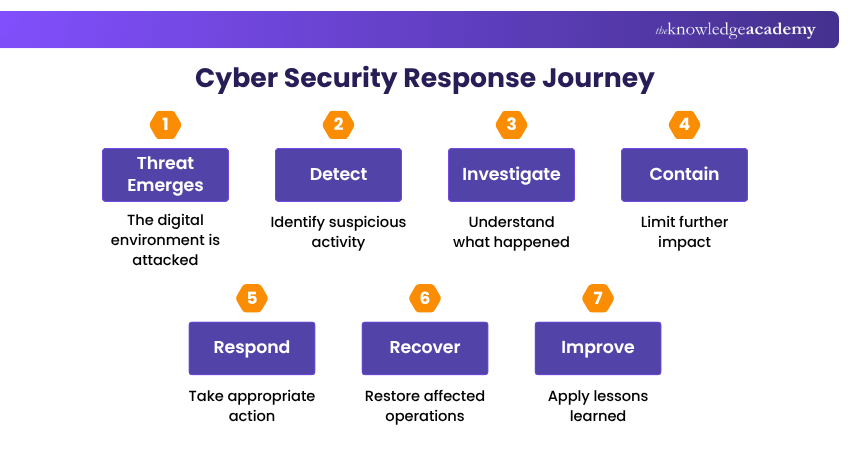
Effective Cyber Security enables organisations to monitor networks, systems and user activity for suspicious behaviour. Detecting unusual activity earlier can give security teams more time to investigate, contain threats and minimise potential damage.
8) Builds a Stronger Security Culture
Technology alone cannot address every security risk. Employees also play an important role in protecting organisational information. Cyber Security awareness can help employees recognise suspicious activity, follow security procedures and report potential incidents. This contributes to a workplace where security becomes a shared responsibility instead of being solely an IT concern.
This is how the Cyber Security threat response process works:
9) Protects Intellectual Property and Competitive Advantage
Beyond customer and employee data, organisations also hold proprietary information such as trade secrets, product designs, source code and strategic plans. Cyber Security helps prevent this information from being stolen, leaked or accessed by competitors, protecting the value an organisation has built and the advantage that comes with it.
10) Enables Secure Digital Growth and Innovation
Adopting new technology, from cloud platforms to AI tools, carries risk if security isn't considered from the outset. A strong Cyber Security foundation gives organisations the confidence to innovate and scale digitally, knowing that new systems and processes are being introduced without creating unnecessary exposure.
Where is Cyber Security Used?
Cyber Security is used across industries that rely on digital systems, connected devices and sensitive information. Here are some key areas where Cyber Security is widely applied:
1) Financial Services
Banks, payment providers and other financial organisations handle large volumes of sensitive customer data. Cyber Security helps protect online banking systems, payment platforms, account credentials and financial information from unauthorised access and fraudulent activity.
Security measures such as access controls, authentication, encryption and transaction monitoring can also help organisations detect suspicious activity and respond to threats better.
2) Healthcare
Healthcare organisations manage sensitive patient information and increasingly rely on digital records, connected medical devices and online healthcare services. Cyber Security helps protect these systems and the information they process against unauthorised access, disruption and data loss.
Effective security measures can also support the availability of important healthcare systems while ensuring that authorised professionals can securely access the information they need.
3) Government and Public Services
Government agencies and public-sector organisations manage sensitive information and provide many essential services through digital systems. These environments can contain citizen information, internal government data and systems supporting public services.
Cyber Security helps protect these assets against unauthorised access, data breaches and service disruption. Given the scale and sensitivity of the data involved, public-sector organisations face additional regulatory oversight and are common targets for large-scale attacks, making robust security critical to public trust and service continuity.
Specialised Cyber Security roles include:
Security AnalystEthical HackerPenetration TesterSecurity EngineerCloud Security SpecialistSecurity ArchitectChief Information Security Officer (CISO)
4) E-commerce and Retail
E-commerce and retail businesses regularly process customer information, account credentials and payment-related data. Their websites, applications and online payment processes can therefore become targets for cyber threats.
Cyber Security helps protect online transactions and customer accounts while reducing the risk of data exposure and fraudulent activity. Strong security practices can also support customer confidence when using digital shopping platforms.
5) Cloud and Remote Work Environments
Cloud services and remote working allow employees to access applications, systems and information from different locations and devices. However, this can introduce security risks when accounts, devices or access permissions are not adequately protected.
Cyber Security helps organisations secure remote connections, cloud applications, user identities and shared information. Measures such as Multi-factor Authentication (MFA) and appropriate access controls can reduce the risk of unauthorised access.
6) Critical Infrastructure
Critical infrastructure includes systems supporting essential services such as energy, water, transport and communications. Cyber incidents affecting these environments can disrupt operations and potentially affect the availability of essential services.
Cyber Security helps protect the digital and operational systems supporting this infrastructure by reducing vulnerabilities, monitoring suspicious activity and supporting incident response and recovery. This makes Cyber Security an important part of maintaining operational resilience.
Pro Tip
Prioritise vulnerabilities based on risk rather than trying to fix everything at once. Focus first on weaknesses that are most likely to be exploited or could cause the greatest impact.
Conclusion
A firm grasp on the Benefits of Cyber Security plays an important role in protecting data, systems and business operations against evolving digital threats. Its benefits extend from reducing security risks and protecting sensitive information to supporting continuity and customer trust, and long-term competitive advantage.
Every malware leaves a trail. Learn how to investigate and neutralise malicious software with our Malware Analysis Course. Sign up now!
Frequently Asked Questions
Is Cyber Security a Good Career?

Cyber Security can be a strong career choice. It offers strong job growth, competitive pay, and solid job security because every industry needs to protect digital data from cyber threats. Cyber Security skills are needed worldwide, allowing professionals to work across industries and locations, including remote opportunities.
What is the Role of Cyber Insurance in Cyber Security?
Cyber insurance helps organisations manage some financial consequences associated with cyber incidents. However, it should complement rather than replace preventive and responsive Cyber Security measures. Insurers may also assess controls such as MFA and vulnerability management when evaluating coverage.
How Often Should an Organisation Review Its Cyber Security Measures?
Cyber Security measures must be reviewed regularly and whenever significant changes occur. This could include introducing new systems, cloud services, working arrangements or business processes. Reviews are also important after security incidents or when new vulnerabilities affect the organisation's technology.
What Should an Organisation Do First After Detecting a Cyber Security Incident?
The immediate priority is to activate the organisation's incident response process and contain affected systems while preserving relevant evidence. The exact response depends on the incident, which is why having a documented incident response plan before an attack occurs is important.

John Davies


Cyber Security Governance & Assurance Specialist
John Davies is a cybersecurity expert specialising in governance, risk management, and compliance. With over 15 years in the field, he has led enterprise-wide security programmes across finance, healthcare and public sector organisations. His content provides practical guidance on building secure environments, managing risk and aligning with regulatory frameworks.


 If you wish to make any changes to your course, please


