


We may not have the course you’re looking for. If you enquire or give us a call on 01344203999 and speak to our training experts, we may still be able to help with your training requirements.
Benefits of Corporate Social Responsibility (CSR) for Businesses
ByThe Knowledge AcademyLast updated on: 24 October 2026
Discover 12 key benefits of Corporate Social Responsibility (CSR) and how responsible business practices can support employees, customers and communities. Explore how CSR contributes to brand reputation, employee engagement, customer loyalty and sustainable business development, with real-world examples from leading companies.

An Overview
1. CSR balances business goals with social, ethical and environmental responsibilities.2. CSR can improve employee satisfaction, engagement and retention.3. Responsible practices can strengthen customer loyalty, trust and brand reputation.4. CSR supports innovation, community development and better risk management.5. Effective CSR requires genuine commitments, transparency and measurable results.
Have you ever chosen a brand because it supports a cause you care about? Or felt more connected to an organisation because it treats its employees and communities responsibly? These decisions show how business practices can influence the way people view and interact with companies. That's where Corporate Social Responsibility (CSR) comes in.
CSR involves businesses considering the social, environmental and ethical effects of their activities while remaining accountable to stakeholders. When implemented effectively, responsible practices can support stronger relationships, meaningful social impact and long-term business development. So, what are the benefits of CSR for businesses? Let's explore!
12 Key Benefits of Corporate Social Responsibility
Corporate social responsibility can create value for businesses and society by encouraging ethical conduct, environmental responsibility and positive stakeholder relationships. However, its benefits depend on the quality of implementation, stakeholder expectations and measurable results. Here are the key benefits:
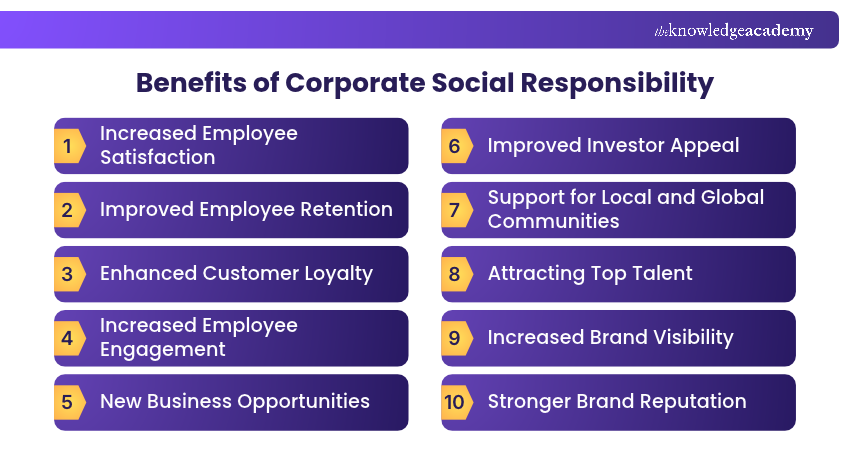
1) Increased Employee Satisfaction
How a company treats its employees can influence workplace satisfaction and organisational performance. Employees are more likely to feel satisfied when their organisation provides fair working conditions, respects their well-being and demonstrates responsible business practices.
CSR initiatives that support employee welfare, inclusion and meaningful workplace values can contribute to a more positive working environment. When employees feel respected and valued, they may develop a stronger sense of satisfaction with their roles and organisation.

2) Improved Employee Retention
CSR initiatives can contribute to employee retention by supporting a positive workplace culture and strengthening employees' connection with organisational values.
For example, ethical employment practices, employee well-being programmes and opportunities to participate in meaningful initiatives may encourage employees to remain with an organisation.
3) Enhanced Customer Loyalty
Improved customer loyalty is one of the key CSR benefits. Consumers may develop stronger connections with brands that demonstrate credible social and environmental commitments.
When customers believe that a business acts responsibly and delivers on its commitments, this can strengthen trust and encourage repeat engagement. However, loyalty also depends on product quality, pricing, customer experience and other factors.
Pro Tip
When communicating CSR achievements, explain what your organisation has done and what results it has achieved. Specific, verifiable information is more credible than broad claims such as “We care about the planet.”
4) Increased Employee Engagement
CSR initiatives can encourage employees to participate in activities beyond their routine responsibilities. Volunteering programmes and community projects, for example, may strengthen employees' sense of purpose and connection to organisational values.
CSR activities can also encourage teamwork and collaboration when employees work together on shared projects. For example, employee volunteering, environmental programmes and community partnerships can encourage participation, teamwork and opportunities to develop new skills.
5) New Business Opportunities
CSR can help organisations identify business opportunities by responding to changing social, environmental and customer expectations.
For example, a business may identify demand for responsibly sourced products, qualify for supplier opportunities with relevant sustainability requirements or reach customers seeking lower-impact alternatives. These initiatives may help businesses enter new markets or strengthen existing offerings.
6) Improved Investor Appeal
A credible CSR strategy may make an organisation more attractive to investors who consider environmental, social and governance-related factors when evaluating businesses.
Transparent reporting, ethical conduct and responsible risk management can help investors understand how an organisation manages material sustainability-related opportunities and risks.
Trainer Insight: Different Investors Have Different Priorities
Not every investor evaluates CSR in the same way. Some examine climate-related risks, while others focus on governance, labour practices or financial performance. Organisations should understand which sustainability matters are relevant to their operations and provide evidence that supports their disclosures.
7) Support for Local and Global Communities
CSR initiatives play an important role in supporting communities through activities such as education, healthcare, environmental improvement and economic development. Businesses may contribute through community investment, employee volunteering, skills-sharing programmes and partnerships with charities or local organisations.
By actively contributing to societal well-being, businesses can build stronger relationships with the communities in which they operate. The effectiveness of these initiatives depends on whether they address genuine community needs and deliver meaningful, measurable benefits.
Turn social responsibility principles into meaningful business practices with the ISO 26000 Foundation Training now!
8) Attracting Top Talent
A strong CSR strategy may help organisations attract professionals who value ethical behaviour, responsible workplace practices and meaningful organisational goals. For example, candidates may consider an employer's environmental commitments, community involvement and approach to employee welfare when choosing where to work.
Demonstrating genuine responsibility can strengthen an employer's appeal, although recruitment success also depends on compensation, career opportunities and workplace conditions.
9) Increased Brand Visibility
CSR initiatives may increase brand visibility when responsible business activities attract public interest. These activities can introduce an organisation to audiences who may not otherwise be familiar with it.
For example, a business that collaborates with a local charity on a community project may receive coverage through the charity's communications or local media. However, increased visibility does not automatically lead to a stronger reputation or customer loyalty.
10) Stronger Brand Reputation
One of the benefits of corporate social responsibility is that consistent and responsible business practices can support a stronger brand reputation.
Businesses that demonstrate ethical conduct, transparent decision-making and accountability may strengthen confidence among customers, employees, suppliers and other stakeholders.
Trainer Insight: Reputation Is Built Through Consistency
A single charitable initiative does not define an organisation's overall responsibility. Stakeholders may also examine everyday practices, including supplier relationships, treatment of employees and accountability when problems arise.
11) Improved Risk Management and Resilience
CSR helps businesses recognise and respond to environmental, social and ethical risks that could affect their operations, stakeholders and long-term performance.
For example, responsible sourcing practices may help organisations identify labour-related concerns and potential supply disruptions. Environmental initiatives can also support resource planning and preparedness for changing operating conditions.
12) Purpose-led Innovation
CSR can encourage businesses to develop products, services and processes that respond to social or environmental challenges while supporting organisational objectives.
For example, companies may explore more sustainable packaging, energy-efficient operations, accessible products or circular business models that reduce waste. By considering broader stakeholder needs, organisations can identify opportunities for innovation and create solutions that deliver value beyond immediate commercial returns.
Turn sustainability goals into smarter strategies and meaningful results by joining the Business Sustainability Course now!
Real-world Examples of Corporate Social Responsibility
The following examples show how three organisations describe and implement selected social or environmental responsibility initiatives. These activities illustrate different CSR approaches but do not, on their own, prove improvements in reputation, retention or financial performance.
1) Google's CSR Initiatives
Google pursues environmental sustainability initiatives focused on areas such as clean energy, operational efficiency, water stewardship and technology-supported environmental solutions.
Its 2026 Environmental Report, which covers its 2025 activities, describes clean energy procurement, efforts to reduce environmental impacts and projects supporting water replenishment. These initiatives illustrate how a technology company can integrate environmental considerations into operations and product development.
Google's approach provides an example of environmental responsibility within CSR. However, these activities should not be presented as direct evidence of improved employee recruitment or employer reputation without supporting research.
2) Johnson & Johnson's Employee Volunteering Initiatives
Johnson & Johnson has supported employee volunteering through initiatives such as Talent for Good, which encourages employees to contribute their skills and expertise to community organisations.
Its documented activities include skills-based volunteering and pro bono support for non-profit organisations working on healthcare and community challenges. These initiatives demonstrate how businesses can use employee expertise to support social responsibility and community development.
3) LEGO's Sustainability and Social Responsibility Initiatives
The LEGO Group focuses its sustainability and social responsibility initiatives on children, environmental responsibility and responsible business practices. Its activities include supporting learning through play, increasing the use of recycled and renewable things, reducing single-use plastic packaging and working to lower environmental impacts.
LEGO continues to develop more sustainable materials and packaging while supporting programmes that help children access learning opportunities through play. These initiatives demonstrate how a business can connect its products, environmental commitments and community activities with broader social responsibility objectives.
CSR Initiative Evaluation Checklist
Use this checklist to assess whether a CSR initiative is relevant, credible and measurable.
□ Does the initiative address a genuine social or environmental need?□ Is it aligned with the organisation's values and responsibilities?□ Have relevant stakeholders been consulted?□ Are its objectives and expected outcomes clearly defined?□ Have suitable resources and responsibilities been assigned?□ Can its progress and impact be measured?□ Are the organisation's CSR claims accurate and supported by evidence?□ Is there a plan to review and improve the initiative?
Lead with integrity and build trust through every business decision by signing up for the Business Ethics Course now!

The Knowledge Academy develops accessible learning content across Project Management, IT, Cybersecurity, Data Science, Business Analysis, HR, Accounting and Finance, Leadership and Health and Safety. Its resources combine subject research with clear explanations to help professionals build practical knowledge across a wide range of disciplines.
View Detail

 If you wish to make any changes to your course, please


