


We may not have the course you’re looking for. If you enquire or give us a call on +44 1344 203 999 and speak to our training experts, we may still be able to help with your training requirements.
Top Benefits of 5G Technology
ByThe Knowledge AcademyLast updated on: 03 November 2026
Discover the key benefits of 5G technology and how it transforms digital connectivity. From faster speeds and reduced latency to improved network capacity and reliability, explore how 5G supports smart cities, IoT devices, business operations, and seamless communication across industries.
The Core Idea
5G technology goes beyond faster internet speeds. Its key benefits include:1. Faster Connectivity: Supports higher data speeds for streaming, downloads and data-intensive applications.2. Lower Latency: Reduces communication delays for applications requiring quick responses.3. Greater Network Capacity: Helps networks handle increased traffic in high-demand environments.4. Advanced Connectivity: Supports large-scale IoT applications and customised network services.5. Real-world Performance: Actual benefits depend on network coverage, infrastructure and device compatibility.
As digital technology continues to evolve, faster and more reliable connectivity has become increasingly important. 5G technology represents a major advancement in mobile networks, helping people, businesses, and devices communicate more efficiently.
From enabling higher internet speeds to facilitating the Internet of Things (IoT), 5G technology stands to revolutionise how we interact with digital services and connected devices. Want to know how? Read this blog to learn more about the benefits of 5G technology.
Benefits of 5G Technology
Let's discuss some of the key benefits of 5G technology and how they support faster, more flexible and reliable connectivity below:
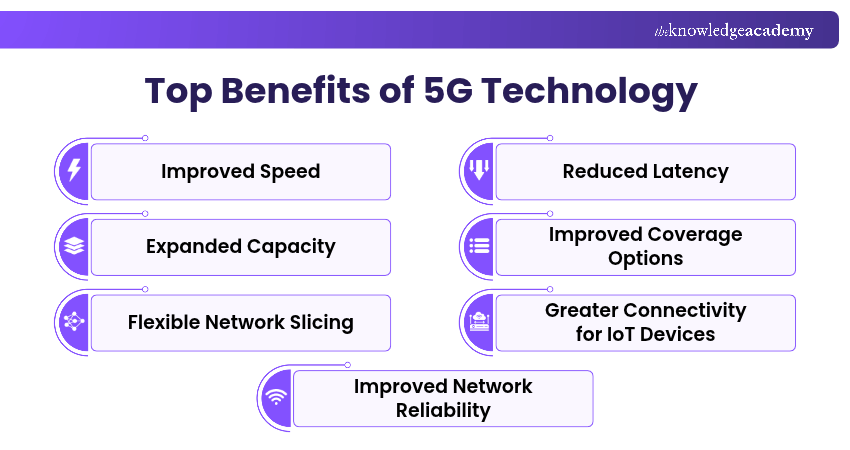
1) Improved Speed
One of the core benefits of 5G technology is its substantially faster data speeds compared to previous generations. With theoretical peak downlink rates of up to 20 Gbps under specified ideal conditions, 5G enables faster file transfers, high-definition video streaming, and smoother virtual reality experiences.
For businesses, these higher speeds can support faster access to cloud platforms, improving workflows and productivity. Industries such as media and entertainment can also benefit from ultra-high-definition streaming and immersive formats such as 360-degree videos.

2) Reduced Latency
Reduced latency is another important benefit of 5G technology. Latency is the delay in data transmission, and 5G is designed to reduce this delay significantly compared to previous mobile networks. Certain 5G applications target radio-interface latency as low as one millisecond under specific conditions. However, this does not represent the end-to-end delay experienced by every 5G user or application.
Lower latency supports applications requiring rapid responses, including industrial automation, remote operations, and connected vehicles. It enables faster data exchange and more responsive communication, although actual performance depends on network conditions, service configuration and supporting infrastructure.
Practical Example: 5G in Industrial Monitoring
A manufacturing facility uses connected sensors to monitor equipment performance and detect potential faults. With a suitably designed 5G network, the facility can transmit information between devices and monitoring systems with lower delays. When combined with local processing and automated controls, this can support quicker responses to equipment problems and improve operational monitoring.
3) Expanded Capacity
Expanded capacity allows 5G networks to support greater overall data traffic and more demanding connections, while reducing the risk of network congestion when sufficient network resources are available. This capability is particularly valuable as demand grows for connected devices, digital services, and data-intensive applications.
It also supports smart cities and industrial IoT systems that depend on reliable data exchange between connected infrastructure and digital services. In densely populated areas and major events, 5G can help maintain better connectivity and network performance compared to earlier generations.
4) Improved Coverage Options
5G technology can support different coverage requirements using low, mid, and high frequency spectrum bands. Low-band 5G supports wider geographical coverage, while mid-band spectrum provides a balance between coverage and capacity. Higher-frequency deployments can provide substantial capacity over shorter distances and may require denser infrastructure.
These technologies can improve access to digital services across urban and rural environments. However, 5G does not automatically provide wider or more consistent coverage than 4G. Actual availability depends on operator investment, available spectrum and network infrastructure, particularly in remote locations.
5) Flexible Network Slicing
Network slicing is an advanced 5G capability that allows operators to create multiple logical networks, known as network slices, over shared physical infrastructure. Each network slice can be configured to support specific applications with different requirements for speed, capacity, latency and reliability.
For example, one slice can support IoT or industrial services with communication requirements, while another can prioritise high-speed applications such as virtual reality. This capability, available through suitably configured 5G standalone networks, enables more efficient resource allocation and customised network services.
6) Greater Connectivity for IoT Devices
5G systems are designed to support a significantly higher density of connected devices, making them valuable for the growing Internet of Things (IoT) ecosystem. This includes smart home devices, wearables, industrial sensors and other connected technologies.
By supporting numerous simultaneous connections, the wider 5G ecosystem can enable larger IoT deployments across smart cities, homes and industries. It also supports industrial automation and monitoring systems that depend on timely and consistent data exchange.
7) Improved Network Reliability
5G technology can support more dependable communication through advanced radio technologies, quality-of-service management and improved network resource allocation. In suitably configured networks, these capabilities help manage communication requirements and reduce the likelihood of service interruptions.
Such features are particularly valuable for industrial automation, connected infrastructure and applications that require consistent data exchange. However, improved reliability is not guaranteed across all 5G networks, as actual performance depends on coverage, infrastructure, network configuration and operating conditions.
Learn how to turn connected devices into intelligent solutions with the Internet of Things IoT Systems and Applications Training – Join now!

The Knowledge Academy develops accessible learning content across Project Management, IT, Cybersecurity, Data Science, Business Analysis, HR, Accounting and Finance, Leadership and Health and Safety. Its resources combine subject research with clear explanations to help professionals build practical knowledge across a wide range of disciplines.
View Detail

 If you wish to make any changes to your course, please


