


 Top Rated Course


We may not have the course you’re looking for. If you enquire or give us a call on +61 272026926 and speak to our training experts, we may still be able to help with your training requirements.
What is Psychological Safety: Fundamentals and Importance
The Knowledge Academy 13 February 2026Psychological safety is the belief that one will not be punished or humiliated for speaking up with ideas, questions, concerns, or mistakes. This sense of security fosters communication, which in turn encourages innovation and builds trust among team members. When people feel safe, collaboration thrives and the workplace flourishes.

Training Outcomes Within Your Budget!
We ensure quality, budget-alignment, and timely delivery by our expert instructors.
Table of Contents
Would you rather work in an environment where you have limited freedom to voice your opinion, or in one where they would listen to you and take your opinions seriously? The latter would be preferred by the majority of people; an environment where honesty, trust, and inquisitiveness are promoted.
One can only imagine that it is possible to express ideas without fear of ridicule, to ask questions, and confess errors. This is what Psychological Safety is about. We shall discuss the reasons why this is important and how you can develop it in your team or organisation.
Table of Contents
1) What is Psychological Safety?
2) The Three Fundamentals of Psychological Safety
3) 8 Steps Toward Creating More Psychological Safety at Work
4) Benefits of Psychological Safety
5) What is an Example of Psychological Safety at Work?
6) Conclusion
What is Psychological Safety?
Psychological Safety refers to a belief that one is able to express him/herself in a team or organisation freely without being afraid of being embarrassed or subjected to undesirable effects. It establishes a culture in which individuals feel free to take interpersonal risk and make contributions freely.
Harvard Business School claims that Psychological Safety at work is founded on four elements:
a) Being Willing to Help: The members of the team should not be afraid of seeking assistance and believe that other teammates will be on their side.
b) Inclusion and Diversity: The feeling of belonging and the importance of their individual views are both provided to everybody.
c) Avoidance of Risk and Failure: The errors are viewed as a chance to learn instead of something that should be blamed.
d) Open Conversation: Discussion is open, respectful and promotes the involvement of every voice.
With these factors in place, the likelihood of teams innovating, working as a team and high-level performance increases.
The Three Fundamentals of Psychological Safety
To create a psychologically safe workplace, focus on these three fundamentals:
a) Inclusion: Ensure everyone feels included and valued.
b) Learning Orientation: Encourage a growth mindset where mistakes are seen as learning opportunities.
c) Open Dialogue: Promote honest and respectful communication.
8 Steps Toward Creating More Psychological Safety at Work
The Psychological Safety at Work will help to establish trust, promote innovation, and enhance team performance. These are eight steps to be undertaken based on the knowledge of experts:
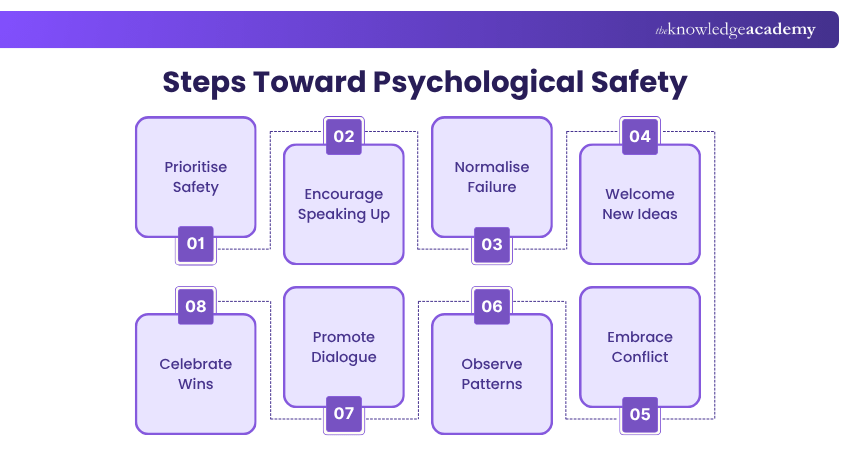
1) Start With Why
Make your team realise how beneficial Psychological Safety is. Show how it contributes to creativity, collaboration, and employee wellbeing. Acknowledge each person’s contribution to strengthen trust. When people see the bigger purpose, they are more likely to embrace it.
2) Define What “Safe” Looks Like
Establish clear norms for respectful communication, transparency, and conflict resolution. Highlight that mistakes are opportunities to learn, not reasons for blame. By setting clear expectations, teams know exactly what behaviours are encouraged.
3) Model Vulnerability and Openness
Leaders should share concerns and admit uncertainties. This builds credibility and normalises interpersonal risk-taking. When leaders are authentic, it gives others permission to do the same.
4) Enable Participation and Active Listening
Encourage contributions by asking open-ended questions, listening without interruption, and acting on team input to show their voices matter. Genuine listening makes employees feel respected and valued.
5) Establish Real Relationships
Build genuine connections with team members. Regular check-ins and sincere care for wellbeing foster trust. Strong relationships form the foundation of a supportive team culture.
6) Create Safe Spaces for Feedback and Dialogue
Organise regular meetings or forums where employees can freely share ideas, concerns, or feedback. Ensure these spaces are consistent, fair, and inclusive. Safe forums create confidence in speaking up without fear.
7) Celebrate Learning From Mistakes
Treat mistakes as valuable lessons and recognise the effort even when outcomes fail. This strengthens a growth mindset and reduces fear of judgment. Rewarding learning signals that improvement is more important than perfection.
8) Train Leaders to Foster Safety
Provide leadership training focused on building trust, openness, and inclusive practices. Equipping managers with the right tools helps them nurture Psychological Safety across teams. Well-trained leaders set the tone for the entire organisation.
Master psychological skills to boost wellness, resilience, and peak performance by signing up for our Psychological Skills Training for Human Wellness now!
Benefits of Psychological Safety
Psychological Safety brings numerous benefits to the workplace, including:
a) Increased Innovation: A safe environment encourages creative thinking and innovation.
b) Better Collaboration: Teams work more effectively when members feel safe enough to share their opinions and innovative ideas.
c) Higher Employee Engagement: Employees who feel psychologically safe are more engaged and committed to their work.
d) Reduced Turnover: A supportive work environment reduces employee turnover and increases retention.
e) Enhanced Performance: Overall team performance improves when members feel safe and supported.
f) Reduces Interpersonal Conflict: Psychologically safe teams have fewer conflicts and solve disputes in a more constructive manner.
g) Encourages Honest, Tough Conversations: It leaves room so that employees can bring up hard topics or disprove ideas without intimidation, thus resulting in optimal decision-making.
h) Builds Organisational Resilience: When a team is in a state of change or uncertainty, a psychologically safe team adapts faster.
Unlock human behaviour insights - transform your career and mindset today by registering for the Psychology Course now!
What is an Example of Psychological Safety at Work?
An excellent illustration of Psychological Safety in the workplace is when the workers are relaxed in telling bad news or making mistakes without being blamed. Amicable reaction, gratitude, and a solution-focused approach by the managers will instil trust and foster candour.
Such a reaction is an indication that integrity is encouraged, and education is facilitated, even during failure. Conversely, anger-based or disapproval-based reactions may deter transparency and form a culture of silence. Psychological Safety refers to encouraging people to feel respected, heard, and supported, particularly when it comes to having a hard talk.
Conclusion
Building a culture of trust does not necessarily need to be complex. You can make your team feel heard, appreciated and encouraged with small, consistent steps. Psychological Safety is not only a notion but the key to creativity, cooperation and confidence in the workplace. Build it today and watch the change it brings tomorrow.
Acquire essential skills to identify and understand various Mental Health conditions by registering in our Mental Health Courses – Register now!
Frequently Asked Questions
What are the Barriers to Psychological Safety at Work?

Barriers to Psychological Safety include fear of judgment, lack of trust, poor communication, and punitive responses to mistakes.
What Does a Lack of Psychological Safety Look Like?
A lack of Psychological Safety would result in employees feeling afraid to speak up, share ideas, or admit mistakes, leading to disengagement and low morale.
What are the Other Resources and Offers Provided by The Knowledge Academy?
The Knowledge Academy takes global learning to new heights, offering over 3,000+ online courses across 490+ locations in 190+ countries. This expansive reach ensures accessibility and convenience for learners worldwide.
Alongside our diverse Online Course Catalogue, encompassing 19 major categories, we go the extra mile by providing a plethora of free educational Online Resources like Blogs, eBooks, Interview Questions and Videos. Tailoring learning experiences further, professionals can unlock greater value through a wide range of special discounts, seasonal deals, and Exclusive Offers.
What is The Knowledge Pass, and How Does it Work?
The Knowledge Academy’s Knowledge Pass, a prepaid voucher, adds another layer of flexibility, allowing course bookings over a 12-month period. Join us on a journey where education knows no bounds.
What are the Related Courses and Blogs Provided by The Knowledge Academy?
The Knowledge Academy offers various Mental Health Courses, including Psychology of Behaviour at Work Training, Psychology Course and Psychological Skills Training for Human Wellness Training. These courses cater to different skill levels, providing comprehensive insights into Occupational Psychologist.
Our Health & Safety Blogs cover a range of topics related to Psychological Safety in the Workplace, offering valuable resources, best practices, and industry insights. Whether you are a beginner or looking to advance your Health & Safety skills, The Knowledge Academy's diverse courses and informative blogs have got you covered.
What are the Related Courses and Blogs Provided by The Knowledge Academy?
The Knowledge Academy offers various Health & Safety Courses, including Advance First-Aid Training, Active and Healthy Lifestyle Training, and Counselling Certifications. These courses cater to different skill levels, providing comprehensive insights into What is Yoga.
Our Health & Safety Blogs cover a range of topics related to Panic and Anxiety Attacks, offering valuable resources, best practices, and industry insights. Whether you are a beginner or looking to advance your Health and Safety knowledge, The Knowledge Academy's diverse courses and informative blogs have you covered.

The Knowledge Academy


Global Training Provider
The Knowledge Academy is a world-leading provider of professional training courses, offering globally recognised qualifications across a wide range of subjects. With expert trainers, up-to-date course material, and flexible learning options, we aim to empower professionals and organisations to achieve their goals through continuous learning.


 If you wish to make any changes to your course, please


