


 Top Rated Course

We may not have the course you’re looking for. If you enquire or give us a call on +61 272026926 and speak to our training experts, we may still be able to help with your training requirements.
Data Governance vs Information Governance: What's the Difference?
The Knowledge Academy 27 April 2026In a world awash with data, understanding the nuances between Information Governance vs Data Governance is vital for protecting and leveraging your organisation’s most valuable asset. Together, they form a robust defence and optimisation strategy for an organisation’s most critical resource. Read along to learn more about Data Governance and Information Security.
Home
 Resources
IT Security & Data Protection
Data Governance vs Information Governance: What's the Difference?
Resources
IT Security & Data Protection
Data Governance vs Information Governance: What's the Difference?
Resources
IT Security & Data Protection
Data Governance vs Information Governance: What's the Difference?

Training Outcomes Within Your Budget!
We ensure quality, budget-alignment, and timely delivery by our expert instructors.
Table of Contents
Navigating through the complex maze of Information Governance vs Data Governance is like unravelling the intertwined threads of order and protection. Each serves a unique purpose: one governs the structure and policy of data use, and the other shields it from myriad digital dangers. Their synergy fortifies an organisation’s data architecture, weaving a resilient shield against the chaos of the cyber world and enhancing the wisdom with which we harness our collective digital future.
Table of Contents
1) What is Data Governance?
2) What is Information Security?
3) Data Governance vs Information Security: Understanding difference
4) How to approach and implement Data Governance?
5) How to approach and implement Information Security?
6) Which one does your organisation need?
7) How do they work together?
8) Real-World applications of Data and Information Governance
9) Conclusion
What is Data Governance?
Data Governance systematically manages data to ensure its availability, usability, integrity, and security. It is an essential element of a company’s Data Management plan, ensuring data accuracy, reliability, and consistency.
Data Governance, in practice, involves establishing formal regulations and procedures for working with data, from acquisition and storage to usage and deletion. These guidelines are typically set by an organisational governance committee and executed with the assistance of data stewards across the company. Data Governance policies address critical areas such as data integrity, security, privacy, and regulatory compliance, treating data as an essential resource that is well-maintained, safeguarded, and leveraged to inform business choices and processes.
Organisations need to pinpoint their Critical Data Elements (CDEs) for successful Data Governance, like customer, financial, or operational information. Subsequently, they craft policies and procedures for managing these CDEs. Additionally, they delineate roles and responsibilities, assigning who oversees data quality, has data access, and has authority over data definition modifications.

What is Information Security?
Information governance is a generalised approach to managing all information in an organisation. It goes beyond Data Governance by handling structured and unstructured data such as emails and documents. It aims to mitigate risks, support strategic decision-making, and ensure regulatory compliance.
Information governance aims to orchestrate the organisation’s information assets in alignment with its objectives. This requires a collaborative approach across multiple disciplines—legal, privacy, IT, Risk Management, and business operations—to mitigate information-related risks, particularly legality and security while optimising business activities that depend on information.
To put information governance into action, organisations develop and uphold policies, procedures, and controls that govern the information lifecycle. This governance dictates the creation, usage, storage, archiving, and disposal of information, ensuring adherence to legal standards, safeguarding intellectual property, maintaining privacy, and enabling the strategic and efficient use of information to fulfil the organisation’s ambitions.
Be more mindful about your data privacy, sign up for our Data Privacy Awareness Course - register now!
Information Governance vs Data Governance: Understanding differences
Data Governance is the orchestration of people, processes, and technology to manage data, while Information Security is safeguarding data against threats. Here, We will explore the distinctions between them:
|
Aspect |
Data Governance |
Information Governance |
|
Definition |
Framework of practices for managing critical data assets, focusing on quality, integration, privacy, strategy, and operations. |
Encompassing term for managing all information assets, covering all types of data and documents. |
|
Scope |
Targets data assets such as databases and data warehouses. |
Manages all information assets, including physical and digital formats. |
|
Granularity |
Concerned with structured data that is systematically organised. |
Addresses every information asset, including unstructured data. |
|
Purpose |
Ensures precision, security, and legal compliance of data assets. |
Manages all types to support business goals. |
|
Stakeholders |
Managed by Data Management and IT professionals. |
Engages stakeholders in legal, compliance, Risk Management, and IT. |
|
Approach |
Technical focus on data quality, metadata management, and architecture. |
Focuses on policy creation, compliance, and Risk Management. |
1) Definition
Data Governance establishes a framework of practices and plans for formally managing critical data assets within a company. It integrates personnel, processes, and technology to ensure uniform and proper Data Management. The fundamental components of Data Governance include data quality, integration, privacy, strategy, and operations.
Information governance, on the other hand, is an encompassing term that incorporates Data Governance. It deals with the overarching principles, policies, and procedures related to the entire lifecycle of an organisation’s information, covering both structured and unstructured data and physical documents. Therefore, while Data Governance focuses on Data Management, information governance addresses the management of all informational assets within an enterprise.
2) Scope
Information governance encompasses the management of all information assets within an organisation, including physical and digital formats like records, documents, and emails. Data Governance is more specific, targeting data assets such as databases and data warehouses.
3) Granularity
Information governance is more detailed, addressing every information asset, including unstructured data. Data Governance is concerned with structured data that is systematically organised
3) Purpose
Information governance manages all information types effectively to bolster the organisation’s business goals. Data Governance specifically ensures data assets' precision, security, and legal compliance.
4) Stakeholders
Information governance engages various stakeholders in legal, compliance, Risk Management, and IT. Data Governance generally falls under the purview of Data Management and IT professionals.
5) Approach
The comprehensive information governance strategy focuses on policy creation, compliance, and Risk Management. Data Governance adopts a more technical stance, emphasising data quality, metaData Management, and architecture.
How to approach and implement Data Governance?
Approaching and implementing Data Governance can be structured into a series of strategic steps:
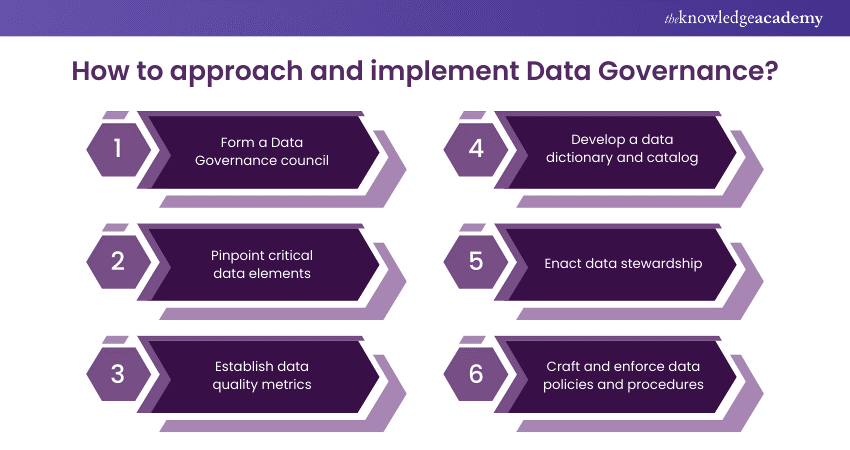
a) Form a Data Governance council: Assemble a diverse team from various departments to guide and supervise the Data Governance framework, policies, and standards.
b) Pinpoint critical data elements: Identify essential data, such as customer, financial, and operational data, that is vital for your business operations and decision-making processes.
c) Establish data quality metrics: Clarify your organisation's definition of data quality and develop metrics to assess it.
d) Develop a data dictionary and catalog: Create comprehensive resources that detail the data available, its meaning, location, and custodianship, ensuring clarity across the organisation.
e) Enact data stewardship: Designate data stewards tasked with maintaining the data’s quality, integrity, and confidentiality.
f) Craft and enforce data policies and procedures: Formulate and implement policies addressing key areas like data privacy, security, usage, and archiving.
Following these steps, an organisation can establish a robust Data Governance system that enhances Data Management and supports its overall strategy.
How to approach and implement Information Governance?
Approaching and implementing Data Governance can be structured into a series of strategic steps:

a) Form an Information Governance committee: Assemble a multidisciplinary team, similar to a Data Governance council, with representatives from various departments. Their mandate will be to create, manage, and monitor the information governance framework, policies, and standards, ensuring alignment with the Information Governance Principles.
b) Conduct an information audit catalogue of your data assets: Identifythe nature of the information, its storage locations, ownership, and current management processes.
c) Formulate an Information Lifecycle Management (ILM) policy: Outline a policy that dictates information creation, utilisation, storage, archiving, and disposal.
d) Enforce Information Security protocols: Safeguard your data against unauthorised access, exposure, alteration, or destruction.
e) Establish retention and disposal timetables: Define the retention period for various information categories and schedule their appropriate disposal.
By following these steps, you can ensure a comprehensive and effective information governance strategy.
Which one does your organisation need?
Choosing between data and information governance isn’t about preference but understanding their roles within your organisation’s Data Management framework. A solid Data Governance structure is essential for organisations that depend heavily on structured data for their decision-making and operational processes.
On the other hand, organisations handling a mix of structured and unstructured data, along with various legal, compliance, and operational demands, might need a broader information governance strategy. This comprehensive approach ensures the proper management of structured data and the secure, efficient, and compliant handling of all information types.
Ultimately, the decision hinges on your organisation’s unique data and information environment and the sector it operates in. Adopting both data and information governance strategies can empower organisations to harness their information assets fully and adeptly manage the complexities of today’s digital landscape.
Solve crimes with just your screen and keyboard. Sign up for our Computer Forensics Foundation Training - register now!
How do they work together?
While separate, data and information governance are complementary components of a robust strategy for information management and data and information resources. Data Governance is a vital part of the broader information governance structure, and it is mainly responsible for managing structured data.
In essence, Data Governance establishes information governance basics. It guarantees that structured data is intact, reliable and secure, and it helps fulfil the overarching goals of information governance. These purposes usually relate to observance of legal and regulatory requirements, Risk Management, and operational effectiveness improvement. Therefore, a reliable Data Governance infrastructure is vital for the impact of information governance because it ensures that managers, business operations, and strategic plans all have state-of-the-art data to rely on.
Real-world applications of Data and Information Governance
Here are some real-World Applications of Data and Information Governance:
Data Governance scenarios
Healthcare institution: Ensuring the precision and confidentiality of patient records is paramount. Data Governance measures might include creating a standardised data dictionary, stringent data access protocols, and the establishment of a dedicated team for ongoing data quality enhancement.
Financial services firm: To mitigate risks and adhere to regulations such as the Sarbanes-Oxley Act, a financial firm may set up a Data Governance council. This council would be responsible for formulating policies governing data usage, maintaining data quality, and safeguarding data privacy, with a system to ensure all financial data is auditable and verifiable.
Build the best Network Security systems, sign up for our Network Defence Training -register now!
Information Governance scenarios
Law Firm: Handling confidential information requires a robust information governance strategy. This could involve deploying a document management system for efficient storage, retrieval, and archival of information, alongside a schedule for document retention and destruction and stringent security protocols to maintain client privacy.
Manufacturing Enterprise: For a manufacturing entity, information governance could mean instituting a system to oversee document revisions and access, ensuring the security of proprietary designs and technical data. Additionally, comprehensive backup and recovery solutions are crucial to safeguard against data loss.
In both domains, the overarching aim is to manage data and information in a manner that is secure, efficient, and aligned with the organisation’s goals. The methodologies and tools employed may differ based on the organisation’s scale, sector, regulatory landscape, and specific requirements.
Conclusion
In simple terms, an organisation’s data is like a woven fabric. The concept of Information Governance vs Data Governance represents the threads that strengthen this fabric. They work together to ensure the organisation handles its data properly, which is key for making good decisions and staying secure in the digital world.
Frequently Asked Questions
How does Data Governance enhance business decision-making?

Data Governance provides a foundation of high-quality data, ensuring business decisions are based on accurate and reliable information.
Why is Information Security crucial for organisations?
Information Security is critical to protecting sensitive data from cyber threats and maintaining trust and compliance in an increasingly digital world.
What are the other resources and offers provided by The Knowledge Academy?
The Knowledge Academy takes global learning to new heights, offering over 3,000+ online courses across 490+ locations in 190+ countries. This expansive reach ensures accessibility and convenience for learners worldwide.
Alongside our diverse Online Course Catalogue, encompassing 17 major categories, we go the extra mile by providing a plethora of free educational Online Resources like Blogs, eBooks, Interview Questions and Videos. Tailoring learning experiences further, professionals can unlock greater value through a wide range of special discounts, seasonal deals, and Exclusive Offers.
What is knowledge pass and how does it work?
The Knowledge Academy’s Knowledge Pass, a prepaid voucher, adds another layer of flexibility, allowing course bookings over a 12-month period. Join us on a journey where education knows no bounds.
What are related courses and blogs provided by The Knowledge Academy?
The Knowledge Academy offers various CISA Training, including Information Systems Auditing, Control, and Security courses. These courses cater to different skill levels, providing comprehensive insights into CISA Books.
Whether you are starting your journey or aiming to elevate your Information Security expertise, immerse yourself in our IT Security & Data Protection Blogs to discover more insights!

The Knowledge Academy


Global Training Provider
The Knowledge Academy is a world-leading provider of professional training courses, offering globally recognised qualifications across a wide range of subjects. With expert trainers, up-to-date course material, and flexible learning options, we aim to empower professionals and organisations to achieve their goals through continuous learning.

Upcoming IT Security & Data Protection Resources Batches & Dates
Date
 CISA Certified Information Systems Auditor
CISA Certified Information Systems Auditor
Mon 14th Sep 2026
CISA Certified Information Systems Auditor
Mon 14th Dec 2026

 If you wish to make any changes to your course, please


