


 Top Rated Course

We may not have the course you’re looking for. If you enquire or give us a call on 01344203999 and speak to our training experts, we may still be able to help with your training requirements.
What is PRINCE2?
Grace Mitchell 21 August 2026PRINCE2, or Projects IN Controlled Environments, is a structured Project Management method that uses principles, practices and processes to help organisations manage projects with clear roles, controls and responsibilities.

Training Outcomes Within Your Budget!
We ensure quality, budget-alignment, and timely delivery by our expert instructors.
Table of Contents
Think of a project like a control room.
You need indicators showing whether things are on track, clear responsibilities for making decisions, warning signals when something goes wrong, and a way to know whether continuing the journey still makes sense.
PRINCE2 provides that control system for projects.
Through its principles, practices and processes, PRINCE2 provides a structured way to organise, manage and control projects while allowing the method to be tailored to different project environments. In this blog, we'll explore what PRINCE2 is, how its principles, practices and processes work, its benefits, certifications and how it compares with Agile.
Key Takeaways
1. PRINCE2 structures Project Management around seven principles, seven practices and seven processes.2. Continued business justification ensures a project remains worthwhile throughout its lifecycle.3. Defined responsibilities and management tolerances help teams maintain control without unnecessary escalation.4. PRINCE2 can be tailored to different project sizes, complexities, and delivery environments.5.PRINCE2 can work alongside Agile approaches, combining structured project governance with adaptive delivery.
What is PRINCE2?
PRINCE2 stands for Projects IN Controlled Environments. It is a structured Project Management method designed to provide clear organisation, governance and control throughout a project's lifecycle.
PRINCE2 defines how responsibilities are assigned, how projects are planned and monitored, when decisions should be escalated and how continued business justification is maintained.
The method is built around seven principles, seven practices and seven processes. These elements work together to guide how a project is organised, managed and controlled while allowing PRINCE2 to be tailored to the project's size, complexity, risk and delivery environment.

Seven Principles of PRINCE2
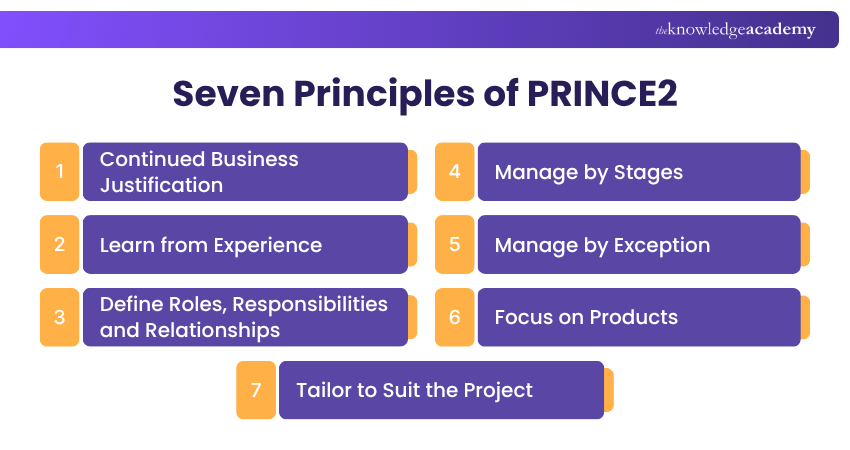
The seven PRINCE2 principles provide the foundation for applying the method consistently. They guide how projects should be managed and help ensure that PRINCE2 remains appropriate throughout the project lifecycle. The seven principles are:
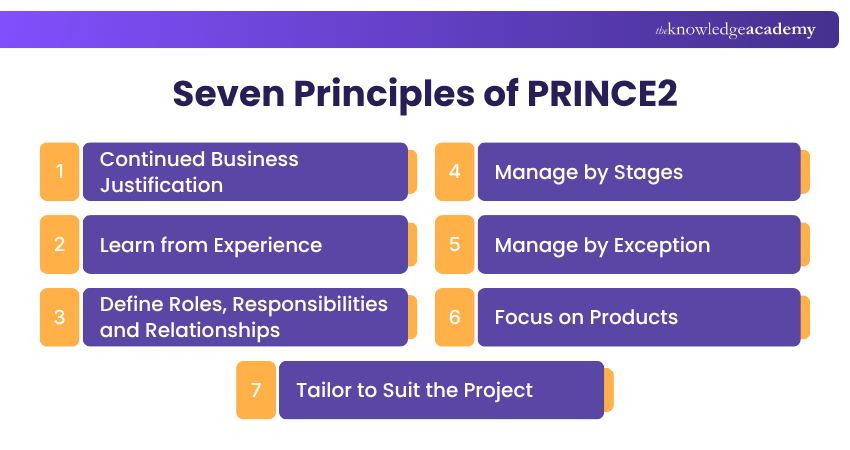
1) Continued Business Justification
A PRINCE2 project needs a valid reason to exist, and that justification should remain relevant throughout its lifecycle.The Business Case considers factors such as expected benefits, costs, risks, and timescales.
If circumstances change significantly, the project should be reassessed rather than continued simply because resources have already been invested. This encourages organisations to focus on whether a project continues to offer sufficient value.
2) Learn from Experience
Projects rarely begin with a completely blank slate. Previous projects, experienced team members, and earlier stages of the same project can all provide useful lessons.
PRINCE2 encourages teams to seek lessons at the beginning, capture new lessons as work progresses, and apply relevant learning throughout the project. This creates an ongoing feedback loop rather than leaving reflection until the project has finished.
3) Define Roles, Responsibilities and Relationships
Effective Project Management requires more than assigning tasks. People need to understand who is accountable, who makes decisions, and how different project participants work together.
PRINCE2 establishes defined roles and responsibilities across the project management team. This reduces uncertainty around ownership and supports clearer communication, collaboration, and decision-making.
4) Manage by Stages
Instead of planning and controlling the entire project as one uninterrupted block of work, PRINCE2 divides it into manageable stages.
At appropriate stage boundaries, progress and future plans can be reviewed before additional resources are committed. This creates natural control points and gives decision-makers opportunities to confirm whether continuing with the project remains appropriate.
5) Manage by Exception
Not every issue needs to be escalated to senior management. PRINCE2 establishes agreed tolerances for project performance, allowing Project Managers to operate within defined boundaries. If forecasts indicate that those tolerances will be exceeded, the situation is escalated to the appropriate management level for a decision.
PRINCE2 in Action
Imagine a Project Manager has authority to manage a stage within agreed cost and time tolerances. A small delay that remains within those boundaries can be handled without escalating every decision. However, if forecasts indicate that an agreed tolerance will be exceeded, the matter is escalated to the appropriate management level.
6) Focus on Products
PRINCE2 places emphasis on clearly understanding what the project needs to produce before focusing on the activities required to produce it.
Products should have clearly understood requirements and quality expectations. This product-focused approach helps reduce ambiguity, control scope, and keep project work centred on agreed outputs.
7) Tailor to Suit the Project
PRINCE2 is not intended to create unnecessary management overhead. The method should be adapted to suit the characteristics and circumstances of each project.
Factors such as scale, complexity, risk, organisational environment, team capability and delivery approach can influence how PRINCE2 is applied. Tailoring helps organisations retain appropriate control without introducing processes that add little value.
Interested to know more about how PRINCE2 works? Join our PRINCE2® Foundation and Practitioner Training now.
Seven PRINCE2 Practices
PRINCE2 Practices describe the key aspects of Project Management that need continuous attention throughout a project. While the principles guide how PRINCE2 should be applied, the practices focus on the areas that must be managed effectively. The seven PRINCE2 Practices are:
1) Business Case
The Business Case practice establishes why the project should be undertaken and whether it remains worthwhile. It considers the expected benefits, costs, risks and timescales to determine whether continued investment is justified. The Business Case is reviewed throughout the project so that decisions remain supported by valid business justification.
2) Organising
The Organising practice defines the project's structure, roles, responsibilities and relationships. It establishes who is accountable for key decisions and how responsibilities are distributed across the Project Board, Project Manager and other project participants. Clear accountability helps improve communication, coordination, and decision-making throughout the project.
3) Plans
The Plans practice provides a structured approach to determining what needs to be delivered, how it will be delivered, when activities should take place, and who will perform them. Plans establish targets against which progress can be monitored and controlled. They can also be developed at different levels to support effective management throughout the project.
4) Quality
The Quality practice focuses on ensuring that the project's products meet defined requirements and are fit for purpose. It involves establishing quality expectations, specifications, and appropriate methods for checking whether products meet agreed standards. This helps teams maintain consistency and reduce the risk of delivering outputs that fail to satisfy user needs.
5) Risk
The Risk practice provides a systematic way to identify, assess and control uncertain events that could affect project objectives. Risks may represent threats or opportunities, and each should be evaluated according to their potential impact and likelihood. Appropriate responses can then be planned to reduce threats or take advantage of opportunities.
6) Issues
The Issues practice provides a structured approach for identifying, assessing and managing events or situations that require project management attention. Issues may include problems, concerns, or proposed changes affecting the project's products or plans. Managing them systematically helps teams understand their impact and determine the appropriate response.
7) Progress
The Progress practice focuses on monitoring actual performance against approved plans and determining whether the project remains under control. It involves reviewing progress, forecasting future performance, and comparing results against agreed tolerances. When performance is forecast to exceed those tolerances, the issue can be escalated to the appropriate management level for a decision.
Seven PRINCE2 Processes
The seven PRINCE2 Processes describe the activities used to direct, manage and deliver a project from its initial idea through to closure. Each process has a specific purpose and helps establish who is responsible for key Project Management activities at different points in the lifecycle. The seven processes are:
1) Starting up a Project: This process determines whether the project idea is sufficiently worthwhile and viable to justify initiation. It begins with a project mandate and includes activities such as appointing key roles, capturing previous lessons and preparing the Project Brief.
2) Directing a Project: Directing a Project enables the Project Board to provide overall direction and make key decisions throughout the project's lifecycle. This includes authorising initiation, approving the project and subsequent stages, providing direction when required and authorising project closure.
3) Initiating a Project: This process establishes the foundations needed to manage the project effectively. The Project Manager develops the Project Initiation Documentation (PID), which brings together important information about areas such as scope, plans, controls, risks, quality and the Business Case. The Project Board uses this information when deciding whether the project should be authorised.
4) Controlling a Stage: Controlling a Stage focuses on the Project Manager's day-to-day management of a management stage. Work is authorised, progress is monitored, issues and risks are reviewed, and corrective action can be taken when necessary. The objective is to keep the stage within agreed tolerances and escalate exceptions when those tolerances are forecast to be exceeded.
5) Managing Product Delivery: Managing Product Delivery focuses on the relationship between the Project Manager and the Team Manager. It ensures that work packages are accepted, completed, and delivered according to agreed requirements, quality expectations, and project controls.
6) Managing a Stage Boundary: This process helps the Project Manager prepare for the end of a management stage and plan the next one. Current performance, risks, issues, lessons and the Business Case are reviewed, and the next Stage Plan is prepared. This information enables the Project Board to decide whether the project should continue, change direction or stop.
7) Closing a Project: Closing a Project provides a controlled way to confirm that the project's products have been accepted and assess whether the project's objectives have been achieved. It also involves evaluating project performance, recording lessons and making arrangements for any required post-project benefits reviews before recommending formal closure.
Advance your project leadership expertise with the PRINCE2® Practitioner Course – Join now!
Benefits of PRINCE2 Project Management
The following are some of the major benefits of PRINCE2 Project Management:
1) Clear Roles and Responsibilities: PRINCE2 establishes accountability by defining who makes decisions, who manages the work and who represents key stakeholder interests.
2) Stronger Project Control: Managing projects in stages allows progress, risks and performance to be reviewed at appropriate points before further resources are committed.
3) Continued Business Focus: Projects are expected to maintain valid business justification, helping organisations avoid continuing work that no longer provides sufficient value.
4) Better Risk and Issue Management: Structured practices help teams identify uncertainty, manage issues, and respond to situations that could affect project objectives.
5) Flexible Application: PRINCE2 can be tailored to suit different project sizes, complexities, industries, organisational environments and delivery approaches. This allows organisations to apply an appropriate level of governance and control without creating unnecessary management overhead.
PRINCE2 vs Agile
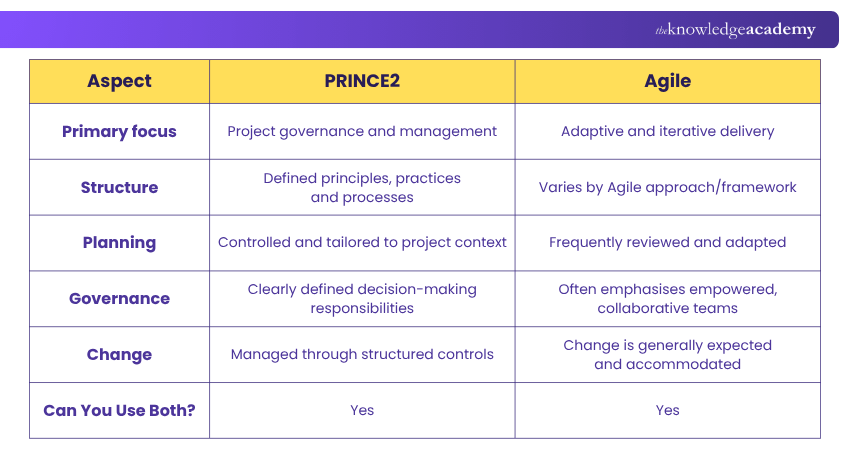
PRINCE2 and Agile are not necessarily competing approaches. PRINCE2 primarily provides a structured method for project governance and management, while Agile approaches focus more heavily on iterative, adaptive ways of developing and delivering products. Because they address different aspects of project delivery, PRINCE2 and Agile can be used together.
PRINCE2 Certifications
PRINCE2 offers different certification levels for professionals who want to build and validate their knowledge of the method. These certifications range from understanding the core concepts of PRINCE2 to applying and tailoring the method in practical project environments.
The main PRINCE2 certification options are:
1) PRINCE2® Foundation: PRINCE2 Foundation introduces the key concepts, terminology, principles, practices and processes of the PRINCE2 method. It is designed to validate a candidate's understanding of how PRINCE2 supports structured Project Management.
2) PRINCE2® Practitioner: PRINCE2® Practitioner Certification is for Project Management professionals who want to validate their enhanced proficiency in PRINCE2®.
3) PRINCE2 Agile® Foundation (Version 2): With PRINCE2 Agile® Foundation (Version 2) Certification, candidates can validate their knowledge of PRINCE2® fundamentals coupled with Agile practices, concepts, and techniques.
4) PRINCE2 Agile® Practitioner (Version 2): This level focuses on applying PRINCE2 Agile® in practical project environments, helping candidates demonstrate their ability to tailor and use PRINCE2® with agile ways of working.
PRINCE2® Foundation Certification holders can directly apply for PRINCE2® Agile Practitioner.
Conclusion
PRINCE2 provides a structured way to manage projects through clearly defined principles, practices, processes, responsibilities and controls. Understanding what PRINCE2 is can help Project Managers see how these elements work together across the project lifecycle. Its ability to be tailored also means organisations can apply the method according to the size, complexity, risk and delivery environment of their projects.
Think of PRINCE2 This Way
Principles = How should we think and make decisions?Practices = What areas need continuous attention?Processes = What Project Management activities happen throughout the lifecycle?
Build a solid project management foundation with the PRINCE2® Foundation Course – Join now!
Frequently Asked Questions
Is PRINCE2 Suitable for Small Projects?

Yes. PRINCE2 can be tailored according to factors such as project size, complexity, risk and organisational environment. Smaller projects can therefore use a lighter application of the method while retaining appropriate governance and control.
Can PRINCE2 be Used with Agile?
Yes. PRINCE2 can provide project governance, roles and controls while Agile approaches support iterative and adaptive delivery. The two can therefore complement each other when appropriately tailored.
Yes. PRINCE2 can provide project governance, roles and controls while Agile approaches support iterative and adaptive delivery. The two can therefore complement each other when appropriately tailored.
PRINCE2 is designed to be adaptable rather than limited to one industry or project type. It can be tailored for different organisational environments, project sizes, complexities and delivery approaches.

Grace Mitchell


Senior Project Management Consultant and Author
Grace Mitchell is a highly experienced project management professional with over 15 years of expertise in leading large-scale projects across industries, including construction, IT, and finance. With qualifications in PRINCE2®, PMP®, AgilePM®, and MSP®, Grace specialises in delivering complex programmes with precision and clarity. Her writing is grounded in real-world application and focuses on helping learners build confidence in project delivery and stakeholder management.
View Detail

 If you wish to make any changes to your course, please


