


We may not have the course you’re looking for. If you enquire or give us a call on 01344203999 and speak to our training experts, we may still be able to help with your training requirements.
Top 10 Big Data Tools: Features and Uses
ByVishnu SankarLast updated on: 30 October 2026
Explore 10 leading big data tools, including Apache Hadoop, Spark, Databricks, Google BigQuery and Snowflake. Discover their features, uses and key differences, along with important factors to consider when choosing the right big data tool.
Quick Preview
1. Apache Hadoop, Spark and Flink support different distributed processing requirements.2. MongoDB provides document-based data storage, while Kafka supports distributed event streaming.3. Databricks, Google BigQuery and Snowflake support cloud-based data engineering, warehousing and analytics.4. Tableau and Microsoft Power BI help organisations explore data through interactive reports and dashboards.5. Choosing a suitable big data tool depends on data volume, processing requirements, integration, scalability and technical expertise.
Every second, businesses generate information through online transactions, customer interactions, connected devices and digital services. But collecting data is only the beginning. The real challenge lies in organising, processing and analysing this information to support meaningful decisions.
Big data tools help organisations address these challenges. From Apache Hadoop and Spark to Tableau and Power BI, these technologies support different stages of data management and analysis. Each tool serves a different purpose, making it important to understand where it fits into your organisation's data management and analytics processes.
Top 10 Big Data Tools
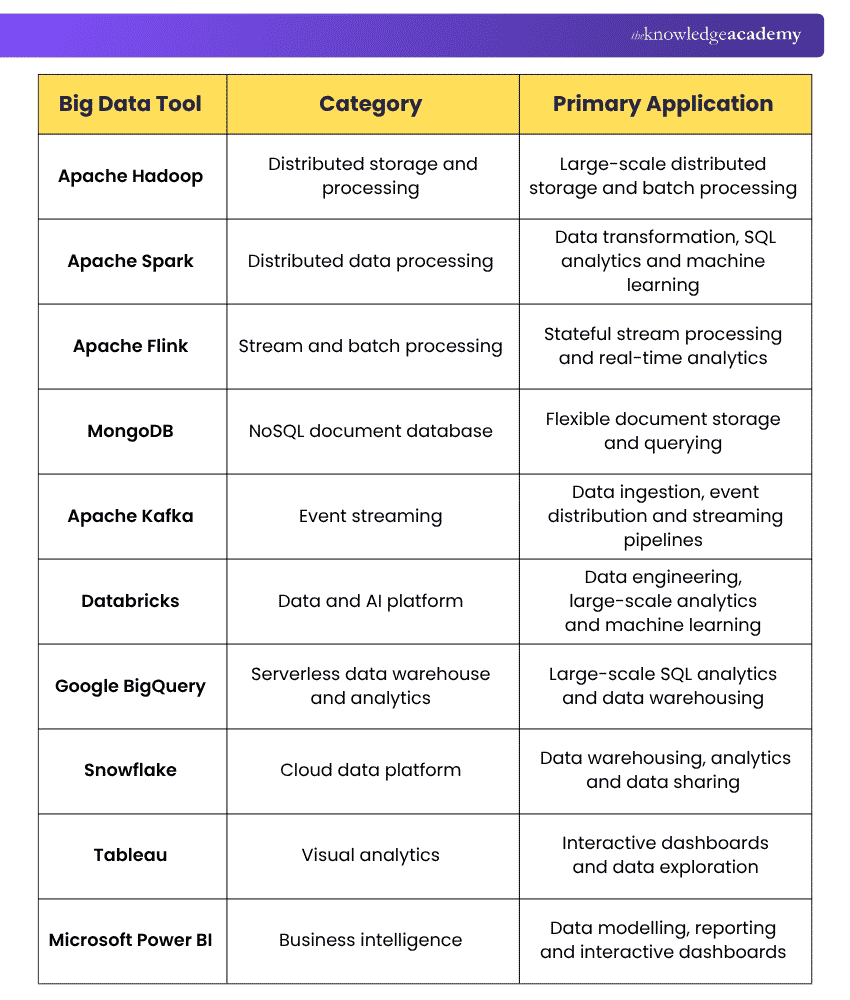
Big data tools support different stages of data management, from distributed storage and processing to event streaming, cloud analytics and visualisation. The following 10 tools offer capabilities suited to different data requirements and business applications:
The table below compares their categories and primary applications.
Now let's explore these tools in detail:
1) Apache Hadoop
Apache Hadoop is an open-source framework that enables organisations to store and process large datasets across clusters of computers. It supports scalable operations and fault tolerance through distributed infrastructure. Hadoop includes several components for managing storage, computing resources and batch-processing workloads.
Key Features:
1) Hadoop Distributed File System: Stores large files across multiple machines, supporting data replication and fault tolerance.
2) Hadoop YARN: Manages cluster resources and schedules distributed applications.
3) Hadoop MapReduce: Supports parallel batch processing by dividing workloads into smaller tasks.
4) Hadoop Common: Provides libraries and utilities required by other Hadoop components.
5) Distributed Scalability: Allows organisations to expand storage and processing capacity by adding suitable cluster resources.
Best Suited For: Organisations managing large datasets in Hadoop-based environments, particularly those requiring distributed storage and batch-oriented processing.
Gain expertise in managing large data sets with the Hadoop Big Data Certification – Join now!
2) Apache Spark
Apache Spark is an open-source distributed processing engine designed for large-scale data analytics and transformation. It distributes computational workloads across clusters and supports SQL queries, stream processing and machine learning. Spark works with various data sources and storage systems, making it useful for complex data engineering and analytics tasks.
Key Features:
1) Distributed Data Processing: Divides computational tasks across cluster resources to process large datasets.
2) Spark SQL: Supports structured data processing through SQL queries and DataFrame APIs.
3) Structured Streaming: Enables scalable stream processing using Spark's structured processing APIs.
4) MLlib: Provides machine learning algorithms and utilities for analytical workloads.
5) In-memory Computing: Supports caching and retaining suitable data in memory to improve performance in certain workloads.
Best Suited For: Data engineers, data scientists and organisations performing large-scale data transformations, batch analytics and stream processing.
Trainer Insight
Spark's in-memory capabilities can improve performance for suitable workloads, but they do not guarantee faster processing in every situation. Performance also depends on data size, available memory, processing logic and cluster configuration.
3) Apache Flink
Apache Flink is an open-source framework for distributed processing of bounded and unbounded data streams. It is useful for applications requiring continuous processing and stateful computations. Flink supports streaming and batch-style workloads, allowing organisations to analyse incoming information and process existing datasets.
Key Features:
1) Stateful Stream Processing: Maintains application state across events to support continuous calculations and analysis.
2) Event-time Processing: Processes events based on when they occurred rather than only when they reach the system.
3) Exactly-once State Consistency: Supports consistent state updates through checkpointing and recovery, with end-to-end guarantees depending on compatible sources and sinks.
4) Window Operations: Groups events into defined windows for aggregation and analysis.
5) Distributed Scalability: Runs processing workloads across cluster resources with fault-tolerance capabilities.
Best Suited For: Organisations developing streaming analytics, event-driven applications and continuous data processing systems.

4) MongoDB
MongoDB is a document-oriented NoSQL database designed to store and manage information in flexible, JSON-like documents. Unlike relational databases that primarily organise information into tables, MongoDB uses collections of BSON documents. Its document model supports applications with varied or evolving data structures.
Key Features:
1) Document-based Storage: Stores information in BSON documents that support nested structures and flexible fields.
2) Flexible Data Model: Allows applications to accommodate changing document structures without requiring identical fields in every record.
3) Horizontal Scaling: Uses sharding to distribute data and workloads across multiple servers.
4) Indexing and Querying: Supports indexes and queries for retrieving relevant information.
5) Aggregation Framework: Provides operations for transforming, grouping and analysing stored data.
Best Suited For: Applications requiring flexible document storage, scalable data access and support for evolving data structures.
5) Apache Kafka
Apache Kafka is an open-source distributed event streaming platform used to publish, store and consume streams of records. It supports the continuous movement of information between applications and services, making it useful for data integration and event-driven architectures.
Key Features:
1) Event Publishing and Consumption: Allows producers to publish events and consumers to read them.
2) Distributed Topics: Organises event streams into topics and partitions for scalable storage and consumption.
3) Durable Event Storage: Retains events according to configured retention policies.
4) Replication and Fault Tolerance: Supports replicated partitions to improve availability and resilience.
5) Streaming Integration: Connects event producers, processing systems and downstream applications through Kafka clients and integration technologies.
Best Suited For: Organisations building real-time data pipelines, event-driven applications, log collection systems and streaming architectures.
Learn how Apache Kafka helps organisations process millions of events in real time in the Apache Kafka Training – Sign up now!
6) Databricks
Databricks is a unified data and AI platform that supports data engineering, large-scale analytics, machine learning and business intelligence. Built around a lakehouse architecture, it combines capabilities associated with data lakes and data warehouses. It helps organisations process information from multiple sources and manage analytical workflows in a collaborative environment.
Key Features:
1) Lakehouse Architecture: Combines flexible data storage with data warehousing and analytical capabilities.
2) Distributed Data Processing: Uses Apache Spark and other supported processing technologies to handle large-scale workloads.
3) Data Engineering: Supports data ingestion, transformation and pipeline orchestration.
4) Machine Learning and AI: Provides tools for developing, training and managing machine learning models and AI applications.
5) Data Governance: Uses a unity catalogue to support data discovery, access control and governance across supported assets.
Best Suited For: Organisations seeking an integrated environment for data engineering, large-scale analytics, machine learning and AI workloads.
7) Google BigQuery
Google BigQuery is a fully managed, serverless data platform designed for large-scale data analysis. It enables organisations to query and analyse substantial datasets using SQL without directly managing the underlying computing infrastructure. BigQuery also supports data integration, machine learning and business intelligence workflows.
Key Features:
1) Serverless Architecture: Manages the underlying infrastructure used for supported analytical workloads.
2) SQL Analytics: Allows users to analyse large datasets through SQL queries.
3) BigQuery ML: Supports building and using machine learning models with SQL-based workflows.
4) Data Integration: Provides capabilities for loading, connecting and analysing data from supported sources.
5) Security and Governance: Offers access controls and governance capabilities for managing analytical data.
Best Suited For: Organisations requiring managed data warehousing, large-scale SQL analytics and integration with Google Cloud services.
8) Snowflake
Snowflake is a fully managed cloud data platform that supports data engineering, analytics, data sharing and AI workloads. Its architecture separates storage and computing resources, allowing organisations to manage analytical workloads without administering traditional database infrastructure. Snowflake also provides capabilities for data integration, governance and collaboration.
Key Features:
1) Cloud Data Platform: Provides managed services for storing, processing and analysing data.
2) Independent Compute Resources: Supports separate compute resources for different workloads, helping organisations manage performance and resource allocation.
3) SQL Analytics: Enables users to query and analyse structured and supported semi-structured data.
4) Data Engineering: Supports ingestion and transformation through capabilities such as Snowpipe, streams, tasks and dynamic tables.
5) Data Sharing and Governance: Provides features for controlled data access, collaboration and sharing.
Best Suited For: Organisations requiring cloud-based data warehousing, analytical workloads, data engineering and secure data collaboration.
EXTRA INSIGHT
The big data platform and tools market size is expected to grow to £115.87 billion in 2030.
9) Tableau
Tableau is a powerful data visualisation and business intelligence tool that enables users to explore data and create interactive dashboards and reports. It provides graphical tools for analysing information from supported data sources, allowing users to identify patterns, compare results and communicate findings.
Key Features:
1) Interactive Dashboards: Combines charts, tables and other visual elements into dashboards.
2) Drag-and-drop Analysis: Enables users to create many visualisations through graphical interactions.
3) Data Connectivity: Connects to supported databases, files, cloud platforms and analytical systems.
4) Visual Exploration: Helps users examine patterns, relationships and variations through interactive charts.
5) Sharing and Collaboration: Supports publishing and sharing analytical content through relevant Tableau products.
Best Suited For: Data Analysts, Business Analysts and organisations requiring interactive data visualisation and business reporting.
10) Microsoft Power BI
Microsoft Power BI is a Business Intelligence (BI) and data visualisation platform that helps organisations connect to data sources, prepare information and create interactive reports. It supports data modelling, analytical calculations and reporting, with integrations across Microsoft's technology ecosystem.
Key Features:
1) Interactive Reports: Creates charts, tables, maps and dashboards for exploring business information.
2) Power Query: Supports data connection, cleaning and transformation.
3) Data Modelling: Enables users to establish relationships between datasets and create analytical models.
4) DAX Calculations: Provides a formula language for creating measures and analytical calculations.
5) Data Connectivity: Supports connections to databases, cloud services, files and other compatible sources.
Best Suited For: Organisations requiring business intelligence reporting, financial dashboards and analysis across supported data sources.
Trainer Insight
A dashboard is only as current as its underlying information. In Power BI, imported data must be refreshed to reflect source changes, while DirectQuery can retrieve updated information when report queries run. However, caching and dashboard tile refresh schedules may affect when users see those changes.
Master how to transform raw data into interactive dashboards and insightful reports with our Microsoft Power BI Training – Register now!
How to Choose the Right Big Data Tool?
Choosing the right big data tool depends on your organisation's data requirements, technical resources and intended applications. Consider these five factors:
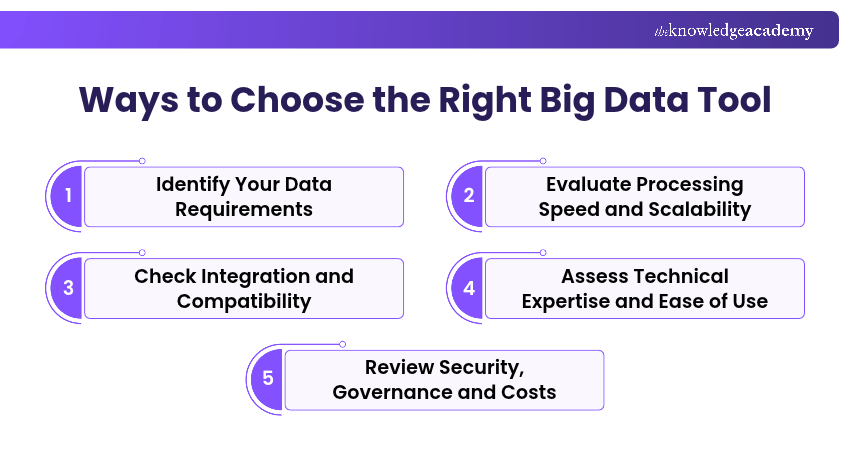
1) Identify Your Data Requirements: Determine whether you need data storage, large-scale processing, event streaming or visualisation. For example, Apache Spark supports distributed processing, while MongoDB manages flexible document data.
2) Evaluate Processing Speed and Scalability: Assess processing requirements and expected data growth. Apache Flink supports continuous event processing, while batch processing suits scheduled workloads.
3) Check Integration and Compatibility: Review supported APIs, connectors and data formats to ensure compatibility with existing databases, cloud services and analytical systems.
4) Assess Technical Expertise and Ease of Use: Consider your team's skills and training needs. Power BI and Tableau offer graphical interfaces, while Apache Spark and Databricks may require specialised expertise.
5) Review Security, Governance and Costs: Evaluate access controls, data protection, licensing, infrastructure and maintenance costs. Open-source tools may reduce licensing expenses but still require operational resources.
Keep This in Mind
Big data tools support different requirements, from distributed processing and event streaming to cloud analytics and reporting. Choosing the right solution depends on your data requirements, technical expertise and existing infrastructure. Compare relevant capabilities and test shortlisted tools using realistic workloads before making a decision.

Vishnu Sankar is a Senior Content Writer with 5+ years of experience across content development, software development, web development and system administration. His technical background and professional training support his expertise in IT and Tech, while his extensive research and writing experience covers Project Management and Health and Safety.
View Detail

 If you wish to make any changes to your course, please


