


We may not have the course you’re looking for. If you enquire or give us a call on 01344203999 and speak to our training experts, we may still be able to help with your training requirements.
Best Personality Development Tips For Everyday Life
ByThe Knowledge AcademyLast updated on: 21 November 2026
These personality development tips show you how to build self-awareness, speak with confidence, and handle everyday interactions with care. Practise simple techniques for listening, asking for feedback, and responding under pressure. Start with one behaviour and track what changes.

Quick Preview
1. Recognise situations that bring out your strengths and identify where you tend to hold back.2. Build confidence in unfamiliar situations by planning your responses and practising in lower-pressure settings.3. Handle disagreements by listening carefully, expressing your views and setting clear boundaries.4. Reflect on your behaviour, seek feedback and use what you learn to make improvements.
Ask three people to describe you, and you might get three different answers.
Someone says you’re decisive because you’re the one who sorts things out when family plans change. A friend says you take ages to choose a film. A colleague says you’re the person who asks the question everyone else is thinking.
Each answer comes from a different setting, with different people and expectations. That makes the differences worth paying attention to. If you can make a quick decision when family plans fall apart, what helps you do that? And could you bring some of that same decisiveness to a situation where you usually hesitate?
Below you will explore top personality development tips that will help your overall growth. Let's get started!
Top Personality Development Tips
Think of a moment in your week that rarely goes the way you’d like. Use the personality development tips below to decide what you can do next time:
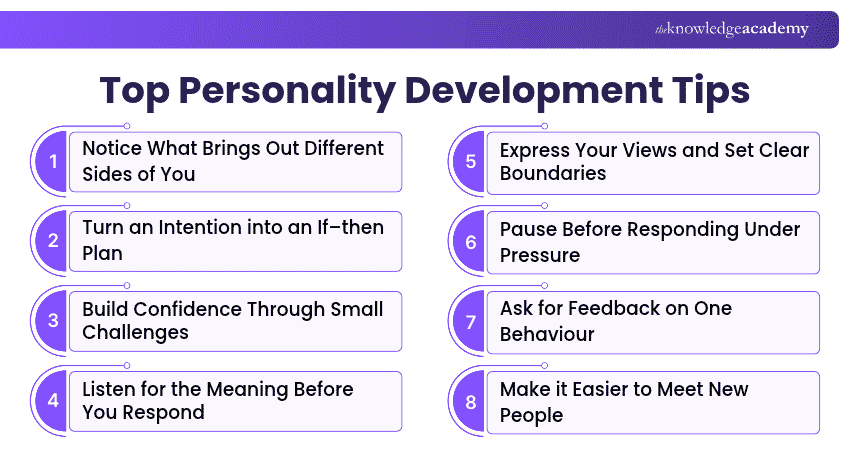
1) Notice What Brings Out Different Sides of You
Think of one situation in which you felt at ease and one in which you held back. Write down who was there, what was happening, and how you responded. You might find that you offer plenty of ideas one-to-one but hesitate when a discussion moves quickly. That gives you a specific situation to work on.

2) Turn an Intention into an If–then Plan
Choose a situation you encounter often and decide in advance how you’ll respond. For example, “If someone asks for suggestions in our weekly meeting, I’ll share one idea from my notes.” This technique, known as an implementation intention, pairs a recognisable cue with a specific action.
3) Build Confidence Through Small Challenges
Take a skill you want to use in a more demanding setting and try it somewhere familiar first. If you want to speak more comfortably in groups, explain a familiar idea to one colleague, give a short update to a small team, then volunteer to lead part of a meeting. Adjust the size of each step to suit your experience.
4) Listen for the Meaning Before You Respond
Let the other person finish, then check if you’ve understood the point that matters most. If a colleague says the handover is difficult, ask, “Is the main issue when you receive the brief or what’s missing from it?” Use their answer to guide what you say next.
Trainer’s insight
Where you raise a concern can matter as much as how you phrase it. If an issue involves someone’s performance, a private conversation gives them space to explain what happened. If the whole group needs to weigh a risk before deciding, raise it while there’s still time to discuss it.
5) Express Your Views and Set Clear Boundaries
Give your recommendation, explain your reason, and leave space for a reply. Try, “I’d move the launch to Thursday so we have time to check the final figures. Would that work for your team?” When you need to set a boundary, be clear about what you can offer. “I can review the first draft today. I’ll need until Friday to review the full report.”
Learn to get your point across and say no respectfully with the Assertiveness Skills Training - Join now!
6) Pause Before Responding Under Pressure
If a message frustrates you, give yourself a moment before replying. Write a draft, then reread it and replace any assumptions about the sender’s intentions with what you know and what you can do next. If a colleague blames you for a delay, you could reply, “I sent the draft on Monday. I’ll check where the handover stalled and update you this afternoon.”
7) Ask for Feedback on One Behaviour
Choose someone who saw you in a specific situation and ask about something they could observe. After a presentation, try, “At what point did the recommendation become clear?” Their answer can help you decide whether to state the recommendation earlier or change how you explain it.
8) Make it Easier to Meet New People
Pick a setting with a shared activity, such as a book group, volunteer session, or professional meetup. Give yourself one modest goal, like introducing yourself to someone and asking what brought them there. If you enjoyed the conversation and agreed to stay in touch, follow up with something you discussed.
9) Explore a Different Perspective
Choose an article, book, or podcast that offers a different view on something you care about. Afterwards, explain the author’s strongest point in your own words. If their reasoning raises a question you hadn’t considered, bring it into your next conversation or decision.
10) Use Non-verbal Communication Thoughtfully
Use your pace, volume, and posture to help people follow what you’re saying. If you’re presenting a recommendation, face the group, slow down as you state it and pause before moving on to your reasons. That brief pause gives people time to absorb the point and respond.
Build a more confident presence in meetings and presentations with the Nonverbal Communication Training – Register now!
11) Show Consideration by Following Through
If you say you’ll send an update on Thursday, keep the commitment or let the person know in advance if the timing has changed. When you make a mistake, acknowledge the effect and explain how you’ll put it right. A message such as “I sent the earlier version, which delayed your review. Here’s the corrected file” makes the next step clear.
12) Track Your Behaviour and Adjust Your Approach
At the end of the week, review one behaviour you practised. Record when you had the chance to use it, what you did and what you’ll change. If you spoke up in one of three meetings and the other two moved on before you could contribute, try making your point earlier in the discussion or asking the organiser to add it to the agenda.
Pro Tip
When reviewing your decisions, consider the values behind them. If two options both seem reasonable, name the value you want your decision to reflect. If two friends ask for help on the same evening, you might honour the commitment you made first or prioritise the person whose need is more urgent. Naming the value helps you explain your choice clearly.

The Knowledge Academy develops accessible learning content across Project Management, IT, Cybersecurity, Data Science, Business Analysis, HR, Accounting and Finance, Leadership and Health and Safety. Its resources combine subject research with clear explanations to help professionals build practical knowledge across a wide range of disciplines.
View Detail

 If you wish to make any changes to your course, please


