


We may not have the course you’re looking for. If you enquire or give us a call on 01344203999 and speak to our training experts, we may still be able to help with your training requirements.
CCNA Exam Tips: 15 Strategies to Prepare for Success
ByThe Knowledge AcademyLast updated on: 14 November 2026
Explore the top CCNA exam tips to understand exam objectives, improve your preparation and approach the examination with confidence.
What You'll Learn
1. Understand the CCNA exam objectives and essential preparation requirements.2. Strengthen your networking knowledge through practical exercises and subnetting.3. Improve configuration and troubleshooting skills using Cisco IOS commands.4. Use practice exams and revision strategies to identify knowledge gaps.5. Build confidence through effective time management and exam-day preparation.
When you sit for your CCNA exam and a networking scenario appears asking you to identify why two devices cannot communicate, remembering definitions isn't enough. It’s about understanding how the network works. That's why effective CCNA preparation goes beyond reading study materials.
The Cisco Certified Network Associate (CCNA) exam tests your understanding of networking concepts and your ability to apply them in practical situations. Whether you're new to networking or looking to validate your existing skills, the right preparation strategies can make a difference.
In this blog, we'll explore practical and effective CCNA exam tips to help you study effectively, strengthen your technical knowledge and approach the exam confidently.
Top CCNA Exam Tips
Preparing for the CCNA exam requires a combination of technical knowledge, hands-on experience and consistent revision. The following CCNA exam tips can help you organise your preparation and improve your networking skills:
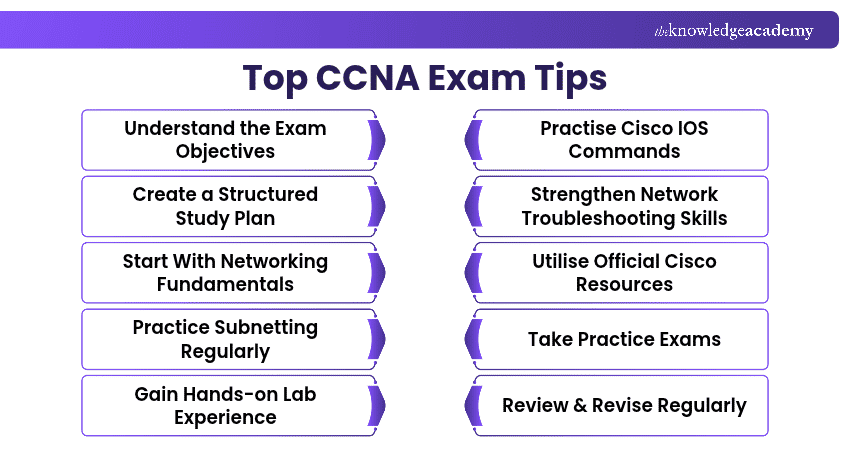
1) Understand the Exam Objectives
Begin your preparation by reviewing the official CCNA exam objectives published by Cisco. These explain the topics and skills you are expected to understand before taking the examination. Identify the major domains, examine their weightages and review the technical requirements under each topic.
For example, IP connectivity requires an understanding of routing decisions, static routes and Open Shortest Path First (OSPF). Knowing these requirements helps you focus on the relevant concepts instead of studying unrelated networking topics.

2) Create a Structured Study Plan
Develop a study plan that outlines the topics you need to cover and the time available before your examination. Divide your preparation into manageable sessions and set specific goals for each week. Include time for learning concepts, completing practical exercises, revising previous topics and taking practice tests.
For example, you could dedicate one week to networking fundamentals, another to switching and VLANs and additional sessions to routing and troubleshooting. A structured schedule helps you maintain consistency and reduces the need for last-minute preparation.
3) Start With Networking Fundamentals
Build a strong understanding of networking fundamentals before progressing to advanced topics. Focus on essential concepts such as the OSI model, TCP/IP, IP addressing, network devices, ethernet and common protocols.
For example, understanding how switches forward frames and how routers make forwarding decisions can help you interpret more complex networking scenarios. A strong foundation makes it easier to understand routing, switching, security and troubleshooting concepts later in your preparation.
4) Practice Subnetting Regularly
Subnetting is an important networking skill that involves dividing IP networks into smaller logical networks. Spend time understanding subnet masks, Classless Inter-Domain Routing (CIDR), network addresses, broadcast addresses and usable host ranges.
Practise calculating subnets manually instead of relying entirely on online calculators. For example, given the network 192.168.10.0/26, try identifying the subnet mask, total number of addresses and usable host range.
Want to ensure that networking meets seamless collaboration? Learn how to achieve it in the CCNP Collaboration Training – Sign up now!
5) Gain Hands-on Lab Experience
Reading networking concepts is useful, but hands-on practice helps you understand how those concepts work in real situations. Use networking tools such as Cisco Packet Tracer, Cisco Modelling Labs or GNS3 to practice configuring devices and troubleshooting network problems.
Focus on tasks such as assigning IP addresses, configuring VLANs, setting up static routes and verifying network connectivity. Hands-on exercises help you connect theoretical knowledge with actual networking operations.
Try This CCNA Practice Lab
Create a small network using Cisco Packet Tracer. Configure two VLANs, assign IP addresses and use a router or Layer 3 switch to enable routing between them. Then use commands such as show vlan brief, show ip interface brief and ping to verify the configuration.
6) Practise Cisco IOS Commands
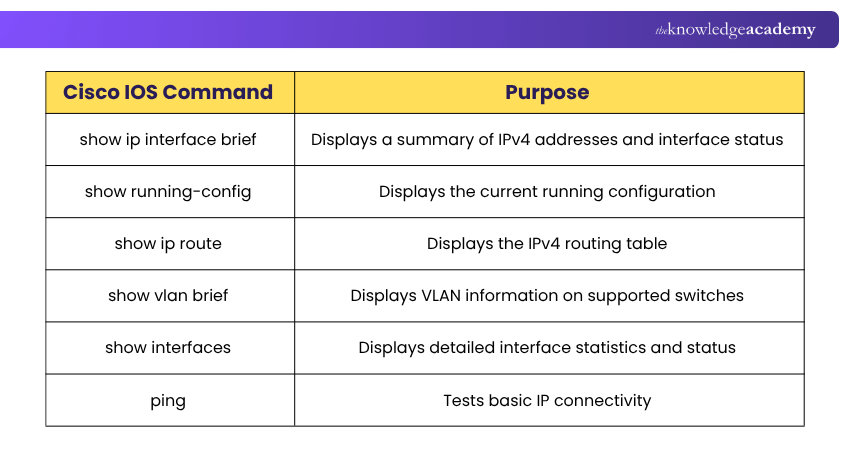
Cisco IOS commands are important for configuring, monitoring and troubleshooting network devices. Become familiar with commands used for interface configuration, routing, VLAN management and network verification.
Some useful commands include:
7) Strengthen Network Troubleshooting Skills
Troubleshooting is an essential part of networking and CCNA preparation. Practise identifying issues involving incorrect IP addresses, disabled interfaces, VLAN mismatches, routing errors and connectivity failures. Instead of changing several settings at once, investigate the network systematically to determine where the problem occurs.
For example, if two devices cannot communicate, check their IP configurations, interface status, VLAN membership and routing information before making changes. This approach helps develop analytical skills that are useful in both the CCNA exam and real-world networking environments.
Pro Tip
When diagnosing a connectivity problem, begin with physical connections and interface status. Then check IP addressing, VLAN assignments and routing configurations. Following a structured approach makes it easier to isolate the issue instead of changing several settings at once.
8) Utilise Official Cisco Resources
Cisco provides learning resources designed to help candidates prepare for certification examinations. Use official exam objectives, Cisco U. learning materials, Cisco Packet Tracer, Cisco Modeling Labs and other official preparation resources to strengthen your knowledge.
These materials help you develop practical networking skills and become familiar with relevant technologies. You can also refer to Cisco documentation when you need more detailed explanations of networking commands, protocols or configuration procedures. Prioritising reliable resources helps you avoid inaccurate or outdated preparation material.
9) Take Practice Exams
Practice exams can help you evaluate your understanding of CCNA topics and become familiar with answering technical questions under time constraints. Take mock tests after studying major domains and review your performance carefully. Also, identify the concepts that require further revision.
For example, if you frequently make mistakes in routing questions, revisit routing tables, next-hop decisions and static route configurations. Practice exams are most useful when combined with technical review and hands-on exercises.
Learn how to simulate real networks and turn troubleshooting into your strength with the GNS3 Training now!
10) Review & Revise Regularly
Regular revision helps reinforce networking concepts and improves long-term knowledge retention. Review important topics after completing each study session and revisit them at planned intervals. Use short notes, diagrams, flashcards and practical exercises to refresh your understanding.
For example, after studying VLANs, revisit their configuration commands and practise verifying them in a lab. Avoid leaving revision until the final days before your examination. Consistent review helps you identify forgotten concepts early and maintain confidence throughout your preparation.
11) Join Study Groups or Forums
Joining CCNA study groups and networking communities can provide additional support during your preparation. It will help clarify difficult topics and introduce different problem-solving approaches. For example, if you struggle to understand OSPF neighbour relationships, discussing a lab scenario with other learners may help you identify mistakes in your configuration.
Cisco's Learning Network and other reputable networking communities can also be useful places to explore technical discussions and preparation advice. However, use official Cisco documentation to verify information when discussions contain conflicting explanations.
12) Stay Updated With CCNA Exam Changes
Cisco periodically updates its certification exams to reflect developments in networking technologies and industry requirements. Check Cisco's official certification pages for announcements about exam versions, revised objectives and examination policies.
For example, CCNA 200-301 v1.1 remains available until 2 February 2027, while v2.0 begins on 3 February 2027. The updated exam places greater emphasis on practical troubleshooting and modern network operations. Using current study materials helps ensure that your preparation matches the exam you intend to take.
13) Improve Time Management
Effective time management helps you work through the examination without spending too long on individual questions. During practice exams, use realistic time limits and observe how much time you spend on different question types.
Networking scenarios and performance-based lab questions may require additional time for analysis or configuration. If you encounter a difficult question, consider the available information carefully and make the best possible decision without allowing it to consume excessive examination time.
Trainer Insight
Cisco's certification exam interface does not allow candidates to return to a previous question after moving forward. Read each question carefully, manage the time spent on lab tasks and avoid rushing through answers with the expectation of reviewing them later.
14) Read Exam Questions Carefully
Reading each question carefully is essential for understanding what is being asked. Pay attention to networking terminology, configuration details and instructions that indicate the expected answer. For example, a question asking you to identify the best route may require you to consider the longest prefix match rather than simply selecting the route with the lowest metric.
Similarly, troubleshooting questions may include information about interface status, VLAN membership or routing configurations. Take time to identify the important details before selecting an answer or making configuration changes.
Learn networking the hands-on way with Cisco Packet Tracer. Sign up for the Cisco Packet Tracer Course now!
15) Stay Calm & Manage Exam Anxiety
Feeling nervous before an important examination is common. However, maintaining a calm and focused approach can help you perform more effectively. Prepare your examination arrangements in advance, understand the testing requirements and ensure you get adequate rest.
During the examination, read questions carefully and concentrate on the task in front of you rather than worrying about previous answers.
Your Final CCNA Preparation Checklist
Before taking the examination, use this checklist to review your readiness.□ Review all applicable Cisco CCNA exam objectives.□ Practise IPv4 and IPv6 addressing and relevant subnetting calculations.□ Complete router and switch configuration exercises.□ Verify configurations using relevant Cisco IOS commands.□ Troubleshoot common networking and connectivity issues.□ Complete timed practice exams and review incorrect answers.□ Familiarise yourself with the examination interface and navigation rules.□ Confirm your examination appointment and identification requirements.

The Knowledge Academy develops accessible learning content across Project Management, IT, Cybersecurity, Data Science, Business Analysis, HR, Accounting and Finance, Leadership and Health and Safety. Its resources combine subject research with clear explanations to help professionals build practical knowledge across a wide range of disciplines.
View Detail

 If you wish to make any changes to your course, please


