


We may not have the course you’re looking for. If you enquire or give us a call on 01344203999 and speak to our training experts, we may still be able to help with your training requirements.
ACCA Exam Tips: How to Prepare and Succeed
ByThe Knowledge AcademyLast updated on: 18 November 2026
Preparing for ACCA exams requires effective study habits, regular question practice and strong exam techniques. Explore 15 practical tips to improve your preparation and approach each exam with confidence.
Quick Overview
1. Prepare for ACCA exams by understanding their structure and assessment requirements.2. Organise your study time and set achievable learning targets.3. Make effective use of past questions, mock exams and computer-based practice tools.4. Interpret exam questions, plan answers and manage your time effectively.5. Strengthen weak areas through focused revision and regular performance reviews.
Struggling to pass your ACCA exams? You're not alone! Every aspiring Accountant faces the pressure of learning a vast syllabus, but with the right approach, success is within reach. From time management to effective study techniques, these tips can help you prepare more effectively.
Whether you're tackling financial reporting, audit and assurance or taxation, applying these techniques can help you improve your understanding and exam performance. Don't leave your success to chance! Explore the ACCA exam tips to develop a more structured approach to your preparation.
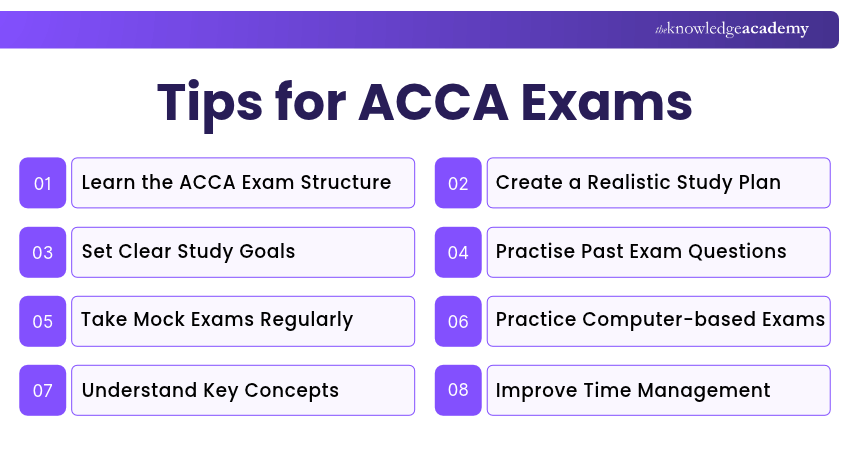
Tips for ACCA Exams
Preparing for ACCA exams requires more than memorising accounting principles and financial concepts. Individuals need to understand the syllabus, practise applying their knowledge and develop effective exam techniques.
A structured preparation strategy can help you manage your studies, identify weaknesses and approach each examination with greater confidence. Here are 15 practical ACCA exam tips to help you prepare effectively and improve your performance.
1) Understand the ACCA Exam Structure and Syllabus
Before beginning your preparation, familiarise yourself with the syllabus, exam format and assessment requirements for your chosen ACCA paper. Review the topics covered, the types of questions included and the marks allocated to different sections.
Understanding these details helps you organise your studies and prepare for the specific demands of the examination. ACCA provides official syllabuses, study guides and specimen exams for individual papers. Always check that the materials correspond to your exam paper, syllabus year and intended sitting.
2) Create a Realistic Study Plan
A realistic study plan helps you cover the syllabus without leaving important topics until the final weeks. Start by calculating the time available before your examination and dividing it into manageable study periods.
Allocate sufficient time for learning concepts, practising questions, revising topics and completing mock exams. Set aside additional time for challenging subjects and include regular breaks to maintain concentration.
3) Set Clear Study Goals
Setting specific study goals gives your ACCA preparation direction and makes progress easier to measure. Instead of planning to study an entire subject in one sitting, break your preparation into smaller objectives. These might include completing a chapter, understanding an accounting concept or answering a set of examination questions.
Establish daily and weekly targets based on your available study time and examination date. Reviewing these targets regularly helps you recognise progress, maintain motivation and identify areas that need additional attention.
4) Practise Past Exam Questions
Practising past examination questions helps you become familiar with the wording, difficulty and practical application of ACCA assessments. It also allows you to identify how accounting principles, financial techniques and professional judgement are tested in different scenarios.
After attempting a question, compare your response with the available resource or suggested answer. Identify any missed requirements, calculation errors or weaknesses in your explanations. Remember that older questions may not reflect current syllabus, legislative or accounting standard changes, so prioritise updated practice materials where available.
5) Take Mock Exams Regularly
Mock exams help you assess how well you can apply your knowledge under examination conditions. Attempt full-length practice assessments within the permitted time, using the appropriate question format and computer-based environment.
This helps you become familiar with exam pressure, improve your concentration and recognise areas where you may need more practice. After completing each mock, review your answers carefully instead of focusing only on the overall score.
6) Develop Computer-based Exam Skills
The ACCA Practice Platform allows individuals to practise exam-style questions in an environment similar to the live computer-based examination. It helps you become familiar with the screen layout, navigation tools, question formats and available response features.
Understanding these functions beforehand can reduce unnecessary difficulties during the actual exam. So, use the platform to practise answering questions, managing your workspace and reviewing your performance.
Evaluate financial reporting processes effectively with Audit and Assurance (AA) Training – Register soon!
7) Focus on Understanding Concepts
Understanding accounting and financial concepts is more effective than simply memorising definitions, formulas or model answers. ACCA examinations assess your ability to apply knowledge to different situations, so you need to understand why particular principles are used and how they influence financial decisions.
For example, when studying financial reporting, focus on how accounting treatments affect financial statements rather than memorising entries without understanding their purpose. This helps you approach unfamiliar examination scenarios with greater confidence.
Common Mistake
Two questions may cover the same topic but require different answers depending on the organisation's circumstances. For example, a recommendation suitable for a large multinational company may not be practical for a small business with limited resources. Candidates should consider the specific context before applying general accounting or business principles.
8) Develop Time Management Skills
Effective time management is essential for completing ACCA examinations within the allocated duration. Individuals must balance reading, calculations, analysis and written responses while ensuring they have sufficient time to attempt the required questions.
Spending too long on one difficult question can limit the marks available from the remaining sections. If a question takes longer than planned, practise moving on and returning to it where the examination format permits. This helps you use your available time more efficiently.
9) Analyse Questions and Plan Answers
ACCA questions often require individuals to interpret business scenarios, analyse financial information and respond to specific instructions. Strong question interpretation skills help you understand exactly what is being asked and avoid including information that does not contribute to the answer.
Pay close attention to instruction words such as explain, calculate, evaluate, discuss and recommend, as they indicate different response requirements. Before answering, identify the marks available, outline the main points to cover and decide how to structure your response.
10) Identify and Improve Weak Areas
Recognising your weaker subjects allows you to focus your study time where it is most needed. Regularly review practice questions, quizzes and mock exam results to identify topics you find difficult. Common weaknesses may include calculation accuracy, understanding accounting standards, interpreting scenarios or completing questions within the available time.
11) Strengthen Your Exam Technique
Exam technique refers to how effectively you apply your knowledge and present answers during an examination. Even when individuals understand the subject, poor answer structure, irrelevant explanations or incomplete calculations can affect their performance.
Developing a clear approach to different question types is therefore an important part of ACCA preparation. Practise presenting calculations with appropriate workings, linking written explanations to the scenario and using the available response tools to organise your answers clearly.
12) Participate in Group Study Sessions
Group study sessions provide opportunities to discuss complex concepts, exchange ideas and learn from other ACCA candidates. Explaining topics to others can also help reinforce your understanding and reveal gaps in your knowledge.
13) Practise Using Available Formulae and Reference Materials
Some ACCA exams provide formulae sheets, mathematical tables or other reference materials during the examination. Familiarise yourself with the specific materials provided for your paper and exam sitting, and practise applying them to exam-style questions.
Understanding when and how to use these resources can help you solve calculations efficiently and focus your revision on formulas and concepts you are expected to know independently.
14) Revise Before the Exam
Regular revision helps reinforce previously studied concepts and reduces the need for intensive last-minute preparation. Rather than revisiting the entire syllabus only a few days before the examination, schedule short revision sessions throughout your study period. This gives you opportunities to revisit challenging topics and strengthen your understanding gradually.
Trainer's Insight
A question can feel easy when you've just reviewed its solution because the method is still fresh in your memory. A better indication of exam readiness is whether you can solve a similar question several days later without looking at notes. This helps distinguish genuine understanding from short-term familiarity.
15) Learn from Your Practice Mistakes
Reviewing mistakes made during practice questions and mock exams helps you understand why certain answers were incorrect. Rather than simply checking the correct answer, examine whether the error resulted from a misunderstanding of concepts, incorrect calculations or poor question interpretation.
Once you identify the reason behind each mistake, focus on understanding the correct approach and applying it to similar questions. Practising these areas again helps reinforce your understanding, improve accuracy and build confidence in handling challenging exam questions.
Prepare compliant and reliable financial reports with the Financial Reporting (FR) Course – Join now!

The Knowledge Academy develops accessible learning content across Project Management, IT, Cybersecurity, Data Science, Business Analysis, HR, Accounting and Finance, Leadership and Health and Safety. Its resources combine subject research with clear explanations to help professionals build practical knowledge across a wide range of disciplines.
View Detail

 If you wish to make any changes to your course, please


