


We may not have the course you’re looking for. If you enquire or give us a call on 01344203999 and speak to our training experts, we may still be able to help with your training requirements.
Home
 Resources
Project Management
Top 10 Project Scheduling Techniques Every Project Manager Should Know
Resources
Project Management
Top 10 Project Scheduling Techniques Every Project Manager Should Know
Top 10 Project Scheduling Techniques Every Project Manager Should Know
ByThe Knowledge AcademyLast updated on: 10 November 2026
Effective project scheduling starts with the right techniques. Check how different approaches help Project Managers organise tasks, manage timelines and meet deadlines.

The Rundown
1. Project scheduling techniques help Project Managers organise activities, resources, dependencies and deadlines.2. The critical path method identifies the sequence of dependent activities that determine the project's earliest completion date.3. PERT and Monte Carlo simulation help assess uncertainty in project duration estimates.4. Resource levelling and resource smoothing help manage resource availability and workload distribution.5. Fast-tracking and crashing can shorten project schedules but involve different risks and trade-offs.
Ever managed a project where deadlines seem to move faster than the work itself? One delayed task can disrupt an entire timeline, leaving Project Managers juggling resources, priorities and expectations. This is where project scheduling techniques make a difference, turning complex activities into organised and manageable plans.
Imagine knowing which tasks need immediate attention, where resources are stretched and how potential delays could affect delivery. With the right project scheduling techniques, you can plan more effectively and respond to changing requirements. In this blog, we'll explore 10 techniques that can help you create realistic schedules and keep projects moving forward. Let's dive in!
Top Project Scheduling Techniques
Different projects require different approaches to scheduling. Some techniques help identify critical activities, while others focus on resource allocation, uncertainty or reducing project duration. Here are 10 important project scheduling techniques that every Project Manager should know:
1) Critical Path Method (CPM)
The Critical Path Method (CPM) is a scheduling technique used to identify the longest sequence of dependent activities that determines the earliest possible project completion date based on estimated durations and activity dependencies. It helps Project Managers understand which activities are critical to maintaining the planned finish date.
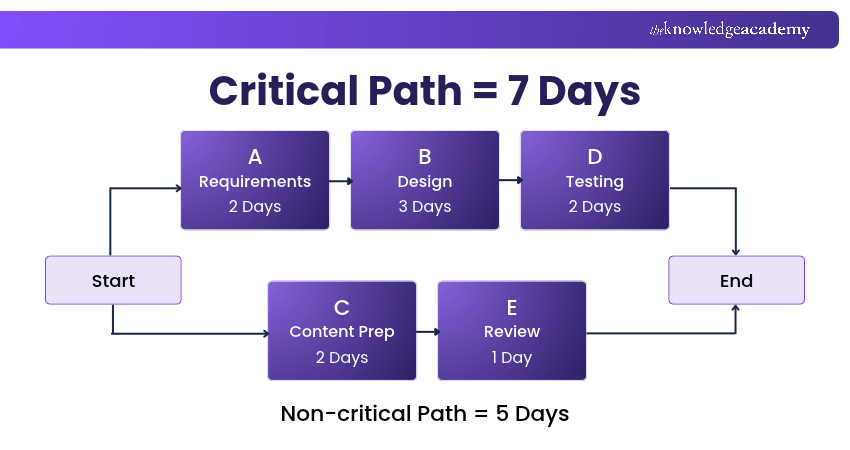
Consider a project with two possible paths. The first path includes requirements (2 days), design (3 days) and testing (2 days), taking 7 days in total. The second path includes requirements (2 days), content preparation (2 days) and review (1 day), taking 5 days.
Since the first path takes longer, it becomes the critical path, determining the project's minimum completion time of 7 days. The second path has 2 days of float, meaning it can be delayed by up to 2 days without affecting the overall project completion date, assuming no other constraints change.

2) Gantt Chart
A Gantt Chart is a visual scheduling technique that displays project activities as horizontal bars along a timeline. Each bar represents an activity's planned duration, making it easier to understand when work should begin and finish. Gantt Charts can also show task dependencies, milestones and progress.
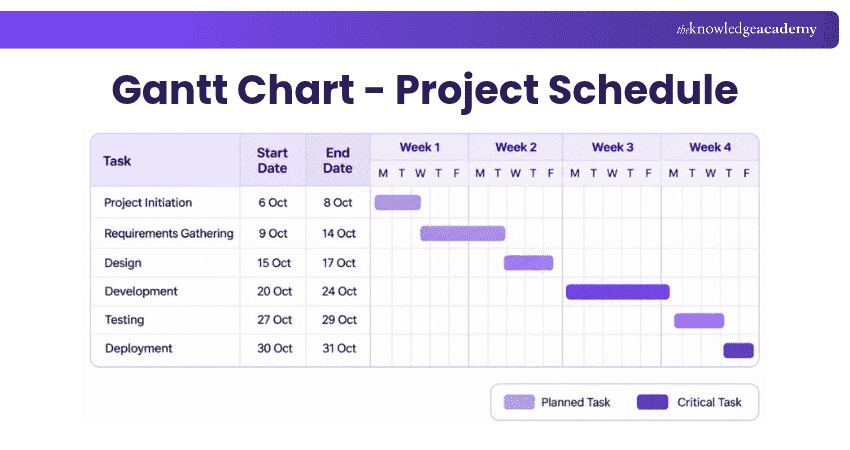
For example, a software development team can use a Gantt Chart to schedule activities from project initiation and requirements gathering to design, development, testing and deployment. This helps the team visualise timelines, coordinate tasks and monitor progress. Gantt Charts can be created using spreadsheets or project management software, depending on the project's complexity and reporting requirements.
3) Program Evaluation and Review Technique (PERT)
The Program Evaluation and Review Technique (PERT) helps estimate activity durations when there is uncertainty about how long tasks may take. PERT uses three duration estimates:
a) Optimistic (O): The shortest reasonable duration under favourable conditions.
b) Most Likely (M): The duration expected under normal conditions.
c) Pessimistic (P): The longest reasonable duration under unfavourable conditions.
The traditional PERT expected-duration formula is:

For example, if an activity has an optimistic duration of 4 days, a most likely duration of 6 days and a pessimistic duration of 10 days:

This estimate can support activity scheduling and broader project duration analysis when combined with the activity dependency network.
PERT is particularly useful for projects involving uncertain activity durations, such as research, product development and complex technical work.
4) Monte Carlo Simulation
Monte Carlo Simulation is a quantitative scheduling technique used to analyse how uncertainty may affect project completion dates. Instead of relying on a single duration estimate, it uses probability distributions and repeated simulations to generate a range of possible schedule outcomes.
For example, a Project Manager estimates that software development activities could take between 10 and 20 days. Monte Carlo Simulation runs thousands of possible schedule scenarios using probability-based duration estimates to calculate the likelihood of meeting a deadline. The results help the team assess schedule risks and set realistic completion targets.
Trainer's Insight
A schedule may indicate a particular completion date, but that does not mean the project will finish on that day. When uncertainty is significant, use schedule risk analysis to communicate possible completion dates and their probabilities rather than relying on one optimistic estimate.
5) Critical Chain Method
The critical chain method is a scheduling approach that considers both activity dependencies and resource constraints when developing a project schedule. Unlike traditional critical path analysis, which primarily focuses on activity sequences, critical chain scheduling considers how limited resources affect when work can be performed.
It uses strategically placed time buffers to protect the project completion date against delays. Project buffers protect the final delivery date, while feeding buffers help prevent delays on non-critical activity chains from affecting the critical chain.
For example, a software development team might include a project buffer after its final scheduled activity to absorb unexpected delays in development or testing without immediately affecting the committed delivery date.
Master the skills to create realistic schedules and keep projects moving toward success. Sign up for the Effective Planning and Scheduling Course – Sign up now!
6) Resource Levelling
Resource levelling is a technique used to resolve situations where resources are overallocated or unavailable when required. It involves adjusting activity start and finish dates based on resource constraints. As a result, the project schedule may change, and the overall completion date may be extended.
For example, if two construction activities require the same crane simultaneously, resource levelling can reschedule one activity until the crane becomes available, preventing overallocation and creating a feasible work schedule.
7) Resource Smoothing
Resource smoothing helps Project Managers adjust activities to achieve a more balanced use of resources without changing the project's completion date or violating specified schedule constraints. It typically involves moving activities within their available float to reduce peaks and gaps in resource demand.
For example, if several non-critical activities require additional staff during the same week, some tasks may be rescheduled within their available float to distribute the workload more evenly. Unlike resource levelling, resource smoothing preserves the required project completion date by adjusting work within available scheduling flexibility.
What Makes up a Project Schedule?
A project schedule combines several elements to create a practical timeline. These include:1. Tasks and Activities: The work required to complete project deliverables.2. Durations: The estimated time needed to complete each activity.3. Dependencies: Relationships that determine the sequence of project tasks.4. Milestones: Significant events or achievements within the project timeline.5. Resources: People, equipment and materials required to perform activities.6. Constraints: Restrictions that influence when activities can start or finish.7. Schedule Baseline: The schedule’s approved version used to measure performance.8. Project Calendars: Working days, holidays and resource availability considered during scheduling.9. Schedule Contingency: Time allowances, where appropriate, to address identified schedule uncertainty.
8) Fast-tracking
Fast-tracking is a schedule compression technique that reduces project duration by overlapping activities that would normally be performed sequentially. For example, a software development team might begin testing completed modules while development continues on other modules, rather than waiting for all development work to finish.
This approach can shorten the overall project schedule without necessarily increasing resource costs. However, overlapping activities may increase coordination challenges and the risk of rework. Fast-tracking is most suitable when activities can safely overlap and the potential risks are understood.
9) Crashing
Crashing is another schedule compression technique that aims to shorten project duration by allocating additional resources or incurring extra costs. For example, a construction project may employ additional workers or use extra equipment to accelerate activities that affect the project's completion date.
Project Managers must evaluate whether the time saved justifies the additional expense. Crashing is generally applied to critical activities where extra resources can realistically reduce the duration. However, adding more resources does not always make an activity faster.
Here's a quick summary of the differences between fast-tracking and crashing:
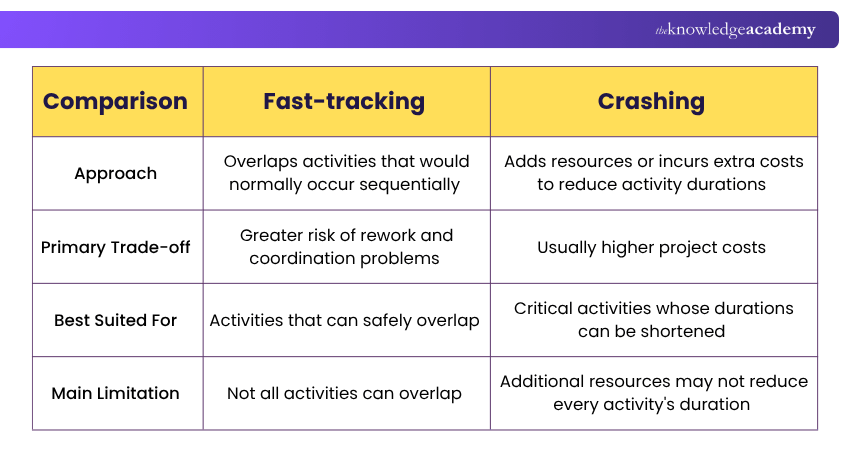
Both techniques can reduce project duration, but the right choice depends on activity dependencies, available resources, costs and acceptable risks.
10) Milestone Scheduling
Milestone scheduling focuses on identifying and tracking significant points or events throughout a project, typically represented as zero-duration milestones in a detailed schedule. Instead of presenting every activity in detail, it highlights important dates such as approvals, phase completions, product launches and final deliveries.
For example, a website development project may include milestones for design approval, development completion, testing approval and website launch. This approach is particularly useful for communicating progress to stakeholders and monitoring major project commitments.
Manage complex projects through structured planning with Project Planning and Control™ (PPC) Foundation and Practitioner Course – Join now!

The Knowledge Academy develops accessible learning content across Project Management, IT, Cybersecurity, Data Science, Business Analysis, HR, Accounting and Finance, Leadership and Health and Safety. Its resources combine subject research with clear explanations to help professionals build practical knowledge across a wide range of disciplines.
View Detail

 If you wish to make any changes to your course, please


