


We may not have the course you’re looking for. If you enquire or give us a call on 01344203999 and speak to our training experts, we may still be able to help with your training requirements.
Top Machine Learning Techniques You Should Know
ByRichard HarrisLast updated on: 17 September 2026
Choosing the right machine learning technique starts with knowing what each approach is designed to do. Explore popular methods and their role in analysing data and solving problems.

INPUT: Data
TASK: Find useful patterns
METHOD: __________
OUTPUT: Prediction / Class / Cluster / Insight
That blank is where the machine learning technique comes in. Different methods learn from data differently, and selecting one depends largely on the problem you are trying to solve. From regression to neural networks, let’s look at the techniques that can fill that blank.
What are Machine Learning Techniques?
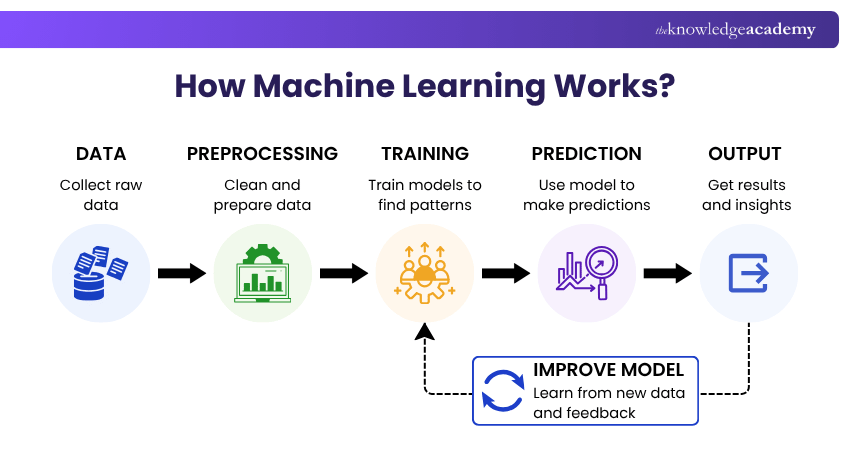
Machine Learning (ML) techniques are methods and approaches used to learn patterns from data and solve particular types of problems. Rather than programming every possible rule manually, machine learning models use data to learn relationships that can subsequently support predictions, classifications or other outputs.
For example, an organisation might want to determine whether a transaction appears suspicious. Classification could be used when labelled examples of known classes are available, while anomaly detection could help identify transactions that differ substantially from established patterns.

Top Machine Learning Techniques
Different machine learning techniques solve different types of problems. Some predict values, some classify data and others discover structures that were not previously known. Let’s explore these techniques in detail:
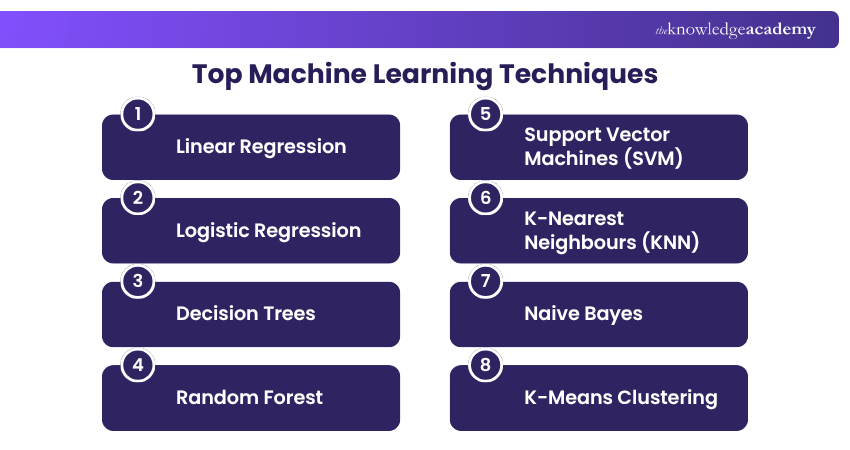
1) Linear Regression
Linear regression is a supervised learning technique used to model relationships between variables and predict a continuous numerical value. It is commonly used for:
a) Sales forecasting
b) Price estimation
c) Demand prediction
d) Trend analysis
Example: Predicting prices of houses based on factors such as property size and location.
Pro Tip
Start with a simple baseline before moving towards more complex models. It gives you a useful reference for determining whether additional complexity actually improves performance.
2) Logistic Regression
Despite what the name suggests, logistic regression is used primarily for classification rather than predicting continuous values. It estimates the probability of an observation belonging to a particular class and can be used for binary classification problems.
Common applications include:
a) Spam detection
b) Customer churn prediction
c) Risk classification
d) Fraud detection
Example: Predicting whether an email should be classified as spam or not spam.
3) Decision Trees
Decision trees use a tree-like structure to make predictions by splitting data according to selected features. Each internal node represents a decision based on a feature, while the branches lead towards different outcomes or predictions. Decision trees can be employed for both classification and regression.
Example: Predicting whether a customer is likely to leave a service based on factors such as usage patterns, account information and previous interactions.
4) Random Forest
Random forest refers to an ensemble learning method that combines predictions from multiple decision trees. Instead of depending on a single tree, it builds multiple trees using randomness in the training process and combines their outputs. This can improve predictive performance and reduce the tendency of an individual decision tree to overfit.
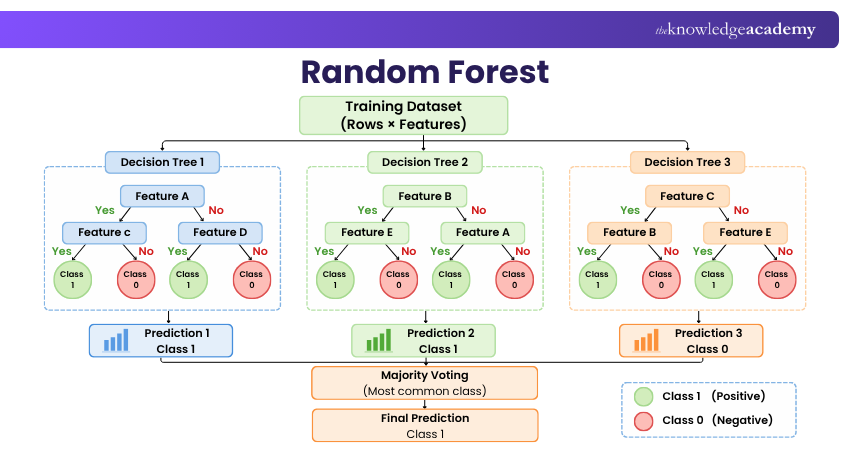
Example: Assessing credit risk using information such as financial history, income and other relevant variables.
5) Support Vector Machines (SVM)
Support Vector Machines are supervised learning methods commonly used for classification. An SVM attempts to find a decision boundary that separates classes while maximising the margin between selected training observations and that boundary. Kernel methods can also enable SVMs to model non-linear decision boundaries.
Common applications include:
a) Text classification
b) Image classification
c) Pattern recognition
Example: Classifying documents into predefined categories based on their features.
Gain hands-on experience with Python libraries and machine learning algorithms with Python with Machine Learning Training – Sign up now!
6)K-Nearest Neighbours (KNN)
K-Nearest Neighbours predicts an outcome based on nearby labelled examples in the feature space. For classification, it typically examines the K nearest observations and uses their classes to determine the predicted class. KNN can also be adapted for regression.
Example: Classifying a new item according to the characteristics of similar labelled items.
Pro Tip
Feature scaling can be important with KNN because its predictions depend on distances between data points. Features measured on very different scales can disproportionately affect those distances.
7) Naive Bayes
Naive Bayes is a probabilistic classification method based on Bayes’ theorem. It generally assumes that each feature contributes independently to predicting a particular class. It is particularly well known for text-based classification tasks. Common applications include:
a) Spam detection
b) Sentiment classification
c) Document categorisation
Example: Classifying a customer review as positive or negative based on the words it contains.
8) K-Means Clustering
K-Means is an unsupervised clustering technique that divides data into a specified number of clusters. It repeatedly assigns observations to the nearest cluster centre and updates those centres until the process converges. Common applications include:
a) Customer segmentation
b) Pattern discovery
c) Grouping similar observations
Example: Dividing customers into groups according to similarities in their purchasing behaviour.
9)Artificial Neural Networks (ANN)
Artificial Neural Networks consist of interconnected computational units organised into layers. They learn by adjusting parameters during training to model relationships between inputs and outputs. ANNs can represent complex, non-linear patterns and can be applied to tasks such as:
a) Classification
b) Regression
c) Pattern recognition
d) Image and speech processing
Example: Recognising patterns within speech or image data.
Transform Excel into a powerful tool for data analysis and predictive insights with AI and ML with Excel Training – Join now!
10) Deep Learning
Deep learning is a crucial subfield of machine learning based around neural networks with multiple layers that learn increasingly useful representations from data. Deep learning has become particularly important for processing high-dimensional data like images, audio and text.
Common applications include:
a) Image recognition
b) Speech recognition
c) Natural Language Processing (NLP)
d) Autonomous driving perception
e) Generative AI systems
Example: A computer vision system can use deep learning to identify objects within images captured by cameras.
Before choosing an ML technique, ask:
What exactly am I trying to predict or discover? Is the desired output numerical, categorical or undefined? Do I have labelled or unlabelled data? How much relevant training data is available? Is model interpretability important? Which evaluation metric represents success? What computational resources are available? How will model performance be monitored?
Applications of Machine Learning
Machine learning techniques become useful when they are applied to real-world problems. Now, let’s explore the applications of ML:
1) Recommendation Systems
Recommendation systems analyse user behaviour to suggest relevant items. Collaborative filtering can use similarities between users and their behaviour, while content-based filtering recommends items according to item characteristics and previous user preferences
2) Fraud Detection and Cyber Security
Machine learning can help identify unusual activity within financial transactions and computer networks. Models can analyse historical patterns and flag activity that differs from expected behaviour for further investigation.
3) Healthcare and Medical Diagnosis
Machine learning models can analyse patient records, medical images and other information to identify patterns that may support diagnosis or prediction. Computer vision can support medical image analysis, while predictive models can help identify patterns associated with outcomes.
4) Autonomous Vehicles
Machine learning can process information from cameras, radar, LiDAR and other sensors used in autonomous and driver-assistance systems. Models can contribute to object detection and the interpretation of aspects of road environments.
5) Finance
ML can analyse financial data for tasks such as fraud detection, risk analysis and market-data analysis. Models can identify patterns and relationships within large datasets to support financial analysis and decision-making.
6) Drug Discovery and Pharmaceutical Research
Machine learning can support drug discovery by analysing chemical structures, molecular interactions and biological information. Models can help researchers prioritise potential drug candidates for further investigation.
7) Social Media Analysis
Machine learning can analyse large quantities of social media information to support:
a) Sentiment Analysis: Determines whether opinions expressed in posts, comments and reviews are positive, negative or neutral.
b) Trend Identification: Detects emerging topics, hashtags and patterns in social media conversations.
c) Content Recommendations: Suggests relevant posts, videos or other content based around user interests and previous interactions.
d) Spam Detection: Identifies potentially unwanted, repetitive or suspicious content using patterns within social media data.
e) Social Listening: Monitors online conversations and mentions to help organisations understand audience feedback, interests and emerging discussions.
8) Energy and Resource Management
ML can analyse energy consumption and predict future demand. Models can process data from smart meters, sensors and historical consumption records to support load forecasting and energy distribution. They can also contribute to forecasting renewable energy generation.
9) Weather Forecasting
Machine learning can analyse historical weather information, satellite imagery and atmospheric data to identify patterns relevant to weather prediction. These applications can support areas such as agriculture, transportation, energy and disaster preparedness.
Stay ahead of the curve in the unstoppable AI revolution with our range of Artificial Intelligence Courses – Sign up now!

Richard Harris creates technically detailed yet accessible content on full-stack development, software architecture and modern development frameworks. His knowledge of frontend and backend technologies helps developers understand how scalable, efficient and high-performing applications are designed and built.
View Detail

 If you wish to make any changes to your course, please


