


 Top Rated Course

We may not have the course you’re looking for. If you enquire or give us a call on 01344203999 and speak to our training experts, we may still be able to help with your training requirements.
Data Science Techniques: Methods and Key Approaches
The Knowledge Academy 29 August 2026Data Science Techniques help professionals analyse data, uncover patterns and build models for prediction and decision-making.

Training Outcomes Within Your Budget!
We ensure quality, budget-alignment, and timely delivery by our expert instructors.
Table of Contents
Key Takeaways
1) Data Science Techniques help transform raw data into patterns, predictions and useful insights.2) Different techniques serve different purposes, from predicting values and classifying outcomes to discovering groups and analysing text.3) Supervised, unsupervised, semi-supervised and reinforcement learning represent different approaches to Machine Learning.4) Choosing an appropriate technique depends on the problem, available data and required output.5) Real-world Data Science projects can combine multiple techniques to address complex problems.
Think about an online store with thousands of customers. The key questions might be:
a) How much will customers spend next month?
b) Which customers have similar buying habits?
The first may call for regression, while the second could be explored using clustering. Same data, different questions and different techniques.
That is what makes Data Science Techniques so important. From Regression Analysis and clustering to Natural Language Processing and Deep Learning, each technique helps illuminate a different kind of insight.
What are Data Science Techniques?
Data Science Techniques are methods and approaches used to collect, process, analyse and interpret data to uncover useful information, identify patterns or build predictive models. They range from statistical approaches such as Regression Analysis and Time Series Analysis to Machine Learning methods such as Decision Trees, clustering and Neural Networks.
Other areas, including Natural Language Processing, focus on particular forms of data such as human language. The appropriate technique depends on factors such as the problem being addressed, the type and quality of data available and the required outcome.

Key Data Science Techniques
Data Science includes numerous techniques for solving different analytical problems. Some are designed to predict outcomes, while others identify patterns, reduce complexity or analyse particular types of information. Here are some important Data Science Techniques:
1) Regression Analysis
Regression Analysis models relationships between variables and is commonly used when the objective involves estimating or predicting a numerical value. For example, a business might analyse historical sales, pricing and other relevant variables to estimate future sales. Different regression methods can be selected depending on the data and analytical requirements.
2) Classification
Classification involves assigning data to predefined categories based on patterns learned from labelled examples. It can be used for problems such as identifying whether an email is spam, classifying customer enquiries or determining whether a transaction shows characteristics associated with fraud.
3) Clustering
Clustering groups data points according to similarities without requiring predefined category labels. Businesses can use clustering for customer segmentation, grouping products with similar characteristics or exploring patterns within large datasets. Different clustering algorithms define similarity and groups in different ways.
4) Decision Trees and Random Forests
Decision Trees use a tree-like structure of decisions to perform classification or regression tasks. Their structure can also make the reasoning behind predictions relatively easy to interpret in many situations.
Random Forests combine multiple decision trees and aggregate their outputs. This approach can improve predictive performance and reduce some of the instability associated with relying on a single tree.
DID YOU KNOW?
Behavioural Data Science merges Psychology, Behavioural Science and advanced analytics to understand and predict human actions. It studies not only consumer behaviour but also how humans, algorithms and systems interact.
5) Dimensionality Reduction
Datasets can contain large numbers of variables, some of which may be redundant or contribute limited useful information. Dimensionality Reduction techniques transform or reduce the number of dimensions while attempting to retain important structure or information. They can support visualisation, exploratory analysis and more efficient modelling.
6) Time Series Analysis
Time Series Analysis focuses on observations recorded over time. It examines patterns such as trends and seasonality and can support forecasting when appropriate. Common applications include analysing sales, demand, financial indicators and other time-dependent measurements.
7) Natural Language Processing
Natural Language Processing (NLP) focuses on computational methods for working with human language. NLP techniques can support tasks such as sentiment analysis, text classification, information extraction, translation and conversational applications.
8) Neural Networks and Deep Learning
Neural Networks refer to computational models made up of interconnected processing units. They can learn complex relationships within data. Deep Learning employs neural networks with multiple layers and is widely applied to complex data such as images, audio and text. These models can be powerful but may require substantial data and computational resources depending on the task.
Uncover the power hidden within your data with our comprehensive Data Mining Training – Sign up now!
9) Association Rule Mining
Association Rule Mining identifies relationships and co-occurrence patterns among items or variables within datasets. A common example is market basket analysis, where businesses analyse which products frequently appear together in transactions. These relationships can support merchandising, recommendation and cross-selling decisions.
10) Recommender Systems
Recommender Systems aim to identify items that may be relevant to individual users. They can use information such as user behaviour, item characteristics and similarities between users or products. Common applications include recommending products, films, music or other content.
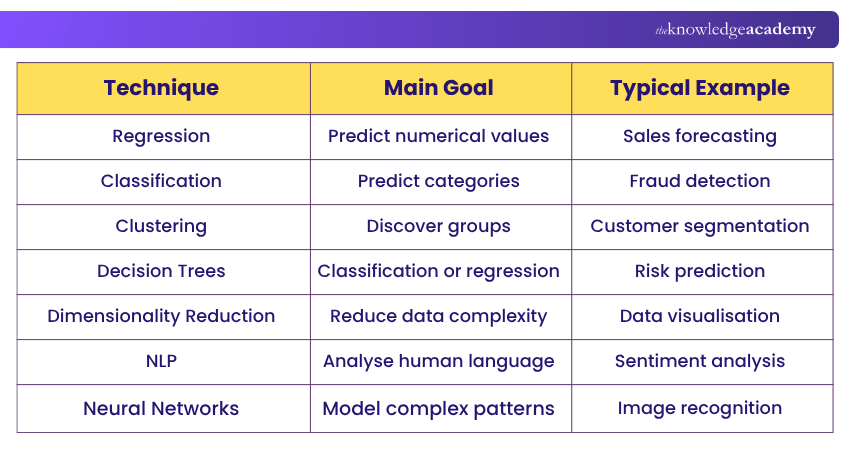
Here are the Data Science Techniques at a glance:
Machine Learning Approaches Used in Data Science
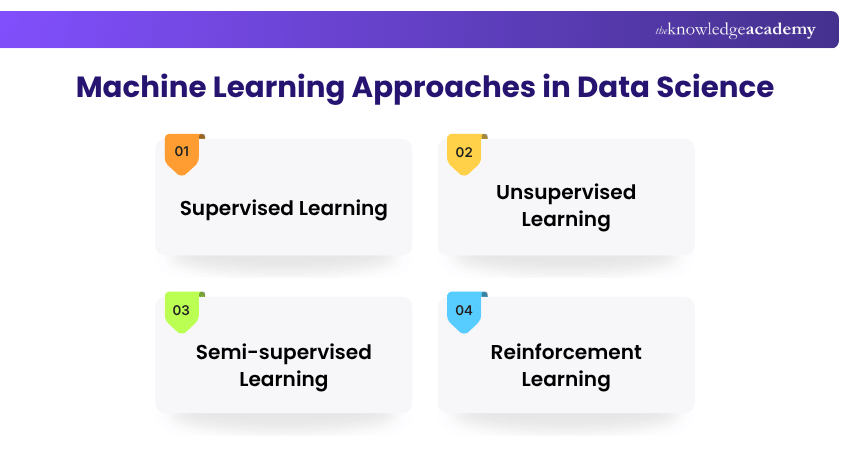
Machine Learning approaches describe different ways models can learn from data. Understanding these approaches can help clarify how individual Data Science Techniques fit into a broader analytical process:
1) Supervised Learning
Supervised Learning uses labelled training data where examples are paired with known outputs. The model learns relationships between inputs and outputs so that it can make predictions for new data. Regression and classification are common supervised learning tasks.
2) Unsupervised Learning
Unsupervised Learning works with data that does not contain predefined output labels. Instead of predicting known categories, the algorithm searches for structures or patterns within the data. Clustering is a common example of an unsupervised approach.
3) Semi-supervised Learning
Semi-supervised Learning combines labelled and unlabelled data during model development. It can be useful when unlabelled data is readily available but obtaining enough reliable labels is expensive or time-consuming.
4) Reinforcement Learning
Reinforcement Learning involves an agent learning how to make decisions through interactions with an environment. The agent gains feedback in the form of rewards and uses this information to learn a strategy for selecting actions over time.
Pro Tip
Don't confuse a learning approach with an individual technique. Supervised learning describes learning from labelled examples, while tasks such as regression and classification can be performed within that approach.
Explore the power of Blockchain technology in the field of Data Science with our comprehensive Data Science and Blockchain Training - join now!
How to Choose the Right Data Science Technique?
There is no single technique that is best for every Data Science problem. The choice should begin with the question you want to answer and the type of data available. Consider the following factors:
1) Objective: Determine whether you want to predict a value, classify an outcome, discover groups, analyse language or identify another type of pattern.
2) Data Type: Consider whether your data is numerical, categorical, textual, image-based, time-dependent or a combination of different formats.
3) Availability of Labels: Determine whether historical examples already contain known outcomes. This can influence whether supervised or unsupervised approaches are appropriate.
4) Dataset Size and Quality: The amount, completeness and reliability of available data can affect which methods are practical.
5) Interpretability: Some situations require users to understand how a model reached its output, while others may prioritise predictive performance.
6) Computational Requirements: Complex models may require more processing power, time and technical resources.
7) Evaluation: Decide how you will measure whether the selected approach actually performs well for the intended problem.
Trainer Insight
A more sophisticated model is not automatically a better model. Consider predictive performance alongside interpretability, computational requirements, available data and the consequences of incorrect predictions.
Real-world Applications of Data Science Techniques
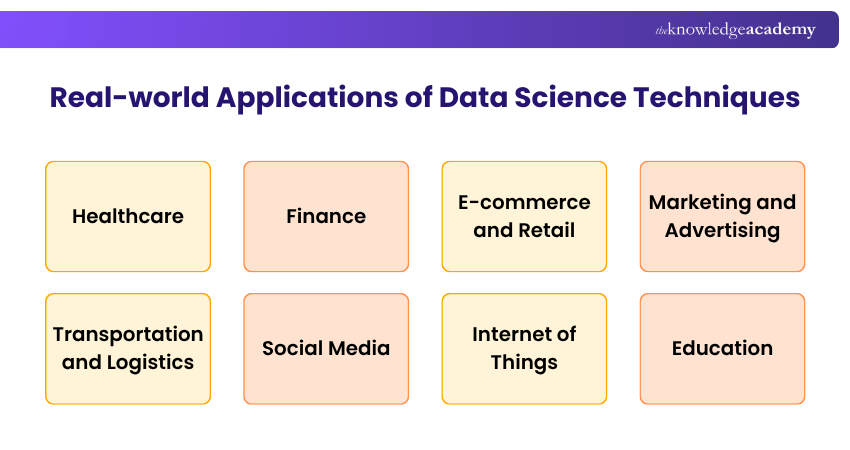
Data Science Techniques are applied across industries to understand information, automate analytical tasks and support decisions. The technique used depends on the problem and available data:
1) Healthcare
Data Science can support areas such as medical research, resource planning and analysis of clinical or medical data. Machine Learning and NLP can be used to analyse medical records, while Deep Learning can support medical image analysis. Predictive approaches may also help identify patterns associated with patient risks or resource requirements.
2) Finance
Financial organisations use Data Science Techniques for areas such as risk assessment, fraud detection and financial forecasting. Classification and anomaly-detection approaches can help identify unusual transaction patterns, while Time Series Analysis can be used to study financial data recorded over time.
KEY INSIGHT
The Banking, Financial Services and Insurance (BFSI) industry segment is holding 45.40% share of the Data Science market in 2026
3) E-commerce and Retail
Retail and e-commerce businesses can use Data Science to understand purchasing behaviour and personalise customer experiences. Recommender Systems can suggest relevant products, clustering can support customer segmentation and Association Rule Mining can identify products that are frequently purchased together.
4) Marketing and Advertising
Data Science can help marketers understand audiences and evaluate campaign performance. Clustering can segment customers with similar characteristics, while NLP can analyse customer comments and reviews. Statistical experiments such as A/B testing can also help compare different marketing approaches.
5) Transportation and Logistics
Data Science can support route planning, demand forecasting and predictive maintenance within transportation and logistics. Time Series Analysis can help forecast demand, while predictive models can analyse equipment or sensor data to identify patterns associated with potential failures.
6) Social Media
Social media platforms generate large volumes of text, behavioural and interaction data. Text mining and NLP can be used to analyse posts and comments, while sentiment analysis can help identify patterns in expressed opinions. Other analytical methods can help organisations study engagement and emerging trends.
7) Internet of Things
Internet of Things (IoT) devices continuously generate information through sensors and connected equipment. Data Science Techniques can analyse these data streams for monitoring, anomaly detection, forecasting and predictive maintenance across industrial systems, connected environments and other IoT applications.
8) Education
Educational institutions can use Data Science to analyse learning and performance data. Analytical and predictive models can help identify patterns in student progress and support educators in recognising where additional intervention may be useful.
9) Gaming and Entertainment
Gaming and entertainment platforms can analyse user behaviour to understand engagement and preferences. Recommender Systems can personalise content, while clustering can identify groups with similar behaviour. Game Developers can also analyse player data to understand how users interact with different mechanics and features.
Pro Tip
Evaluate a technique using measures that reflect the real objective. A model may perform strongly according to one statistical metric while still being unsuitable for the business or operational decision it needs to support.
One Problem Can Require Multiple Techniques
Consider a manufacturing company trying to improve product quality and reduce production disruptions. It might use:
a) Classification to identify products that are likely to fail quality checks
b) Clustering to discover recurring patterns among different types of production defects
c) Anomaly detection to identify unusual machine or production behaviour
d) Time series analysis to forecast production volumes and changing operational patterns
This shows why real-world Data Science often combines several techniques. The challenge is not simply knowing individual algorithms but understanding how different methods can work together to address different parts of the same problem.
Conclusion
Data Science Techniques provide different ways to explore data, uncover patterns and build models for prediction and analysis. From Regression Analysis and clustering to NLP, Time Series Analysis and Deep Learning, each technique serves a different purpose. Choosing an appropriate method begins with understanding the problem, data and desired outcome.
Level up your data skills with our comprehensive Data Science Courses – register now!
Frequently Asked Questions
What are the Five Stages of Data Science?

The five core stages of Data Science are capturing data, maintaining and cleaning it, processing and exploring it, analysing and modelling it, and communicating the final results. These steps turn raw facts into clear choices.
What is the Difference Between AI and Data Science?
Data Science focuses on collecting, cleaning, and analysing data to find hidden patterns and guide human decisions. Artificial intelligence (AI) builds systems that can think, learn, and make decisions on their own without constant human help. In short, Data Science reads and explains data, while AI acts on it.
What is the Difference Between Classification and Clustering?
Classification typically uses labelled data to assign observations to predefined categories. Clustering generally works without predefined labels and identifies groups based on similarities within the data.
Are Complex Data Science Models Always More Accurate?
Not necessarily. Model performance depends on the problem, data, assumptions, training and evaluation. A simpler model may sometimes perform sufficiently while also being easier to interpret, maintain and deploy.

The Knowledge Academy


Global Training Provider
The Knowledge Academy is a world-leading provider of professional training courses, offering globally recognised qualifications across a wide range of subjects. With expert trainers, up-to-date course material, and flexible learning options, we aim to empower professionals and organisations to achieve their goals through continuous learning.


 If you wish to make any changes to your course, please


