


We may not have the course you’re looking for. If you enquire or give us a call on 01344203999 and speak to our training experts, we may still be able to help with your training requirements.
25 Essential Technical Skills and How to Develop Them
ByThe Knowledge AcademyLast updated on: 14 November 2026
Technical skills are practical abilities that help professionals use specialised tools, systems and methods to complete specific tasks. This blog explores 25 essential technical skills across industries, with practical examples and guidance on developing them for different career paths.

At a Glance
1. IT and Software Skills: Programming, software engineering, DevOps, cybersecurity and cloud computing support digital systems.2. Data and AI Skills: Machine learning, data science and visualisation help professionals analyse information and develop solutions.3. Design and Engineering Skills: CAD, graphic design and robotics involve specialised technologies and technical processes.4. Business and Industry Skills: Financial modelling, healthcare systems, HRIS and marketing tools support specific business functions.5. Skill Development: Practical projects, structured learning and regular feedback help turn technical knowledge into workplace abilities.
What can you actually do with technology?
You might know Python, recognise a financial dashboard or use design software. But can you write a program, interpret financial data or create a design that meets specific requirements?
That's the difference between knowing about technology and having the skills to apply it.
Technical skills help professionals apply specialised knowledge to complete tasks, solve problems and achieve practical results across industries.
So, which Technical Skills matter most for your career? Let's explore 25 important skills, their applications and real-world examples.
25 Important Technical Skills Across Different Industries
Technical skills vary across industries, from developing software and analysing data to operating specialised systems and managing technical processes. Here are 25 important technical skills, along with examples of how professionals apply them in different fields.
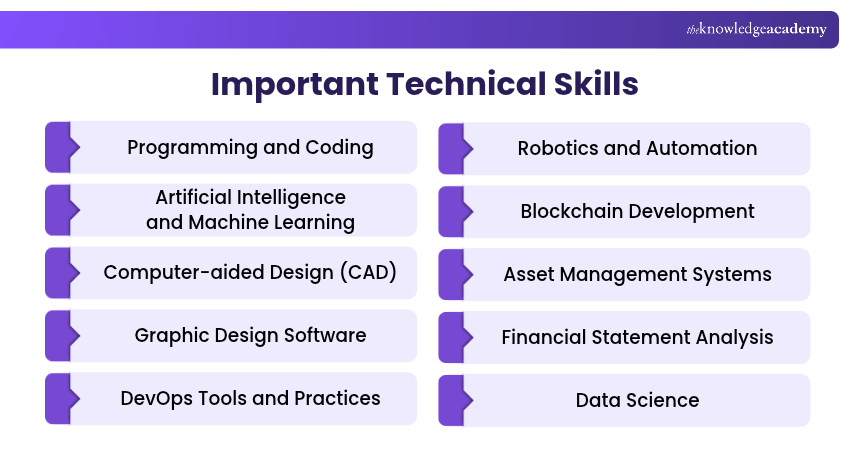
1) Programming and Coding
Programming involves designing and writing instructions that computers can execute to perform tasks, while coding focuses on expressing those instructions in a programming language. Common languages include Python, Java, JavaScript and C++, each with different applications.
Professionals use programming skills to develop applications, process data, automate tasks and create software features. Strong programming also involves debugging, testing and understanding how instructions affect system behaviour.
Example: A Business Analyst uses Python to clean a spreadsheet containing duplicate sales records and automatically calculate monthly revenue totals.

2) Artificial Intelligence and Machine Learning
Artificial Intelligence (AI) involves developing or using systems that perform tasks associated with capabilities such as prediction, language processing and pattern recognition. Machine Learning (ML) is a field of AI in which models learn patterns from data to make predictions or other outputs.
Technical skills in this area may include preparing datasets, training models, evaluating performance and using frameworks such as TensorFlow, PyTorch or scikit-learn. Professionals also need to understand limitations such as inaccurate predictions, data bias and model reliability.
Example: A retailer develops a machine learning model using historical sales information to forecast demand for selected products. Its predictions are reviewed against actual sales before being used in planning.
Trainer Insight: Using AI vs Developing AI
Using an AI-powered application does not require the same technical expertise as building a machine learning model. If your aim is to develop AI systems, focus on programming, data preparation, model evaluation and relevant mathematical concepts rather than tool familiarity alone.
3) Computer-aided Design (CAD)
Computer-aided Design (CAD) involves using specialised software to create, modify and document two-dimensional drawings or three-dimensional models. It is widely used in engineering, architecture, manufacturing and product design.
CAD skills include technical drawing, working with dimensions and tolerances, creating assemblies and preparing designs for review or production. Software such as AutoCAD, SolidWorks and Autodesk Fusion supports different types of design work.
Example: A Mechanical Engineer uses CAD software to develop a detailed model of a machine component, including its dimensions and the arrangement of connected parts.
4) Graphic Design Software
Graphic design software skills involve creating and editing visual content using digital tools. Designers work with typography, colour, layout, imagery and visual hierarchy to communicate information effectively.
Common tools include Adobe Photoshop, Illustrator, InDesign and other design applications. Beyond knowing where software features are located, professionals must understand file formats, image resolution, print requirements and accessibility considerations.
Example: A Graphic Designer uses Illustrator to create a scalable company logo and Photoshop to prepare photographs for a marketing campaign.
5) DevOps Tools and Practices
DevOps involves practices that connect software development and IT operations to improve collaboration, delivery and system reliability. Technical capabilities include version control, automated testing, Continuous Integration and Continuous Delivery (CI/CD), configuration management and infrastructure as code.
Tools such as Git, GitHub Actions, Jenkins, Docker and Terraform can support different parts of a DevOps workflow. However, DevOps is not simply a collection of tools. It also involves managing how software changes are built, tested, released and monitored.
Example: A development team uses GitHub Actions to run automated tests whenever a code change is submitted. The team configures the workflow so that changes must pass the required automated checks before proceeding to the next deployment stage.
6) Robotics and Automation
Robotics involves designing, programming, operating or maintaining machines that can perform controlled physical tasks. Automation refers more broadly to using systems and technologies to carry out processes with reduced manual intervention.
Relevant skills may include sensor integration, control systems, Programmable Logic Controllers (PLCs), robotic programming and fault diagnosis. Robotics and automation are used in manufacturing, logistics, agriculture and other industries.
Example: A manufacturing technician configures a robotic arm to move components between production stations and checks that its sensors detect parts correctly before operation.
7) Blockchain Development
Blockchain development involves creating applications or systems that use distributed ledgers to maintain records across participating computers. Developers may work with smart contracts, cryptographic techniques, transaction processing and blockchain networks.
Skills can include programming with Solidity, understanding consensus mechanisms and testing smart contracts for security weaknesses. However, blockchain is not necessary for every record-keeping application, so developers must assess whether it suits the project's requirements.
Example: A development team creates a smart contract that records a transaction and applies predefined conditions before transferring a digital asset.
8) Asset Management Systems
Asset management systems help organisations record, monitor and manage assets throughout their lifecycle. Depending on the industry, assets may include IT equipment, industrial machinery, buildings or other physical resources.
Technical skills involve maintaining asset registers, tracking maintenance activities, monitoring equipment status and generating reports. Organisations may use Enterprise Asset Management (EAM) software or Computerised Maintenance Management Systems (CMMS).
Example: A facilities technician uses an asset management system to track maintenance schedules and service records for air-conditioning equipment across multiple buildings.
9) Financial Statement Analysis
Financial statement analysis involves examining financial reports to understand an organisation's performance, financial position and cash flows. Professionals review documents such as income statements, balance sheets and cash flow statements.
Important skills include calculating financial ratios, comparing reporting periods, identifying trends and interpreting results within a business context. Analysts must also understand accounting principles and the limitations of the information available.
Example: A Financial Analyst compares a company's current ratio and operating profit margin over three reporting periods to identify changes in liquidity and profitability.
10) Data Science
Data science combines statistics, programming, data management and analytical methods to investigate complex questions. It may involve collecting data, preparing datasets, exploring patterns, developing predictive models and evaluating outcomes.
Professionals often use Python, R, SQL and specialised analytical libraries. Data science is broader than preparing reports because it can include designing experiments and developing models that estimate future outcomes or classify information.
Example: A logistics company uses historical delivery information, traffic conditions and weather data to develop a model that estimates the likelihood of shipment delays.
Develop strong data analysis and problem-solving skills using Python with our Python Data Science Course – Join now!
11) Digital Marketing Tools and Analytics
Digital marketing technical skills involve using software and platforms to plan, execute and evaluate online marketing activities. These may include search engine optimisation, paid advertising, social media management, email campaigns and website analytics.
Professionals use tools such as Google Analytics, Google Ads, Google Search Console and marketing automation platforms. Effective use requires understanding campaign objectives, audience behaviour, tracking methods and relevant performance metrics.
Example: A marketer reviews website traffic and conversion data to compare two advertising campaigns, then adjusts the campaign targeting based on the findings.
12) Financial Planning and Forecasting Tools
Financial planning and forecasting involve estimating future income, expenditure, cash requirements and business performance. Professionals use spreadsheets and financial planning software to prepare budgets, forecasts and scenario-based projections.
Relevant technical skills include building forecasting models, working with assumptions, comparing actual results with budgets and analysing variances. Forecasts are estimates rather than guaranteed outcomes, so assumptions need to be documented and reviewed.
Example: A finance team builds a 12-month cash flow forecast using expected customer payments, operating expenses and planned equipment purchases.
13) Healthcare Information Systems and Medical Coding
Healthcare information systems allow authorised professionals to record, retrieve and manage information used in patient care and healthcare administration. These may include Electronic Health Record (EHR) systems, clinical information systems and patient scheduling platforms.
Medical coding is a related but distinct technical skill involving the classification of diagnoses or other healthcare information using applicable coding standards. The systems and coding classifications used vary by country, organisation and purpose.
Example: A Clinical Administrator updates authorised information in an electronic health record, while a trained medical coder assigns appropriate diagnostic codes from the classification system required by the healthcare organisation.
14) Human Resource Information Systems (HRIS)
Human Resource Information Systems (HRIS) are software platforms used to manage workforce information and support HR processes. These systems may include employee records, leave management, recruitment workflows, reporting and integration with payroll.
HRIS skills involve maintaining accurate records, configuring permitted workflows, generating reports and applying appropriate data access controls. Popular examples of HR technology platforms include Workday and SAP SuccessFactors.
Example: An HR Administrator uses an HRIS platform to review employee leave balances and prepare an authorised departmental absence report.
15) IT Support and Systems Administration
IT support involves diagnosing and resolving technical problems affecting computers, software, networks and user access. Systems administration focuses on configuring, maintaining and monitoring IT environments so that they remain operational and appropriately secured.
Relevant skills include operating system administration, network troubleshooting, user account management, software updates, backups and system monitoring.
Example: An IT Technician investigates why an employee cannot connect to a workplace application, checks connectivity and permissions and resolves the issue using approved support procedures.
16) Quantitative Financial Modelling
Quantitative financial modelling uses mathematical, statistical and computational methods to examine financial relationships and estimate possible outcomes. It is commonly applied in investment analysis, portfolio management, risk assessment and financial research.
Professionals may use Python, R, MATLAB or spreadsheets to analyse financial data and build statistical models. These models rely on assumptions, and their results must be tested rather than treated as certain predictions.
Example: A Risk Analyst uses historical asset returns and statistical assumptions to estimate a portfolio's potential losses under different market scenarios.
17) Software Engineering
Software engineering involves designing, developing, testing, deploying and maintaining software systems using structured engineering practices. It extends beyond writing code to include requirements analysis, system architecture, quality assurance and maintainability.
Software Engineers use development frameworks, testing tools, version control and design techniques to build reliable applications. They must also consider scalability, security, performance and the needs of users.
Example: A Software Engineer designs the structure of an order management application, defines how its components interact and creates automated tests to check that order processing works correctly.
18) Web Development
Web development focuses on building and maintaining websites and web applications. It includes front-end development, which controls what users see and interact with, and back-end development, which supports server-side logic, databases and application processes.
Relevant technical skills include HTML, CSS, JavaScript, application frameworks, APIs, database integration and responsive design. Developers also need to consider website accessibility, security and performance.
Example: A Web Developer creates an online appointment booking page that validates submitted information and communicates with a server to check available appointment slots.
Learn the fundamentals of web development, including HTML, CSS, and JavaScript with our Web Development Training – Register now!
19) Presentation Software
Presentation software skills involve creating, organising and delivering information through digital slides. Professionals use tools such as Microsoft PowerPoint and Google Slides to prepare training materials, business reports and project presentations.
Technical abilities include creating reusable templates, formatting charts, integrating multimedia, managing slide layouts and applying accessibility features. Effective presentation design also requires ensuring that visual elements support the information being communicated.
Example: A Business Analyst uses PowerPoint to create a project update containing milestone charts, budget summaries and a visual explanation of outstanding risks.
20) Data Analysis and Visualisation
Data analysis involves examining information to identify trends, patterns and relationships that can support decisions. Data visualisation presents findings through charts, graphs, dashboards and other graphical formats.
Professionals use spreadsheets, SQL, Power BI, Tableau or programming libraries to clean data, calculate metrics and communicate results. Unlike broader data science projects, many data analysis tasks focus on answering defined business questions with available information.
Example: A Sales Analyst uses Power BI to create a dashboard showing monthly revenue, regional performance and product sales trends, helping managers identify areas requiring further investigation.
21) Productivity and Collaboration Software
Productivity and collaboration software helps teams organise work, create documents, exchange information and coordinate activities. Common examples include Microsoft 365, Google Workspace, Microsoft Teams and Slack.
Technical skills include managing shared documents, configuring file permissions, using collaborative editing and version history, and organising digital workspaces. Professionals must also follow workplace security and information-sharing policies.
Example: A Project Coordinator uses Microsoft Teams and SharePoint to organise project documents, control access and maintain a shared record of meeting decisions.
22) Technical Writing and Documentation
Technical writing involves preparing clear, structured information that explains how a product, system or process works. It is used for user manuals, operating procedures, software documentation and troubleshooting guides.
Technical Writers need to understand the subject, organise information logically and use appropriate documentation tools. Accuracy, consistency, version control and audience awareness are especially important when instructions affect technical operations.
Example: A Technical Writer creates a step-by-step software installation guide containing system requirements, configuration instructions and troubleshooting information.
23) Project Management Software and Scheduling
Project management software skills involve using digital tools to organise tasks, allocate resources, monitor progress and manage project schedules. Tools such as Microsoft Project, Jira, Asana and Trello support different planning and tracking approaches.
Relevant skills include creating task dependencies, setting milestones, estimating durations, maintaining schedules and producing progress reports. Understanding scheduling principles is important because software cannot independently guarantee realistic project plans.
Example: A Project Coordinator uses Microsoft Project to link dependent activities and identify how a delayed equipment delivery could affect later project milestones.
24) Cybersecurity Tools and Practices
Cybersecurity skills involve protecting information, systems and networks against threats and unauthorised access. Activities may include identifying vulnerabilities, applying security controls, monitoring events and responding to incidents.
Technical skills include identity and access management, vulnerability assessment, secure configuration, log analysis and incident response. Cybersecurity work requires knowledge of both tools and the organisational processes used to manage risk.
Example: A Security Analyst investigates an unusual login alert, reviews available authentication records and follows the organisation's incident response procedures to assess the event.
25) Cloud Computing Platforms and Services
Cloud computing involves accessing computing resources such as servers, storage, databases and applications through network-based services. Platforms including Amazon Web Services (AWS), Microsoft Azure and Google Cloud offer different types of cloud infrastructure and managed services.
Cloud-related skills include provisioning resources, managing access, configuring networks, monitoring usage and understanding service models such as Infrastructure as a Service (IaaS), Platform as a Service (PaaS) and Software as a Service (SaaS). Cloud security also involves shared responsibilities between providers and customers, depending on the service model and configuration.
Example: A Cloud Administrator configures a hosted application environment, assigns appropriate access permissions and sets up monitoring to identify resource usage and service issues.
Understand how to optimise cloud solutions for business efficiency with our Cloud Computing Training – Register now!
How to Develop Your Technical Skills
Developing technical skills involves choosing relevant capabilities, understanding their principles and applying them through practical tasks. The following six approaches can help you build technical proficiency:
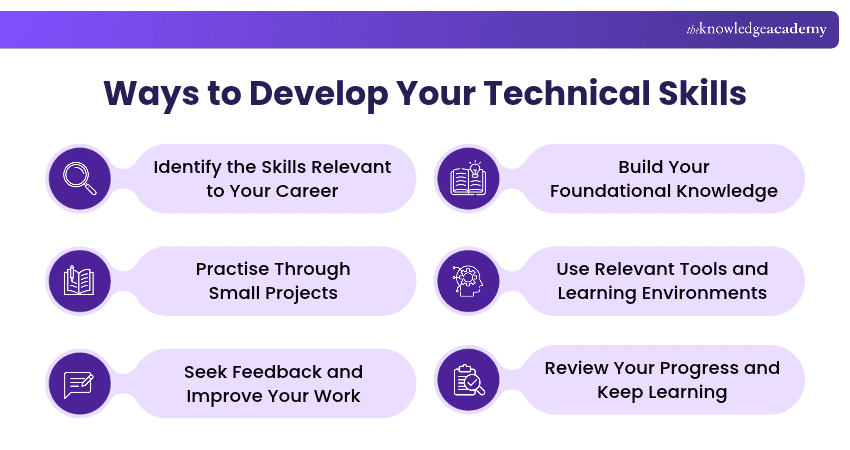
1) Identify the Skills Relevant to Your Career: Review job descriptions, workplace responsibilities and professional requirements to determine which technical capabilities matter most. For example, a marketing professional may prioritise analytics tools, while an IT Specialist may focus on networking or cloud administration.
2) Build Your Foundational Knowledge: Learn the main concepts before moving to advanced tools. Online courses, professional training, documentation and guided tutorials can help you understand terminology, processes and common methods.
3) Practise Through Small Projects: Apply what you learn to manageable tasks. You could build a simple website, prepare a financial dashboard, design a CAD model or create a project schedule. Practical work reveals gaps that theoretical study may not uncover.
4) Use Relevant Tools and Learning Environments: Where possible, practise with the software or systems used in your chosen field. Training environments, trial versions and authorised workplace systems can help you gain experience without affecting live operations.
5) Seek Feedback and Improve Your Work: Ask experienced colleagues, trainers or mentors to review your output. Feedback can help you identify technical errors, improve efficiency and understand professional standards.
6) Review Your Progress and Keep Learning: Set measurable development goals and assess what you can now complete independently. As technologies and professional practices change, revisit your learning needs and update your skills accordingly.
Technical Skills Self-assessment: Where Should You Start?
|
Your Development Goal |
Technical Skills to Explore |
|---|---|
|
Want to build websites or software? |
Programming, software engineering and web development |
|
Interested in working with data? |
Data analysis, data science and AI tools |
|
Working towards engineering or design roles? |
CAD, robotics and graphic design software |
|
Interested in finance-related responsibilities? |
Financial statement analysis, forecasting and financial modelling |
|
Looking to strengthen IT capabilities? |
IT support, cybersecurity, DevOps and cloud computing |
|
Need to manage workplace tasks more effectively? |
Productivity software, presentation tools and project management software |
Choose one relevant skill and demonstrate your progress through a practical task or completed project.
Understand AI tools integration for smarter decision-making in projects with our Artificial Intelligence (AI) For Project Managers Training – Join now!

The Knowledge Academy develops accessible learning content across Project Management, IT, Cybersecurity, Data Science, Business Analysis, HR, Accounting and Finance, Leadership and Health and Safety. Its resources combine subject research with clear explanations to help professionals build practical knowledge across a wide range of disciplines.
View Detail

 If you wish to make any changes to your course, please


