


 Top Rated Course

We may not have the course you’re looking for. If you enquire or give us a call on 01344203999 and speak to our training experts, we may still be able to help with your training requirements.
Skills Required to Become an RPA Developer
Lily Turner 29 August 2026Explore the essential skills that can help you build a successful career as an RPA Developer and excel in process automation.

Training Outcomes Within Your Budget!
We ensure quality, budget-alignment, and timely delivery by our expert instructors.
Table of Contents
Key Takeaways
1. RPA Developers need both technical and problem-solving skills to build reliable automation solutions.2. Programming and scripting knowledge helps developers create, customise and troubleshoot automated workflows.3. Process analysis skills are essential for identifying tasks that are suitable for automation.4. RPA platform expertise helps developers design, test, deploy and maintain automation effectively.5. Continuous learning is important as automation tools, AI capabilities and business requirements continue to evolve.
Task: Automate hundreds of repetitive transactions.
Challenge: Multiple systems, changing data and unexpected errors.
Solution: A well-designed RPA workflow.
But getting from task to solution requires more than an automation tool. RPA Developers need the right combination of technical knowledge, analytical thinking and problem-solving skills to build reliable automation. So, what does it take to become an RPA Developer? Let's explore the key Skills Required to Become an RPA Developer!
Who is an RPA Developer?
A Robotic Process Automation (RPA) Developer is a professional who designs, develops, tests and maintains software robots that automate repetitive, rule-based business tasks. They use RPA tools and technologies to create automated workflows that can perform activities such as data entry, report generation, transaction processing and transferring information between systems.
RPA Developers also analyse business processes to determine which tasks are suitable for automation. Their goal is to create reliable and efficient automation solutions that reduce manual effort and improve business processes.

Essential Skills for RPA Developers
RPA Developers need a combination of technical, analytical and interpersonal skills to build effective automation solutions. These skills help them understand processes, develop reliable workflows, solve automation issues and collaborate effectively with different teams. The following are the required skills for every RPA Developer:
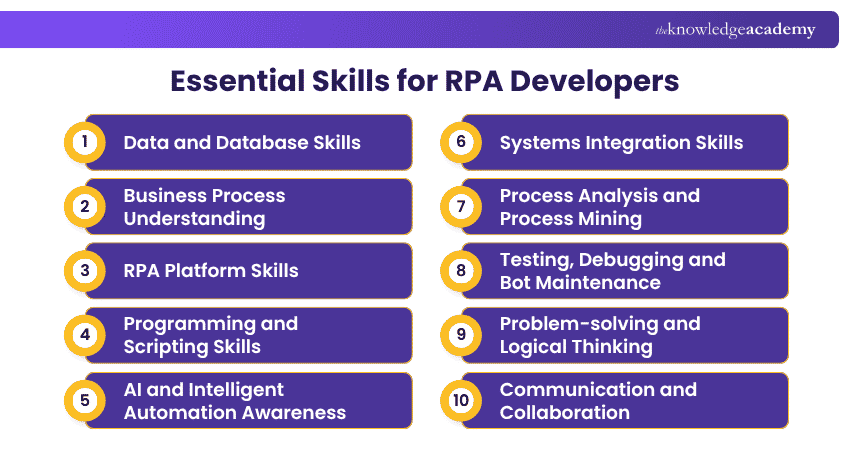
1) Data and Database Skills
RPA solutions often need to read, validate, transform or transfer data between systems. An RPA Developer should therefore understand how data is structured and how automated workflows interact with it.
Working knowledge of databases and SQL can be particularly useful when an automation needs to retrieve or update structured information. Skills in data handling, integration and SQL queries can help Developers work effectively with information across different systems.
Real-world Example: An invoice-processing bot might retrieve supplier information from a database, compare it with invoice data and pass validated information to another business application.
2) Business Process Understanding
Before automating a process, an RPA Developer needs to understand how that process currently works. This includes its sequence of activities, decision points, business rules, exceptions and dependencies.
Strong process understanding helps Developers distinguish between straightforward repetitive tasks and processes that may require redesign or additional judgement before automation. Knowledge of organisational processes is an important capability for RPA Developers.
Real-world Example: Before automating employee expense claims, an RPA Developer should understand approval thresholds, required documentation, rejection conditions and exceptions.
Trainer Insight
Don't automate a process simply because it is repetitive. Understand its steps, rules, exceptions and dependencies first. A poorly understood process can become a poorly designed automation.
3) RPA Platform Skills
RPA Developers need practical experience with RPA platforms such as UiPath, Automation Anywhere, Blue Prism and Microsoft Power Automate. These platforms provide capabilities for designing workflows, interacting with applications, managing automation logic and supporting deployment.
Rather than trying to master every available platform, Developers can begin by learning core automation concepts using one platform and expand their knowledge to others as their role or project requirements evolve.
Real-world Example: An RPA Developer can create a workflow that collects information from forms, checks the details and enters the approved data into a system automatically.
Create scalable automation solutions and boost productivity with Robotic Process Automation Using UiPath Training – Register today!
4) Programming and Scripting Skills
Although many RPA platforms provide low-code capabilities, programming and scripting knowledge can still be useful when automations require custom logic, data transformations or integrations beyond standard platform components.
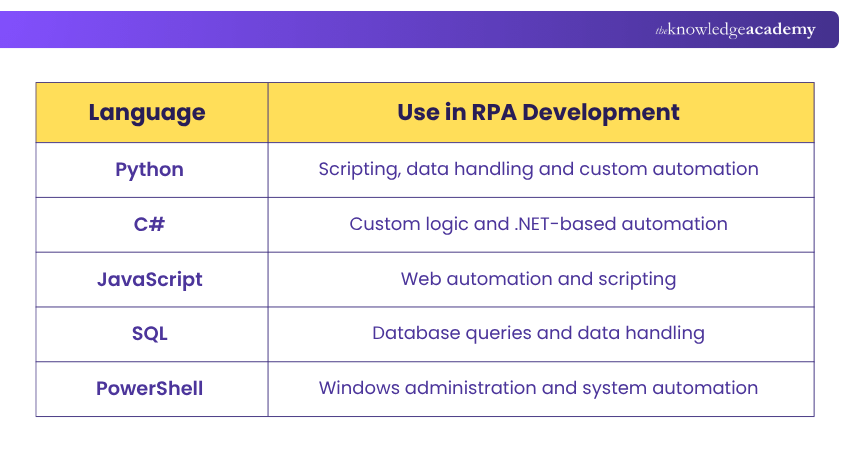
Programming and scripting languages such as Python, C# and JavaScript can be valuable. However, an RPA Developer does not necessarily need to master every programming language. The most useful technologies depend on the RPA platform, organisation and automation requirements.
Real-world Example: An RPA Developer can use a script to convert data into the format needed by another application.
5) AI and Intelligent Automation Awareness
RPA Developers should understand how Artificial Intelligence (AI) can extend traditional automation beyond simple rule-based tasks. AI capabilities can help automation solutions work with unstructured information, recognise patterns and support more complex processes.
Knowledge of areas such as Intelligent Document Processing (IDP), Generative AI and AI-powered automation can help Developers build more advanced solutions as RPA platforms continue to evolve.
Real-world Example: An RPA Developer might use AI to extract information from invoices and an RPA bot to validate and enter that data into a business system.
6) Systems Integration Skills
RPA Developers need to understand how different applications, databases and business systems connect and exchange information. This helps them build bots that can work smoothly across multiple systems within an automation process.
They should also know how to identify integration issues, handle data transfers and adapt workflows when connected systems change. Basic knowledge of Application Programming Interfaces (APIs), databases and system connections can be useful when building more complex automations.
Real-world Example: An RPA Developer may build a bot that collects customer information from a web application and automatically updates it in a CRM system.
7) Process Analysis and Process Mining
RPA Developers need strong process analysis skills to understand how a business process works and determine which tasks are suitable for automation. This involves identifying repetitive steps, business rules, bottlenecks and areas where automation can improve efficiency.
Knowledge of process mining can also help Developers use process data to discover how workflows actually operate, identify variations and uncover automation opportunities. It provides a clearer picture of where delays, repeated steps or inefficiencies occur within a process.
Real-world Example: A team could analyse an order-processing workflow to identify repetitive activities and delays before deciding which steps are suitable for automation.
8) Testing, Debugging and Bot Maintenance
An automation that works during development may still encounter unexpected situations in a live environment. RPA Developers therefore need strong testing and debugging capabilities.
Testing should examine whether the bot behaves correctly under expected conditions as well as how it handles exceptions. Debugging helps Developers identify and resolve problems, while ongoing maintenance keeps automations aligned with changing system requirements.
Real-world Example: A bot designed to process invoices should be tested against missing fields, invalid values, unavailable applications and unexpected document formats rather than only ideal inputs.
9) Problem-solving and Logical Thinking
RPA Developers need to translate business requirements into structured automation logic. This requires breaking larger problems into smaller steps and deciding how the bot should respond to different conditions. Logical thinking is particularly important when designing decision points, loops, validation rules and exception-handling paths.
Real-world Example: If an automated payment exceeds the approval limit, the Developer needs to design the bot to send it for further review instead of processing it automatically.
10) Communication and Collaboration
RPA Developers need strong communication and collaboration skills because automation projects often involve working with Business Analysts, Process Owners, IT teams and other stakeholders. Clear communication helps them understand business requirements and translate them into effective automation solutions.
They also need to explain technical concepts in simple terms, discuss automation challenges and gather feedback from different teams. Good collaboration helps ensure the automation meets both technical requirements and business needs.
Real-world Example: When automating an HR onboarding process, an RPA Developer may need input from the HR team about process rules and from IT about the systems involved.
RPA Developer Readiness Checklist
Before considering your skill set complete, ask yourself:
□ Can I analyse a business process and identify its rules and exceptions?□ Can I identify whether a task is suitable for RPA?□ Can I build an automation using an RPA platform?□ Can I work with structured data and basic database queries?□ Can I understand how an automation interacts with other systems?□ Can I test normal and exception scenarios?□ Can I debug and maintain an existing automation?□ Can I translate business requirements into logical workflow steps?□ Can I explain automation requirements and outcomes to different stakeholders?
Turn complex processes into seamless automated workflows with Blue Prism Training - Sign up now!
How to Develop RPA Developer Skills?
Becoming proficient in RPA requires more than learning the interface of an automation platform. A structured learning path can help connect technical knowledge with practical process understanding. Here are the steps to follow:
1) Understand RPA Fundamentals
Start by learning how RPA works, what types of tasks can be automated and where human judgement or more complex technologies may still be required.
2) Develop Process Analysis Skills
Practice breaking business processes into activities, rules, decisions, inputs, outputs and exceptions. This helps you understand what an automation needs to accomplish before building it.
3) Learn an RPA Platform
Choose an RPA platform and practice designing workflows, interacting with applications, handling data and debugging automations.
4) Build Supporting Technical Skills
Develop working knowledge of technologies such as databases, SQL, APIs and relevant programming or scripting languages according to the environments you expect to work with.
5) Practise Testing and Exception Handling
Create scenarios in which inputs are missing, systems become unavailable or business rules change. Learn how to make your automation respond appropriately.
6) Build End-to-End Automation Projects
Create projects that require you to analyse a process, design the workflow, develop the automation, test it and document the outcome.
7) Expand Your Skill Set
Once the fundamentals are established, explore additional RPA platforms, process mining and other automation technologies relevant to your goals.
Pro Tip
Turn learning into small automation projects. Building, testing and improving complete workflows can reveal skill gaps that individual tutorials or exercises may not expose.
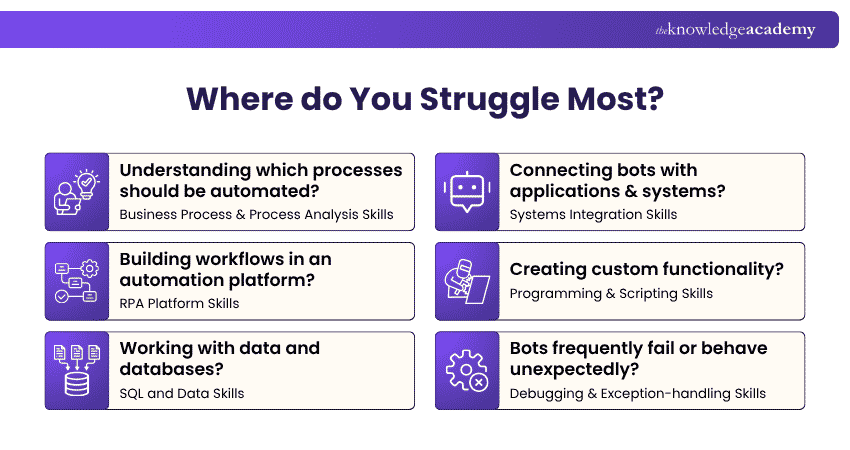
How to Assess Your RPA Developer Skill Gaps?
Not every aspiring RPA Developer needs to strengthen the same area first. Identify where you struggle and focus your learning accordingly. The image below can help you decide which RPA Developer skill you should develop next:
Conclusion
Building the Skills Required to Become an RPA Developer requires a balance of technical, process and interpersonal capabilities. By strengthening your capabilities and keeping pace with evolving automation and AI technologies, you can prepare yourself for new opportunities and build a rewarding career in RPA development.
Develop practical expertise in creating, executing and maintaining automated test scripts with Robot Framework Training - Join now!
Frequently Asked Questions
Is RPA a Good Career Choice?

Yes, RPA can be a good career choice for professionals interested in automation, technology and process improvement. It offers opportunities across industries as organisations automate repetitive processes. Building skills in RPA platforms, programming, AI and process analysis can support career growth.
Is RPA a Form of AI?
No, RPA is not a form of Artificial Intelligence (AI). RPA primarily follows predefined rules to automate repetitive tasks. However, it can be combined with AI technologies to handle more complex activities involving document understanding, language processing and decision-making.
Does RPA Need Coding?
RPA does not always require extensive coding because many platforms provide low-code or visual workflow-building features. However, programming and scripting knowledge can be valuable for creating custom logic, handling complex integrations, transforming data and troubleshooting advanced automation scenarios effectively.

Lily Turner


Senior AI/ML Engineer and Data Science Author
Lily Turner is a data science professional with over 10 years of experience in artificial intelligence, machine learning, and big data analytics. Her work bridges academic research and industry innovation, with a focus on solving real-world problems using data-driven approaches. Lily’s content empowers aspiring data scientists to build practical, scalable models using the latest tools and techniques.
View Detail

 If you wish to make any changes to your course, please


