


We may not have the course you’re looking for. If you enquire or give us a call on 01344203999 and speak to our training experts, we may still be able to help with your training requirements.
Essential Personal Assistant Skills and How to Improve Them
ByThe Knowledge AcademyLast updated on: 06 November 2026
Personal Assistant skills combine communication, organisation, time management and problem-solving to support daily professional responsibilities. Explore 12 essential skills, from digital proficiency to confidentiality and adaptability, along with practical ways to strengthen them.
The Gist
1. Personal Assistants need strong communication, interpersonal and organisational skills to manage daily responsibilities effectively.2. Effective prioritisation and task management help Personal Assistants handle competing deadlines, appointments and changing schedules.3. Strong problem-solving and decision-making skills enable Personal Assistants to address challenges and act within their responsibilities.4. Knowledge of workplace technology and responsible information handling supports efficient, secure and professional assistance.5. Regular practice, constructive feedback and adaptability help Personal Assistants strengthen their abilities and respond to evolving workplace demands.
Imagine managing an executive's busy calendar when an urgent meeting request arrives just as an important deadline approaches. You must coordinate schedules, communicate changes and ensure nothing important is overlooked. Handling situations like these requires a combination of essential Personal Assistant skills.
A Personal Assistant (PA) provides administrative and organisational support that helps employers manage their professional responsibilities effectively. Strong Personal Assistant skills enable professionals to communicate clearly, manage competing priorities and respond to unexpected challenges. In this blog, we explore 12 essential skills and practical ways to improve them.
Essential Personal Assistant Skills
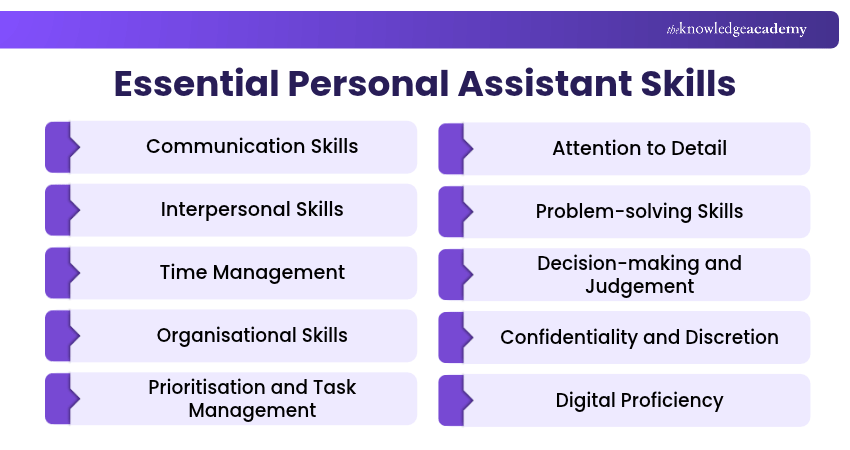
Personal Assistants require a combination of practical and interpersonal abilities to manage responsibilities efficiently. The following are essential Personal Assistant skills:
1) Communication Skills
Effective communication is essential for Personal Assistants because they frequently exchange information with employers, colleagues, clients and other stakeholders. This includes clear verbal communication, professional writing and active listening. Personal Assistants may draft emails, respond to enquiries, prepare correspondence and communicate instructions on behalf of their employers.
They must ensure that information is accurate, appropriately worded and delivered to the intended recipients. For example, when arranging a meeting with several stakeholders, a Personal Assistant must communicate the purpose, timing, location and any relevant instructions clearly.
2) Interpersonal Skills
Interpersonal skills help Personal Assistants establish and maintain positive working relationships with people from different professional backgrounds.
These abilities include empathy, patience, diplomacy and an understanding of professional etiquette. They are particularly important when interacting with senior executives, external clients and colleagues with different communication preferences.
For example, when two stakeholders disagree about meeting arrangements, a Personal Assistant may need to listen to both parties, remain professional and help identify a practical compromise.
3) Time Management
Time management enables Personal Assistants to coordinate appointments, monitor deadlines and allocate sufficient time to important responsibilities. A Personal Assistant may need to manage an employer's calendar, schedule meetings, arrange travel and monitor time-sensitive administrative tasks.
For example, when scheduling back-to-back meetings, a Personal Assistant should consider preparation time, travel requirements and potential delays. Using digital calendars, reminders and scheduling tools can help prevent conflicts and maintain realistic daily arrangements.
4) Organisational Skills
Strong organisational skills help Personal Assistants maintain structured systems for managing documents, correspondence, records and administrative activities. They may be responsible for maintaining digital filing systems, coordinating events, organising travel documentation and ensuring information can be retrieved efficiently.
For example, creating a consistent folder structure for contracts, meeting notes and travel documents can make important records easier to locate when required. While time management focuses on allocating time, organisational skills help keep information, resources and administrative arrangements organised and accessible.
5) Prioritisation and Task Management
Personal Assistants frequently handle several responsibilities with different levels of urgency and importance. Prioritisation helps them identify which tasks require immediate attention and which can be scheduled for later.
Rather than attempting numerous activities simultaneously, effective task management involves assessing deadlines, understanding business requirements and concentrating on the most important work.
Workplace Scenario: Managing Competing Priorities
Imagine an executive asks you to arrange an urgent client meeting while you are preparing documents for a scheduled presentation.
A practical response would involve:
1) Confirming the urgency and requirements of the meeting.2) Checking whether the presentation documents have a fixed deadline.3) Identifying tasks that can be rearranged without affecting important commitments.4) Updating the executive about the revised schedule and any potential conflicts.
This approach demonstrates prioritisation, accountability and the ability to manage competing responsibilities without compromising important work.
6) Attention to Detail
Attention to detail helps Personal Assistants complete administrative work accurately and identify potential errors before they cause problems. This skill is particularly important when preparing documents, managing appointments, processing information and organising events.
For example, a small mistake in a meeting invitation, such as an incorrect time zone or missing attachment, can create confusion for several participants. Carefully checking names, dates, contact details and document contents can reduce avoidable errors.
7) Problem-solving Skills
Problem-solving enables Personal Assistants to identify administrative challenges, investigate their causes and develop practical solutions. Unexpected situations may include scheduling conflicts, travel disruptions, missing documents or last-minute changes to business arrangements.
For example, if a meeting venue becomes unavailable, a Personal Assistant may need to identify an alternative location, check its suitability and coordinate revised arrangements. Effective problem-solving requires gathering relevant information, considering available options and understanding how potential solutions may affect other commitments.
8) Decision-making and Judgement
Personal Assistants may need to make routine administrative decisions independently while recognising when approval is required. Sound judgement involves considering available information, understanding potential consequences and acting within agreed responsibilities.
For example, a Personal Assistant may have permission to rearrange routine internal meetings but may need approval before changing an important client engagement or authorising significant expenditure. Understanding the limits of delegated authority helps prevent inappropriate decisions and maintain accountability.
9) Confidentiality and Discretion
Confidentiality is a fundamental skill for Personal Assistants because the role may involve access to sensitive business information, private correspondence, employee records and executive schedules. Personal Assistants must handle such information responsibly and follow applicable organisational policies and data protection requirements.
This includes checking recipients before sending confidential documents, using approved storage systems and avoiding unnecessary disclosure of private information. Discretion also requires recognising when information should be restricted and when an issue needs to be referred to an authorised individual.
10) Digital Proficiency
Digital proficiency enables Personal Assistants to use workplace technology for scheduling, communication, document preparation and information management. Common applications include Microsoft Outlook, Microsoft Excel, Microsoft Word, digital calendars, video conferencing platforms and task management software.
For example, a Personal Assistant may use shared calendars to arrange appointments, spreadsheets to maintain administrative records and collaboration platforms to coordinate activities. Being comfortable with these technologies can help professionals complete routine tasks more efficiently and adapt to changing workplace requirements.
Pro Tip
Use approved workplace tools to create reusable email templates, recurring calendar reminders and standard document formats. These can reduce repetitive administrative work, but always review automated outputs for accuracy and ensure that confidential information remains protected.
11) Adaptability and Flexibility
Adaptability helps Personal Assistants respond effectively when schedules, priorities or business requirements change unexpectedly. An employer's plans may change because of urgent meetings, travel disruptions, new responsibilities or shifting organisational priorities.
For example, if a business trip is postponed, a Personal Assistant may need to rearrange accommodation, adjust appointments and update relevant stakeholders. Flexibility involves remaining responsive while maintaining accuracy and professionalism. It also includes learning unfamiliar procedures and adjusting working methods when necessary.
Become a valuable asset to any organisation with top-notch administrative and interpersonal skills. Sign up for the PA and Secretarial Courses now!
12) Proactive Support
Proactive support involves recognising upcoming administrative needs and taking appropriate action before problems arise. Rather than responding only to direct instructions, experienced Personal Assistants may anticipate routine requirements by reviewing schedules, monitoring deadlines and preparing relevant information.
For example, before an executive attends a client meeting, a Personal Assistant might prepare the agenda, confirm attendance and ensure the necessary documents are available. This approach helps employers concentrate on their core responsibilities without needing to oversee every administrative detail.
Personal Assistant Skills Self-assessment Checklist
Use this checklist to evaluate your existing abilities:
□ I can write clear and professional emails.□ I can manage appointments and changing schedules.□ I can organise documents and retrieve information efficiently.□ I can prioritise urgent and important tasks.□ I can identify errors in documents and meeting details.□ I understand how to handle confidential information appropriately.□ I can use common workplace software for administrative tasks.□ I can recognise when decisions require approval.
Review the activities you find difficult and identify which skills require additional practice.
How to Improve Your Personal Assistant Skills?
Improving Personal Assistant skills requires consistent practice, feedback and continuous learning. Here are five effective ways to strengthen these abilities:
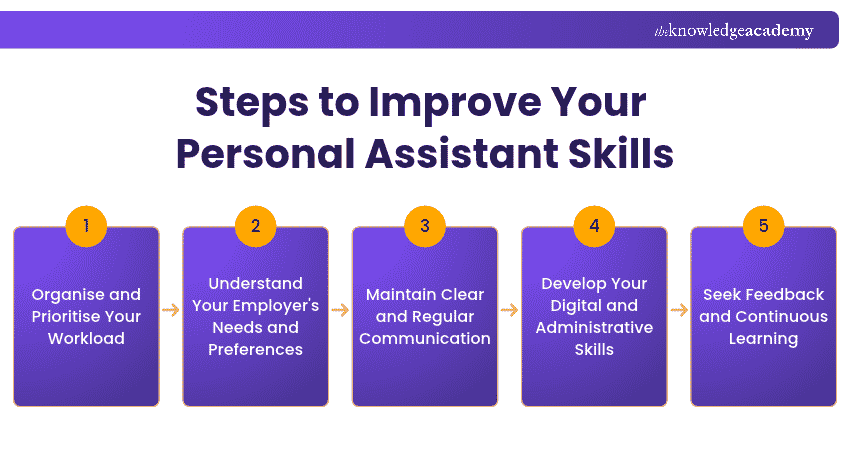
1) Organise and Prioritise Your Workload
Maintain a task list with deadlines and priorities to manage responsibilities efficiently. Use digital calendars and task management tools to track commitments and adjust schedules when necessary. Clarify competing priorities with your employer to ensure important tasks receive timely attention.
2) Understand Your Employer's Needs and Preferences
Learn about your employer's working style, communication preferences and professional priorities. Familiarise yourself with key contacts, business objectives and daily routines. This understanding helps you anticipate requirements and provide personalised administrative support.
3) Maintain Clear and Regular Communication
Keep your employer informed about completed tasks, schedule changes and pending decisions. Provide concise, accurate updates and clarify expectations whenever necessary. Regular communication helps prevent misunderstandings and supports effective coordination.
4) Develop Your Digital and Administrative Skills
Improve your proficiency in workplace tools such as Microsoft Outlook, Excel and document management systems. Practise calendar scheduling, spreadsheet management and secure file sharing. Relevant training and practical exercises can help you manage administrative responsibilities more efficiently.
5) Seek Feedback and Continuous Learning
Request constructive feedback from supervisors or colleagues to identify areas for improvement. Reflect on completed tasks, set realistic development goals and practise new techniques. Continuous learning helps Personal Assistants adapt to changing workplace requirements and technologies.
7-Day Personal Assistant Skills Practice Challenge
Improving your skills doesn't always require major changes. Try these practical activities throughout the week:
□ Day 1: Organise your tasks by urgency and importance.□ Day 2: Draft a professional email and review its clarity.□ Day 3: Practise managing meetings using a shared calendar.□ Day 4: Create a simple spreadsheet to track workplace activities.□ Day 5: Identify a workplace problem and evaluate possible solutions.□ Day 6: Practise explaining a complex task in simple language.□ Day 7: Review your progress and select one skill to develop further.
Learn the methods of organisation and management skills with our Personal & Organisational Development Training – Sign up today!

The Knowledge Academy develops accessible learning content across Project Management, IT, Cybersecurity, Data Science, Business Analysis, HR, Accounting and Finance, Leadership and Health and Safety. Its resources combine subject research with clear explanations to help professionals build practical knowledge across a wide range of disciplines.
View Detail

 If you wish to make any changes to your course, please


