


We may not have the course you’re looking for. If you enquire or give us a call on 01344203999 and speak to our training experts, we may still be able to help with your training requirements.
Top 12 MongoDB Skills for Developers
ByThe Knowledge AcademyLast updated on: 14 November 2026
MongoDB skills help developers build, manage and optimise document-based applications. Explore 12 essential skills, including CRUD operations, data modelling, aggregation, indexing and security. Discover how these capabilities support efficient data handling, database performance and application reliability.

Tables or documents? Fixed structures or flexible schemas? Choosing how to manage data is an important part of application development. However, building reliable applications also requires understanding how databases store, retrieve and process information.
MongoDB offers a flexible, document-oriented approach, but using it effectively requires more than understanding NoSQL concepts. Developers need practical skills in data modelling, querying, performance optimisation and application integration.
In this blog, we'll explore 12 essential MongoDB skills, their practical applications and ways to develop them.
Essential MongoDB Skills
MongoDB supports application development through everyday data operations and advanced database capabilities. The following 12 skills cover foundational development tasks and more specialised concepts that become valuable as application requirements grow.
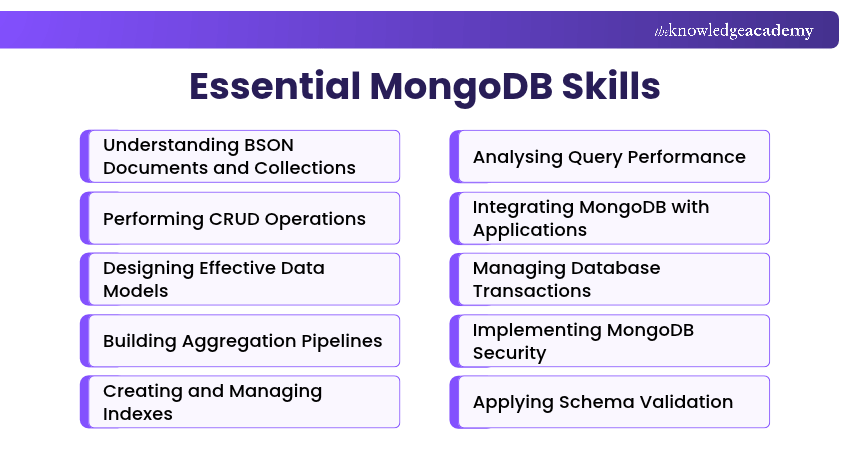
1) Understanding BSON Documents and Collections
Understanding Binary JSON (BSON) documents and collections is a fundamental MongoDB skill. MongoDB stores records as documents containing field-value pairs, which can include nested objects, arrays and different data types. Collections organise these documents within a database.
Developers should understand how document structures represent application information and how the _id field uniquely identifies each document in a collection. For example, a customer profile can contain a name, contact information, delivery addresses and preferences within a single document.

2) Performing CRUD Operations
CRUD operations allow developers to create, read, update and delete information stored in MongoDB. Methods such as insertOne(), find(), updateOne() and deleteOne() support common data management activities, while methods such as insertMany(), updateMany() and deleteMany() support operations involving multiple documents.
Developers use these operations to implement application features that interact directly with stored information. For example, a task management application can use CRUD operations to create assignments, display existing tasks, update their progress and remove records that are no longer required.
Pro Tip
Use precise filters when updating or deleting documents. An empty filter can affect an unintended record or multiple records, depending on the operation.
3) Designing Effective Data Models
Data modelling involves organising information according to application requirements and expected access patterns. MongoDB supports embedded documents, which store related information together, and references, which establish relationships between documents stored separately.
Developers should understand when each approach is appropriate by considering how frequently information is accessed together, how often it changes, and whether document sizes may grow significantly. For example, an e-commerce application might embed order line items within an order while referencing product records that are maintained independently.
4) Building Aggregation Pipelines
Aggregation pipelines allow developers to process documents and generate calculated results from database information. A pipeline consists of stages that perform operations such as filtering, grouping, sorting and transforming data.
Developers can use stages such as $match, $group, $project and $sort to organise information for reporting and analytical requirements. For example, an online retailer can build an aggregation pipeline to calculate monthly revenue, compare product categories and identify sales trends without processing every individual record in application code.
5) Creating and Managing Indexes
Indexing is an important MongoDB skill because indexes help the database locate relevant documents efficiently. Instead of examining every document in a collection, MongoDB can use suitable indexes to support filtering, sorting, and other query operations.
Developers should understand single-field and compound indexes, along with unique index constraints, and select them according to application requirements. For example, an order management system can use a compound index to support searches by customer ID and order date.
However, additional indexes consume storage and can increase the cost of write operations, making careful index selection important.
Trainer's Insight
MongoDB's flexible schema does not eliminate the need for database design. Effective data modelling depends on access patterns, update frequency and the relationships between different types of information.
6) Analysing Query Performance
Query performance analysis helps developers understand how efficiently MongoDB executes database requests. The explain() method provides information about query execution plans, including whether an operation uses an index or performs a collection scan. The executionStats mode provides additional metrics, such as documents and index keys examined.
For example, when a product search becomes slow, analysing its execution plan can reveal whether a query examines significantly more documents than necessary. These findings help developers identify inefficiencies and make informed performance improvements.
7) Integrating MongoDB with Applications
MongoDB integration involves connecting a database to an application through a supported programming language driver. Official MongoDB drivers provide interfaces for executing database operations, handling connections, and working with query results.
Developers should understand how to configure database clients, manage asynchronous operations where applicable, and respond to connection failures. Connection pooling is also important because it allows applications to reuse established connections rather than repeatedly creating new ones.
For example, a Python or Node.js backend can use an official driver to process requests from a web application and communicate with MongoDB.
8) Managing Database Transactions
Transactions help developers maintain consistency when several database operations must be completed together. MongoDB supports multi-document ACID transactions, allowing related changes to be committed together or aborted if the transaction cannot be completed successfully.
Developers should understand transaction sessions, atomicity, and appropriate error handling. For example, when a customer places an order, an application might need to create an order record and reduce the available inventory. A transaction can help ensure that both changes succeed together when the business process requires this behaviour.
9) Implementing MongoDB Security
Database security involves protecting stored information and controlling who can access or modify it. MongoDB supports authentication, role-based access control, and encryption capabilities that help organisations protect database environments.
Developers should understand how to configure application permissions, protect connection credentials, and use TLS to secure data transmitted between applications and database servers. For example, a reporting application can use an account with read-only permissions rather than receiving unnecessary privileges to modify or delete documents.
10) Applying Schema Validation
Schema validation helps developers maintain consistent data structures within MongoDB collections. Although MongoDB supports flexible document schemas, applications often require particular fields, data types or values to ensure information remains suitable for processing.
MongoDB supports validation rules, including rules based on the $jsonSchema operator. For example, an inventory application can require product documents to contain a product name and ensure that quantity and price fields use appropriate numeric types.
These rules help enforce data consistency when validation is configured to reject invalid documents, while retaining flexibility for permitted document variations.
11) Advanced Querying and Filtering
Advanced querying helps developers retrieve specific information from MongoDB collections using comparison operators, logical conditions and filtering techniques. Operators such as $gt, $lt, $in, $and and $or allow applications to identify documents that meet different requirements.
Developers should understand how to query nested documents and arrays, select relevant fields using projections and organise results through sorting and pagination. For example, a job portal can filter job listings by location, salary range and required skills to display relevant opportunities.
Pro Tip
When working with large datasets, use appropriate filters and projections to retrieve only the information your application needs. Add sorting and pagination where necessary to keep results manageable.
12) Working With Change Streams
Change streams allow applications to monitor supported database changes and respond when documents are inserted, updated, replaced, or deleted. This capability supports event-driven application features without requiring continuous manual polling for new database activity.
Developers can use change streams to build notification systems, synchronisation processes and other workflows that respond to database events.
For example, an order management application can monitor changes to order statuses and notify a separate service when an order is dispatched. Change streams are available on supported replica set and sharded cluster deployments.
How to Improve MongoDB Skills?
Building MongoDB expertise involves applying database concepts to realistic development tasks. A structured learning approach can help developers progress from basic database operations to more demanding application scenarios.
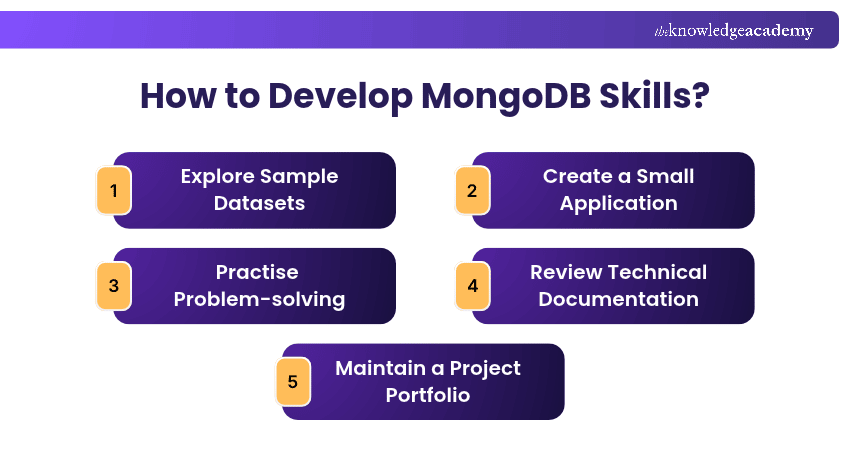
1) Explore Sample Datasets: Use MongoDB Atlas sample datasets to practise exploring collections, querying documents and understanding different data structures.
2) Create a Small Application: Build a practical project using an official MongoDB driver to perform CRUD operations and manage application data.
3) Practise Problem-solving: Investigate unexpected query results, data inconsistencies and application connection errors. Use query execution statistics to identify possible performance issues.
4) Review Technical Documentation: Explore official MongoDB documentation to understand supported features and recommended implementation practices.
5) Maintain a Project Portfolio: Document completed database projects, technical decisions and lessons learned to demonstrate practical experience.
Learn how to monitor Amazon DocumentDB with CloudWatch through the Amazon DocumentDB with MongoDB Training – Join now!

The Knowledge Academy develops accessible learning content across Project Management, IT, Cybersecurity, Data Science, Business Analysis, HR, Accounting and Finance, Leadership and Health and Safety. Its resources combine subject research with clear explanations to help professionals build practical knowledge across a wide range of disciplines.
View Detail

 If you wish to make any changes to your course, please


