


 Top Rated Course

We may not have the course you’re looking for. If you enquire or give us a call on +1 7204454674 and speak to our training experts, we may still be able to help with your training requirements.
Top Java Developer Skills to Advance Your Career
Richard Harris 28 August 2026Java Developer Skills go beyond coding knowledge and support effective application development and career growth. This blog explores the core, advanced and soft skills needed to build your capabilities as a Java Developer.

Training Outcomes Within Your Budget!
We ensure quality, budget-alignment, and timely delivery by our expert instructors.
Table of Contents
Key Takeaways
1. Strong Java fundamentals and Object-Oriented Programming (OOP) provide the foundation for Java Development.2. Modern Java Developers benefit from understanding databases, Spring Boot, REST APIs, testing, version control and build tools.3. Advanced skills such as microservices, application security, cloud technologies and CI/CD can support progression into more complex development roles.4. Technical knowledge alone is not enough. Problem-solving, communication, teamwork and adaptability are also valuable Java Developer Skills.5. Becoming a Java Developer involves combining structured learning with hands-on projects and practical development experience.
Interviewer: “How comfortable are you with Java?”
You: “Pretty comfortable.”
Interviewer: “Great! And Spring Boot, SQL, REST APIs, Git and testing?”
You: “...I thought we were talking about Java.”
Sound familiar?
Learning Java can feel like reaching the finish line, until you realise it is actually the starting line. Real-world Java Development brings frameworks, databases, APIs, testing and development tools into the picture.
But don’t let the growing skill list overwhelm you. You do not need to master everything at once.
So, where should you start and what should you learn next? This blog gives you a clear path from Java fundamentals to real-world development capabilities. Ready to turn “I know Java” into “I can build with Java”? Let’s begin.
Who is a Java Developer?
A Java Developer is a software professional who uses Java to design, develop, test and maintain applications. Depending on the role, they may work on backend services, enterprise applications, APIs, distributed systems or other Java-based software.
Their work varies depending on the application, organisation and development environment, but typically involves turning business or technical requirements into reliable Java-based solutions.
Java Developers also work alongside other developers, testers, designers, architects and stakeholders. As a result, the role requires both technical knowledge and the ability to collaborate effectively.
What Does a Java Developer Typically Do?
A Java Developer may:
1) Design and develop Java applications
2) Write clean and maintainable code
3) Troubleshoot and fix software issues
4) Connect applications to databases and external services
5) Write and maintain automated tests
6) Review and improve existing code
7) Support application deployment and maintenance
8) Collaborate with technical and non-technical teams
Quick Insight
Professional Java Development involves understanding how code, databases, APIs, testing, deployment and software design work together.

Core Java Developer Skills
Java Development involves more than learning the language itself. Developers need a combination of programming, database, framework, testing and development-tool knowledge to build and maintain applications effectively.
Here are the core Java Developer Skills to develop:
1) Java Syntax and Core Concepts
Understanding Java syntax is the starting point for working effectively with the language. Developers should be comfortable with variables, data types, operators, conditional statements, loops, methods and classes.
Strong fundamentals make it easier to understand more complex Java features and identify problems in existing code.
Did You Know?
Java follows a regular release cycle, with selected releases designated for Long-Term Support (LTS). Keeping up with newer Java features can help developers understand how the language and platform continue to evolve.
2) Object-Oriented Programming (OOP)
Object-Oriented Programming (OOP) is a fundamental approach used extensively in Java development. OOP helps developers structure applications around objects containing data and behaviour.
The four commonly discussed principles are:
1) Encapsulation: Groups data and related behaviour while controlling access to internal state
2) Inheritance: Allows a class to derive characteristics and behaviour from another class
3) Polymorphism: Enables a common interface to represent different implementations
4) Abstraction: Exposes essential behaviour while hiding unnecessary implementation details
Understanding these principles helps developers create code that is easier to organise, extend and maintain.
Understand how to integrate Java with front-end technologies efficiently with our Web Development Using Java Training – Sign up now!
3) Collections and Generics
Java's Collections Framework provides interfaces and classes for organising and manipulating groups of objects. Developers should understand structures such as:
1) List
2) Set
3) Map
4) ArrayList
5) HashSet
6) HashMap
They should also understand when different collection types are appropriate.
Generics complement collections by providing stronger type safety and allowing reusable classes and methods to work with different data types.
4) Exception Handling
Applications need to respond appropriately when something goes wrong. Java provides structured exception handling through mechanisms such as try, catch, finally, throw and throws.
Developers should understand the difference between checked and unchecked exceptions and know when exceptions should be caught, propagated or handled at another layer.
Moreover, effective exception handling can make applications more reliable and easier to troubleshoot.
5) Multithreading and Concurrency
Concurrency allows applications to manage multiple tasks that can make progress during overlapping periods. Java provides features and APIs for working with threads, executors, locks, synchronisation, atomic operations and concurrent collections.
Developers working with concurrent applications also need to understand challenges such as race conditions, deadlocks, thread safety and shared state.
Modern Java also supports virtual threads, which can simplify the development of high-throughput applications with many concurrent tasks, particularly when those tasks frequently wait for I/O operations.
6) Streams and Lambda Expressions
Lambda expressions and the Streams API provide expressive ways to process sequences of data.
Developers can use them for operations such as:
Filter → Transform → Sort → Aggregate
Knowing when to use streams and when a conventional loop provides greater clarity is also an important part of writing maintainable Java code.
7) SQL and Database Skills
Many Java applications interact with databases. Java Developers therefore benefit from understanding relational database concepts and SQL.
Useful database skills include:
1) Writing queries
2) Joining tables
3) Filtering and sorting data
4) Understanding primary and foreign keys
5) Working with transactions
6) Designing basic relational data structures
Database knowledge makes it easier to understand how application data is stored, retrieved and updated.
8) JDBC and ORM
Java Database Connectivity (JDBC) is a standard Java API for interacting with relational databases. It allows applications to establish connections, execute SQL statements and process results.
Developers may also use Object-Relational Mapping (ORM) technologies such as Hibernate to map Java objects to relational database structures.
ORM can reduce repetitive database-access code, but developers should still understand SQL and relational database principles.
9) Spring Framework and Spring Boot
Spring is widely used for developing Java applications. Important concepts include Dependency Injection (DI), Inversion of Control (IoC), configuration, transaction management and application integration.
Spring Boot builds on the Spring ecosystem and simplifies the creation and configuration of stand-alone applications.
Java Developers working on modern backend applications can benefit from understanding how Spring and Spring Boot are used to structure application components and services.
Trainer Pro Tip
Don't learn a framework only by memorising annotations. Understand what the framework is doing for you. Knowing concepts such as dependency injection, configuration and application lifecycle makes troubleshooting much easier.
10) REST API Development
Backend Java Developers frequently build and consume REST APIs that enable applications and services to exchange data.
Important concepts include:
1) HTTP methods
2) Request and response handling
3) Status codes
4) JSON
5) API documentation and validation
6) Authentication and authorisation
7) Error handling
Developers should also understand how to design clear and consistent API interfaces.
11) Testing and Debugging
Testing helps verify that software behaves as expected and reduces the likelihood of regressions when code changes.
Java Developers should understand unit testing and commonly use frameworks such as JUnit to test individual components of an application. Depending on the application, they may also work with mocking and integration testing.
Debugging is equally important. Developers need to inspect program behaviour, analyse errors, read logs and identify the underlying cause of defects.
12) Git and Version Control
Version control allows development teams to track changes to a codebase, collaborate on code and manage development history.
Java Developers should be comfortable with common Git concepts such as:
1) Repositories
2) Commits
3) Branches
4) Merging
5) Pull or merge requests
6) Resolving conflicts
The goal is not simply to know Git commands but to understand how version control supports collaborative development.
13) Maven and Gradle
Modern Java applications usually rely on build tools to manage dependencies and automate parts of the build process.
Maven and Gradle are commonly used for tasks such as:
1) Dependency management
2) Compiling code
3) Running tests
4) Packaging applications
5) Automating builds
Understanding at least one build tool helps developers work effectively with real-world Java projects.
14) Software Design Principles
Knowing how to make code work is only part of software development. Developers also need to consider how easily that code can be understood, tested and changed.
SOLID principles provide useful guidance for designing maintainable object-oriented software:
1) Single Responsibility Principle
2) Open/Closed Principle
3) Liskov Substitution Principle
4) Interface Segregation Principle
5) Dependency Inversion Principle
Design patterns can also help developers recognise reusable approaches to recurring software design problems.
Real-world Scenario
Imagine you are a Hiring Manager recruiting for a Junior Java Developer role. Two candidates apply:
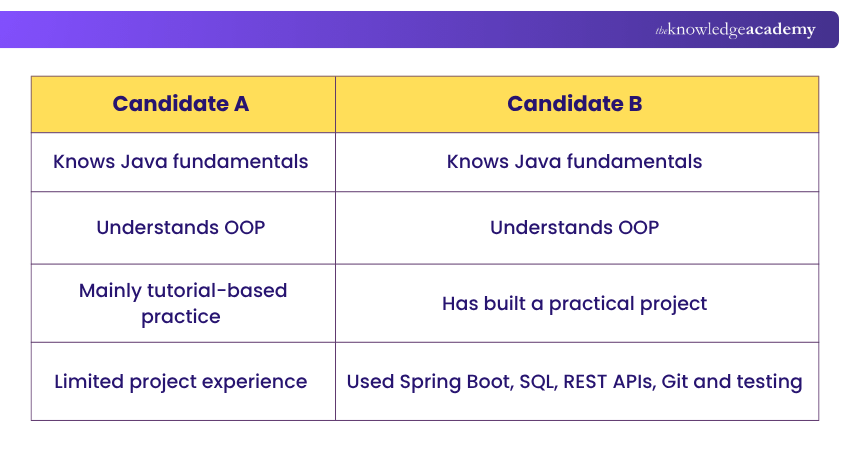
Who would you shortlist for an interview?
☐ Candidate A
☐ Candidate B
Take a moment to decide before reading further.
Answer: Candidate B may be the stronger choice because they demonstrate both Java knowledge and practical development experience. However, the final decision would also depend on factors such as problem-solving ability, code quality and the specific requirements of the role.
Gain an understanding of the Java naming convention to enhance coding readability with our Java Engineer Training – Register now!
Advanced Java Developer Skills
Once developers have established strong fundamentals and gained practical experience in Java, they can expand into areas associated with larger, distributed or production-scale applications.
Now, let’s check the advanced skills that can help Java Developers work with more complex development environments:
1) Microservices
Microservices architecture divides an application into smaller services that can be developed and deployed with a degree of independence.
Java Developers working with microservices should understand service communication, API design, configuration, resilience and distributed-system challenges.
The goal is not to use microservices for every application but to understand when this architectural approach is appropriate.
2) Secure Application Development
Developers share responsibility for building secure software.
Useful areas of knowledge include:
1) Authentication and authorisation
2) Input validation
3) Secure API development
4) Dependency management
5) Secrets management
6) Common application vulnerabilities
Security should be considered throughout development rather than treated only as a final check before deployment.
3) Performance Optimisation
As applications become larger, developers may need to identify performance bottlenecks and understand how the Java Virtual Machine (JVM), memory management and application code affect performance.
Relevant skills can include profiling, monitoring memory usage, analysing garbage collection behaviour and optimising database or application operations.
Pro Tip
Before optimising your Java application, identify where performance issues actually occur. Use profiling, monitoring or benchmarks to find slow code, database queries or resource-heavy operations, then focus your improvements where they matter most.
4) Containerisation and Deployment
Containerisation can help package applications with the dependencies and configuration required to run consistently across environments.
Java Developers may benefit from understanding Docker and the basic principles of container orchestration, particularly when working with cloud-native or microservices-based applications.
5) Cloud Fundamentals
Java applications are frequently deployed to cloud environments. Developers do not necessarily need to become cloud architects, but understanding fundamental cloud concepts can make deployment and troubleshooting easier.
Useful areas include compute, storage, databases, networking, identity and application monitoring.
6) CI/CD Practices
Continuous Integration (CI) and Continuous Delivery or Continuous Deployment (CD) help teams automate stages of building, testing and delivering software.
Java Developers should understand where their code fits within the delivery pipeline and how automated checks help identify problems before changes reach production.
Soft Skills for Java Developers
Technical ability determines what you can build, but success in a development role also depends on how effectively you solve problems, communicate and work with others. Here are the soft skills required for Java Developers:
1) Problem-solving
Java Developers regularly encounter bugs, unexpected application behaviour and changing requirements. Strong problem-solving involves breaking a larger issue into smaller parts, identifying possible causes and testing solutions systematically.
2) Communication
Developers need to communicate technical information to colleagues with different levels of technical knowledge.
Clear communication is particularly important when discussing requirements, documenting decisions, reviewing code and explaining technical problems.
3)Teamwork and Collaboration
Software development is usually collaborative. Java Developers may work with other developers, testers, DevOps professionals, designers, Product Managers and stakeholders.
Being receptive to feedback, contributing to code reviews and sharing knowledge can improve both individual and team performance.
4) Continuous Learning and Adaptability
Java and its surrounding ecosystem continue to evolve. Developers therefore need to be comfortable learning new language features, libraries, frameworks and development practices.
Continuous learning does not mean chasing every new technology. It means recognising which changes are relevant to your role and updating your knowledge accordingly.
5) Attention to Detail
Java Developers need strong attention to detail when writing, reviewing and testing code. Small errors in logic, syntax, configuration or data handling can affect how an application performs.
Careful attention helps developers identify potential issues, maintain code quality and reduce errors before they affect users or reach production.
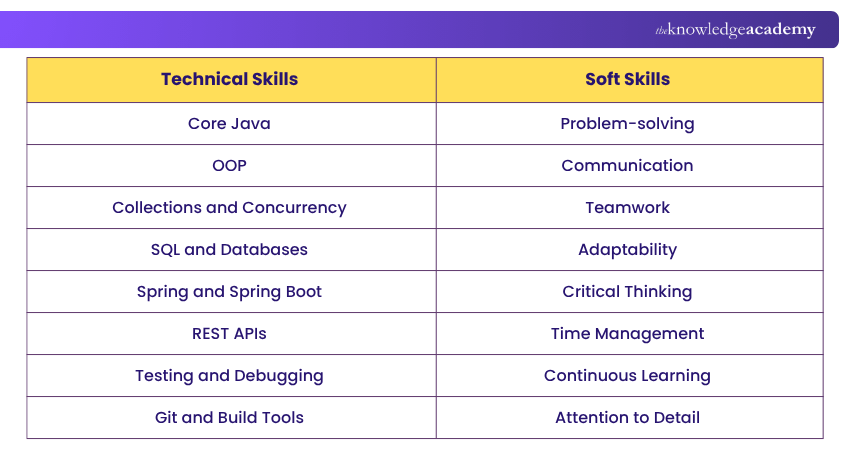
Technical vs Soft Java Developer Skills
The table below provides a quick comparison of the technical and soft skills useful for Java Developers:
Java Developer Skills Checklist
Before moving towards professional Java Development, ask yourself:
Can I write and understand Java code confidently?
Do I understand OOP rather than simply memorising its four principles?
Can I work with collections and handle exceptions appropriately?
Can I connect a Java application to a database?
Can I build and consume REST APIs?
Can I write automated tests and debug problems?
Can I use Git as part of a development workflow?
Do I understand Maven or Gradle?
Can I explain how Spring Boot fits into Java backend development?
Have I built projects that combine several of these skills?
You do not need to master everything before pursuing a Java Developer role. Use the checklist to identify the areas where additional practice would provide the most value.
Conclusion
Building strong Java Developer Skills involves more than knowing how to write code. It is about turning that knowledge into applications that work effectively and solve real problems. From mastering the fundamentals to exploring advanced technologies, every new skill adds to your toolkit. Keep learning, keep building and let every project take your Java journey one step further.
Develop an understanding of Java programming with our Java Programming Course – Join now!
Frequently Asked Questions
Can I Become a Java Developer Without a Computer Science Degree?

A Computer Science degree can provide useful theoretical foundations, but Java Development also depends heavily on demonstrable programming ability. Building strong fundamentals, practising consistently and developing projects can help demonstrate your technical capabilities.
Is Spring Boot Necessary for Java Developers?
Not every Java role requires Spring Boot. However, it is highly relevant to many Java backend and enterprise-development roles, making it a useful skill for developers targeting those areas.
What Java Projects Should Beginners Build?
Beginners can start with projects such as a Task Manager, expense tracker, library management system or simple REST API. Start with smaller applications that strengthen Core Java and OOP skills, then progress towards projects that incorporate databases, testing and frameworks such as Spring Boot.
Do Java Developers Need to Know Cloud Computing?
Cloud knowledge is not required for every entry-level Java role. However, understanding cloud fundamentals becomes increasingly useful when working with modern production environments, distributed applications and cloud-native systems.

Richard Harris


Senior Full Stack Developer and Technology Educator
Richard Harris is a highly experienced full-stack developer with deep expertise in both frontend and backend technologies. Over his 12-year career, he has built scalable web applications for startups, enterprises and government organisations. Richard’s writing combines technical depth with clear explanations, ideal for developers looking to grow in modern frameworks and tools.


 If you wish to make any changes to your course, please


