


We may not have the course you’re looking for. If you enquire or give us a call on 01344203999 and speak to our training experts, we may still be able to help with your training requirements.
Top Financial Modelling Skills to Build Financial Expertise
ByThe Knowledge AcademyLast updated on: 18 November 2026
Learn about the essential financial modelling skills and understand how these skills help professionals build accurate financial models, evaluate investments and make informed business decisions.

Quick Preview
1. Accounting and Forecasting: Understand financial statements and predict future financial performance.2. Excel Skills: Build and manage financial models using spreadsheets, formulas and functions.3. Model Validation: Check calculations, identify errors and improve model accuracy.4. Financial Analysis and Valuation: Analyse financial performance and assess investment opportunities.5. Technology and Problem-solving: Use digital tools and analytical skills to solve modelling challenges.6. Communication and Attention to Detail: Present financial findings clearly and ensure accuracy in financial models.
Revenue: Increasing
Expenses: Rising
Profit margins: Shrinking
The question: What happens next?
Numbers show what's happening, but understanding what they mean for the future requires deeper analysis. Financial modelling helps professionals examine financial performance, test assumptions and forecast possible outcomes.
But building reliable models requires a combination of financial knowledge, technical expertise and analytical thinking. Let's explore the key financial modelling skills that help finance professionals turn numbers into meaningful business insights.
Essential Financial Modelling Skills
Financial Modelling is the process of creating structured, quantitative representations of a business, project or investment to analyse financial performance, forecast future outcomes and support business decisions. The effectiveness of a financial model depends on how accurately information is organised, assumptions are evaluated and results are interpreted.
Here are the essential Financial Modelling Skills that help professionals build reliable models and support informed decision-making.
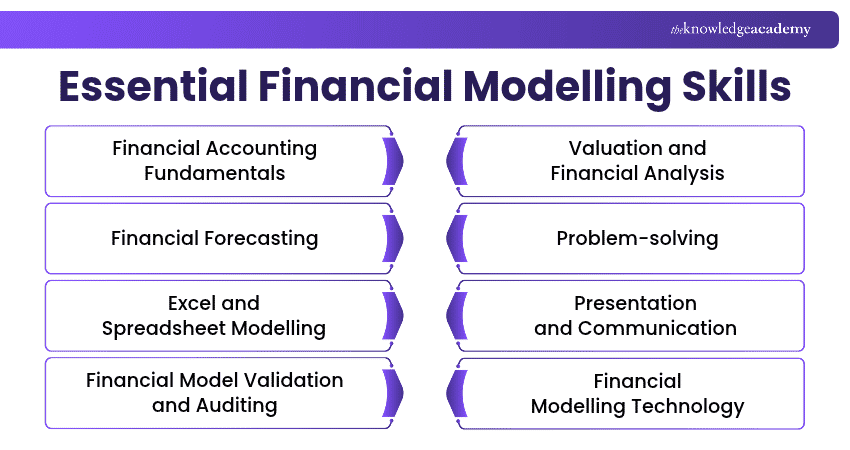
1) Financial Accounting Fundamentals
Accounting involves recording, summarising and reporting a company's financial transactions and events. It provides the foundation for financial modelling by helping professionals understand financial statements, accounting principles, and reporting standards.
Accounting skills are essential because they enable professionals to:
a) Interpret and extract relevant information from financial statements, including revenue, expenses, assets, liabilities and equity.
b) Apply appropriate accounting principles and standards relating to accruals, revenue recognition, depreciation and other financial transactions.
c) Identify and account appropriately for non-recurring, non-cash and non-operating items, such as restructuring costs, share-based compensation and interest income, based on the model's purpose and the applicable accounting treatment.
d) Reconcile financial statements and understand how changes in one statement affect the others.

2) Financial Forecasting
Financial forecasting involves estimating the future financial outcomes of a company, project, or investment using historical data, assumptions, and market conditions. It is a key component of financial modelling because it helps businesses anticipate financial performance and evaluate possible future scenarios.
Forecasting skills enable professionals to:
a) Collect and analyse historical financial data to identify trends and performance drivers, including sales growth, profit margins and operating costs.
b) Develop reasonable assumptions based on business expectations, economic conditions, and relevant financial information.
c) Apply forecasting techniques to estimate revenue, operating expenses, working capital requirements, and future cash flows.
d) Conduct sensitivity and scenario analyses to assess how changes in assumptions affect projected financial performance.
For example, a company can forecast its revenue under different sales growth assumptions to understand how changes in demand could influence profitability and cash flow.
3) Excel and Spreadsheet Modelling
Excel and spreadsheet modelling involves using spreadsheet software to create, structure, and manage financial models. Microsoft Excel remains a widely used tool for financial modelling because it supports calculations, data analysis, forecasting, and automation. Strong spreadsheet skills help professionals build models that are easier to understand, maintain, and update.
These skills enable professionals to:
a) Design and structure financial models logically using consistent worksheets, clearly labelled assumptions and separate sections for inputs, calculations and outputs.
b) Apply Excel formulas and functions, such as SUMIFS, XLOOKUP, INDEX, MATCH and IF, to perform calculations and connect financial information.
c) Organise and analyse financial data using tables, charts and PivotTables, where appropriate.
d) Apply spreadsheet features that improve model usability, consistency and efficiency, such as named ranges, data validation and conditional formatting.
e) Document model assumptions and maintain consistent formatting to improve readability and usability.
For example, a Financial Analyst can build a three-statement model in Excel that automatically updates projected cash flows when revenue growth or operating cost assumptions change.
4) Financial Model Validation and Auditing
Financial model validation and auditing involve reviewing financial models to assess the accuracy, consistency, and reliability of their calculations, assumptions, and outputs. This skill is essential because errors in a financial model can lead to misleading projections and poor business decisions.
Model validation skills enable professionals to:
a) Verify the sources, inputs and assumptions used in financial models through cross-referencing and supporting documentation.
b) Identify formula errors, broken links, unintended circular references and inconsistencies using Excel's formula auditing and error-checking tools.
c) Review model calculations and methodologies to ensure they follow a logical and reasonable approach.
d) Perform reconciliation checks, including confirming that the balance sheet balances and that cash movements are correctly reflected.
e) Document identified issues, corrections and recommendations to improve model reliability.
For example, if a projected balance sheet does not balance, model validation techniques can help identify missing cash flow adjustments, incorrect formulas, or inconsistent assumptions.
Trainer's Insight: A financial model should be tested under different assumptions, including unexpected or extreme scenarios. This helps identify weaknesses that may not appear under normal forecast conditions.
5) Valuation and Financial Analysis
Valuation and financial analysis involve assessing the financial performance, investment potential, and estimated value of a business, project, or asset. These skills are important because financial models are frequently used to evaluate investments, compare opportunities, and support strategic decisions.
Valuation and financial analysis skills enable professionals to:
a) Interpret financial ratios, profitability measures and cash flow indicators to evaluate business performance.
b) Apply valuation techniques, such as Discounted Cash Flow (DCF) analysis, comparable company analysis and transaction-based valuation.
c) Calculate financial measures, such as Net Present Value (NPV) and Internal Rate of Return (IRR), to assess investment opportunities.
d) Examine how assumptions about growth, profitability, discount rates and capital requirements affect estimated valuations.
e) Compare financial outcomes and evaluate potential investment opportunities based on their risks and expected returns.
For example, a financial analyst may use a DCF model to estimate the value of a business based on projected cash flows and compare the result against its current market valuation.
Learn how financial transactions shape business performance with Financial Accounting Course – Sign up soon!
6) Problem-solving
Financial modelling often involves incomplete information, inconsistent data, calculation errors, and uncertain assumptions. Effective problem-solving helps professionals address these challenges systematically.
Problem-solving skills enable professionals to:
a) Identify issues affecting financial models, such as missing information, calculation discrepancies and unrealistic projections.
b) Investigate the causes of problems by reviewing formulas, data sources, assumptions, and relationships between financial statements.
c) Evaluate alternative approaches to address modelling challenges, including adjusting assumptions, correcting calculations, or simplifying model structures.
d) Apply appropriate solutions and examine their impact on financial model outputs.
For example, if forecasted cash flows appear inconsistent with expected revenue growth, a modeller can investigate working capital assumptions, payment terms, and operating expenses to identify the cause.
7) Presentation and Communication
Presentation and communication involve explaining financial models, their results, and their implications to the intended audience. These skills are important because financial models often support decisions made by managers, investors, and other stakeholders who may not be directly involved in building them.
Presentation and communication skills enable professionals to:
a) Organise financial information into clear summaries highlighting important findings, assumptions and financial outcomes.
b) Present financial results using relevant charts, graphs, tables, and financial dashboards.
c) Explain complex calculations and modelling assumptions in language that is understandable to the intended audience.
d) Communicate financial risks, uncertainties and alternative outcomes to support informed decisions.
For example, a Financial Analyst may use a dashboard to illustrate how different revenue growth scenarios affect profitability and cash flow.
Pro Tip: When presenting a financial model, focus on the assumptions, outcomes and decisions that matter most to the audience rather than explaining every calculation.
8) Financial Modelling Technology
Financial modelling technology involves using appropriate digital tools to build, analyse, maintain, and improve financial models.
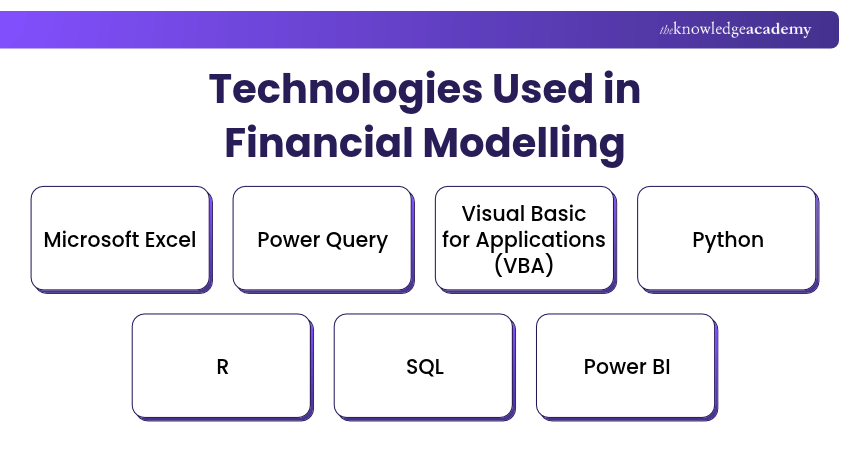
Technology skills enable professionals to:
a) Select appropriate technologies for financial modelling tasks based on data complexity, automation requirements and the intended outputs.
b) Apply programming and data analysis tools, such as Python, R and SQL, where appropriate for financial data processing and analysis.
c) Use Power Query to import, clean, transform and refresh financial data from supported sources.
d) Apply automation tools, including Visual Basic for Applications (VBA) and other suitable technologies, to reduce repetitive manual tasks.
e) Explore AI-assisted tools for generating formulas, supporting data analysis and identifying potential modelling issues while independently verifying their outputs.
For example, Python can help analyse large financial datasets, while Power Query can streamline the preparation of financial information used in Excel models.
9) Attention to Detail
Attention to detail is the ability to recognise and manage small but important elements within financial models. This skill is essential because even minor errors in figures, formulas, or assumptions can significantly affect financial projections and valuation results.
Attention to detail skills enable professionals to:
a) Review financial inputs, assumptions and calculations to identify inconsistencies or incorrect values.
b) Maintain consistent units, currencies, dates, and financial reporting periods throughout a model.
c) Check formulas, cell references and calculation methods when updating financial information.
d) Maintain clear documentation and appropriate version control when modifying financial models.
For example, using figures expressed in thousands alongside figures expressed in millions without appropriate conversion can produce significantly misleading financial results.
10) Analytical Thinking
Analytical thinking involves applying logical reasoning and critical evaluation to understand financial information and interpret modelling results. It helps professionals identify patterns, assess financial performance, and draw meaningful conclusions from complex data.
Analytical thinking skills enable professionals to:
a) Analyse financial results using ratios, historical trends and relevant performance benchmarks.
b) Identify relationships between financial variables, such as revenue growth, operating expenses, profitability, and cash flow.
c) Compare different financial scenarios to understand their potential benefits, limitations and trade-offs.
d) Evaluate whether model outputs are reasonable and consistent with business conditions and underlying assumptions.
e) Summarise financial findings and develop evidence-based recommendations for business decisions.
For example, an analyst may examine a company's declining profit margins despite increasing revenue to determine whether rising costs, pricing changes, or operational inefficiencies are affecting performance.
Develop the skills to support effective financial planning with Financial Modelling and Forecasting Training – Join now!

The Knowledge Academy develops accessible learning content across Project Management, IT, Cybersecurity, Data Science, Business Analysis, HR, Accounting and Finance, Leadership and Health and Safety. Its resources combine subject research with clear explanations to help professionals build practical knowledge across a wide range of disciplines.
View Detail

 If you wish to make any changes to your course, please


