


We may not have the course you’re looking for. If you enquire or give us a call on 01344203999 and speak to our training experts, we may still be able to help with your training requirements.
Essential Technical and Soft Skills for an Enterprise Architect
ByThe Knowledge AcademyLast updated on: 13 November 2026
Enterprise Architect skills combine technical expertise, strategic thinking and leadership to align technology with business goals. From cloud computing and data modelling to communication and problem-solving, these skills help architects design effective enterprise structures and support digital transformation.
At a Glance
1. Technical Expertise: Strong knowledge of cloud computing, infrastructure, data architecture, security and architecture frameworks.2. Strategic Alignment: Connecting technology decisions and investments with business goals.3. Soft Skills: Communication, leadership, critical thinking and creativity enable effective decision-making.4. Continuous Development: Staying current with emerging technologies, architecture practices and evolving business needs.
Imagine an organisation where every application, business process, and technology investment works towards the same goal. Behind this alignment is an Enterprise Architect who connects business strategy with technology decisions and long-term planning.
Enterprise Architects evaluate how business processes, applications, data and technology work together. They develop architecture roadmaps, guide technology decisions and support organisational transformation.
Enterprise Architect skills extend beyond technical knowledge. They require the ability to evaluate complex systems, communicate with stakeholders, and guide architectural decisions that support organisational growth. This blog explores the essential technical and soft skills that help Enterprise Architects succeed.
Top Enterprise Architect Skills
Technical skills help architects understand and evaluate enterprise systems, while soft skills enable them to influence decisions, collaborate with stakeholders, and align architecture with organisational priorities. Let's explore both below.

1) Technical Skills
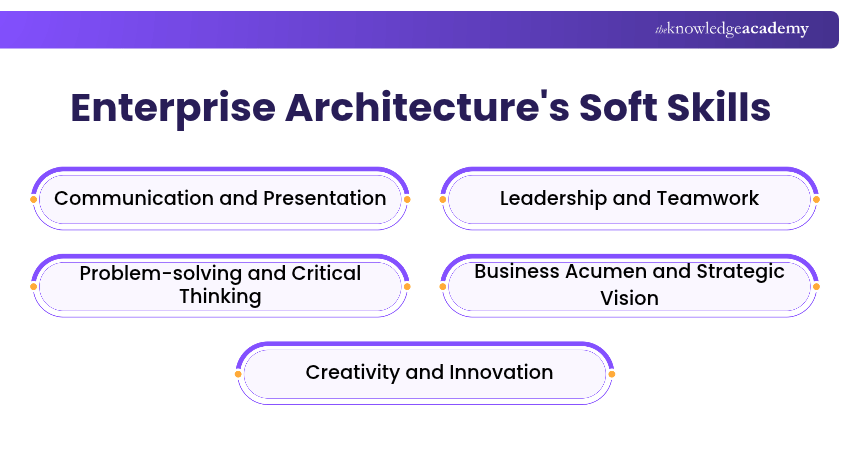
Technical skills relate to the technical aspects of enterprise architecture, such as designing, evaluating and governing the systems and processes that support business goals and strategies. They include:
a) Cloud Computing
Enterprise Architects need to understand how to leverage cloud computing to optimise their organisation's technology capabilities. They should be familiar with public, private, and hybrid cloud environments, as well as multi-cloud strategies involving multiple cloud providers.
For example, an Enterprise Architect may evaluate public cloud platforms such as AWS, Microsoft Azure, or Google Cloud for hosting applications and data services. They may also assess private cloud technologies such as OpenStack or VMware-based infrastructure to support connectivity across cloud and on-premises environments.
Pro Tip
Enterprise architecture rarely involves a single perfect solution. Evaluate the trade-offs between cost, performance, security and flexibility before recommending an approach. Document why particular alternatives were rejected to support future decisions.
b) Infrastructure Design and Management
Infrastructure design and management involves planning and evaluating the physical and virtual components of an IT environment, such as hardware, software, networks, servers, devices, and platforms.
Their responsibilities typically involve establishing architectural principles, identifying dependencies, and recommending infrastructure improvements rather than directly managing routine maintenance or resolving individual technical incidents.
For example, an Enterprise Architect may assess whether an organisation's existing infrastructure can support increased transaction volumes, new digital services, or future expansion. They may recommend infrastructure modernisation, improved redundancy, or changes to the architecture to address performance and resilience requirements.
c) Data Architecture and Modelling
Data architecture and modelling involve understanding how enterprise data is structured, organised, integrated and governed to support business requirements. These capabilities help Enterprise Architects evaluate data relationships, information flows and the consistency of data across systems.
For example, an Enterprise Architect may use data modelling tools such as the erwin Data Modeler or SAP PowerDesigner to understand data structures and relationships. They may also assess technologies such as Azure Data Factory for data integration or Apache Kafka for event streaming when evaluating how information moves across enterprise systems.
d) Enterprise Architecture Frameworks and Tools
Enterprise architecture frameworks and tools include standardised methodologies, models, languages and software used to describe and document the structure, components, relationships and principles of an enterprise. They help create a common and consistent view of business processes, applications, data and technology.
For example, they may use the Zachman Framework to organise enterprise architecture information across different stakeholder perspectives and architectural dimensions.
e) Security and Compliance
Security and compliance involve protecting systems and information against unauthorised access, modification, disruption or damage while addressing relevant laws, regulations, standards, and organisational policies.
Enterprise Architects need to understand how security requirements influence the design and evolution of enterprise systems. They should be able to evaluate architectural risks, identify security dependencies, and recommend approaches that support confidentiality, integrity and availability.
For example, an Enterprise Architect may refer to ISO/IEC 27001:2022 to understand requirements for an Information Security Management System (ISMS).
Build strong foundations for smarter enterprise architecture with the Enterprise Architecture Green Belt Training – Join now!
2) Soft Skills
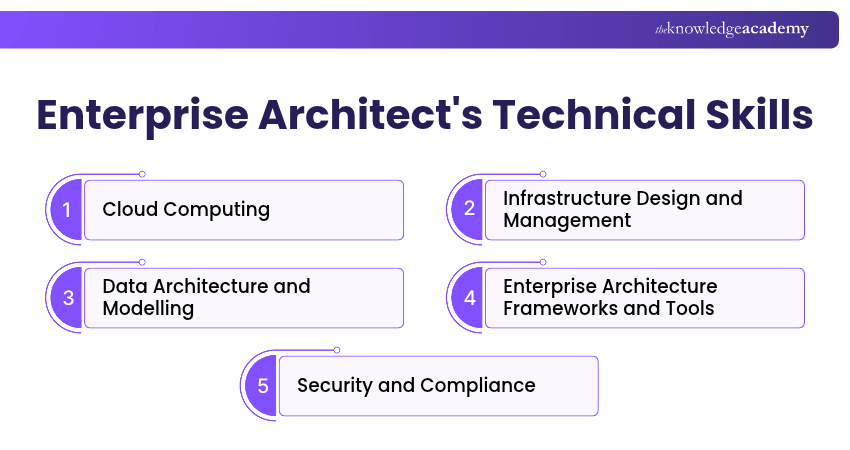
Soft skills relate to the interpersonal, communication, and decision-making aspects of enterprise architecture. They help architects work with stakeholders, influence technical and business decisions, collaborate across teams, and align proposed solutions with organisational strategy. They include:
a) Communication and Presentation
Communication and presentation are the skills of expressing and exchanging information clearly and effectively, verbally and in writing, with different audiences and purposes. Enterprise Architects need to communicate their ideas, plans, designs and recommendations to stakeholders, such as business leaders, customers, vendors, regulators and peers.
For example, an Enterprise Architect may use communication tools such as Microsoft Teams or Slack to collaborate with colleagues and exchange project information. They may also use PowerPoint or Prezi to present architecture roadmaps and explain the potential business outcomes of recommended technology changes.
b) Leadership and Teamwork
Leadership and teamwork involve inspiring, motivating and guiding others towards common objectives while cooperating effectively with different teams. Enterprise Architects need to provide architectural direction, build consensus, and encourage collaboration between business and technology functions.
For example, an Enterprise Architect may use tools such as Trello or Asana to coordinate architectural activities and track dependencies. They may also collaborate through Zoom or Google Meet to discuss architecture recommendations, address stakeholder concerns, and agree on future actions.
c) Problem-solving and Critical Thinking
Problem-solving and critical thinking involve identifying, analysing and addressing problems logically and systematically while evaluating the validity and reliability of information and arguments. Enterprise Architects need to solve complex architectural challenges by examining business requirements, technical constraints, system dependencies, and alternative solutions.
For example, an Enterprise Architect may use Miro or Lucidchart to map dependencies between applications and identify architectural bottlenecks. They may then compare alternative solutions through structured assessments to determine which approach best addresses organisational requirements.
d) Business Acumen and Strategic Vision
Business acumen and strategic vision involve understanding the business context in which systems and processes operate and developing a long-term architectural direction that supports organisational objectives. Enterprise Architects must know how to align technology capabilities with business needs by conducting assessments such as SWOT analysis and gap analysis.
For example, an Enterprise Architect may use Excel or Power BI to examine investment costs, business performance indicators, and operational data. They may also use MindManager or XMind to organise architectural priorities and communicate long-term plans to stakeholders.
Trainer's Insight
A roadmap becomes more useful when it identifies the conditions that must be satisfied before moving to the next stage. Including measurable decision points allows organisations to reassess priorities when business requirements or technical constraints change.
e) Creativity and Innovation
Enterprise Architects need to think creatively when exploring architectural alternatives and addressing complex business and technology challenges. They may use methods such as brainstorming, prototyping, experimentation, and testing to evaluate different approaches.
For example, an Enterprise Architect may use collaborative tools such as Mural, Miro, or FigJam to brainstorm ideas and visualise potential architecture changes with stakeholders.
Learn complex architectures to drive powerful business transformation with the Enterprise Architecture Black Belt Training – Sign up today!

The Knowledge Academy develops accessible learning content across Project Management, IT, Cybersecurity, Data Science, Business Analysis, HR, Accounting and Finance, Leadership and Health and Safety. Its resources combine subject research with clear explanations to help professionals build practical knowledge across a wide range of disciplines.
View Detail

 If you wish to make any changes to your course, please


