




We may not have the course you’re looking for. If you enquire or give us a call on 01344203999 and speak to our training experts, we may still be able to help with your training requirements.
Essential Delegation Skills and How to Improve Them
ByThe Knowledge AcademyLast updated on: 26 November 2026
Delegation skills help leaders assign tasks effectively, manage workloads and support team development. Explore the essential skills needed for successful delegation, practical ways to improve them and a workplace example that demonstrates these skills in action.

The Rundown
Effective delegation helps leaders distribute responsibilities while encouraging employee growth. Here's what makes it work:
1. Task Selection: Identify responsibilities that can be delegated safely and effectively.2. Clear Communication: Explain objectives, deadlines and expected outcomes.3. Employee Capabilities: Consider individual skills, experience and workloads before assigning tasks.4. Accountability: Clarify responsibilities, decision-making authority and progress expectations while maintaining managerial oversight.5. Team Development: Use delegation to build employee confidence, independence and professional skills.
Have you ever felt like there are not enough hours in the day to complete everything on your to-do list? Many managers and team leaders face constant pressure to deliver results while managing multiple responsibilities simultaneously. This is where strong delegation skills make a difference, helping you share tasks effectively while maintaining quality and accountability.
Effective delegation can also improve productivity, build trust and create opportunities for employees to develop their skills. So, how can you become better at delegating? Let's explore the essential skills and practical ways to strengthen them.
Essential Delegation Skills
Effective delegation skills help leaders distribute tasks efficiently while ensuring that team members understand their responsibilities. Here are some of the essential skills for successful delegation:
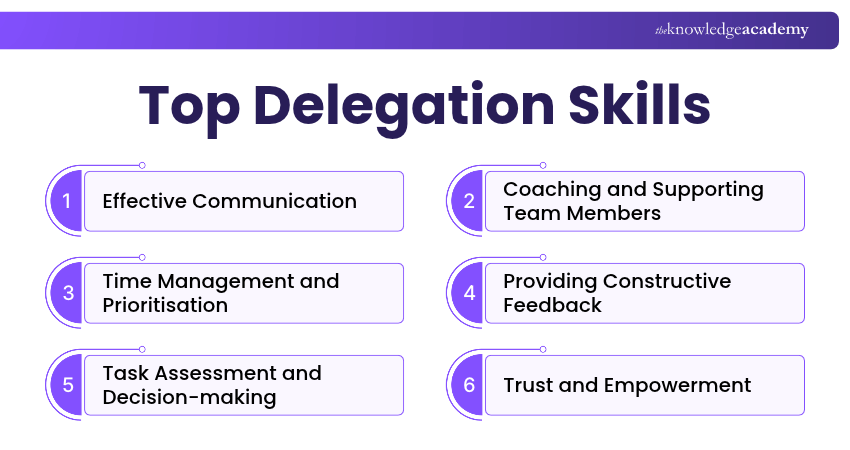
1) Effective Communication
Effective communication is essential for successful delegation. Managers must clearly explain task objectives, deadlines and expected outcomes so that team members understand their responsibilities. Active listening also helps leaders address questions, clarify expectations and prevent misunderstandings.

2) Coaching and Supporting Team Members
Effective delegation requires leaders to assess whether team members need additional guidance to complete assigned tasks. They can provide support through on-the-job training, mentoring or practical demonstrations. This helps employees develop confidence and handle new responsibilities effectively.
3) Time Management and Prioritisation
Good time management helps leaders prioritise responsibilities, set realistic deadlines and allocate enough time for employees to complete delegated work. Managers should also consider task dependencies and schedule progress reviews to keep activities on track.
4) Providing Constructive Feedback
Providing feedback helps team members understand their progress and identify areas for improvement. Leaders should recognise achievements, offer practical suggestions and address challenges when necessary. Constructive feedback encourages continuous learning and supports better performance.
5) Task Assessment and Decision-making
Leaders must assess which tasks are suitable for delegation within their authority and which require their direct attention. This involves considering each task's complexity, importance, risks and the authority needed to complete it. Good decision-making helps managers assign responsibilities appropriately without compromising important outcomes.
Pro Tip
When delegating, make it clear which decisions employees can make independently and which require your approval. This gives them the confidence to take initiative while preventing confusion over responsibilities and authority.
6) Trust and Empowerment
Trust allows leaders to give employees the independence needed to complete assigned responsibilities. Rather than controlling every step, managers should encourage initiative and allow team members to make decisions within agreed limits. This helps employees develop confidence and a sense of ownership.
Turn people skills into leadership strengths with the Introduction to Managing People Training today!
How to Improve Delegation Skills?
Improving delegation skills requires continuous learning, self-assessment and practical experience. The following approaches can help you delegate responsibilities more confidently:
a) Evaluate Your Delegation Skills: Assess how effectively you delegate tasks and identify areas for improvement, such as communication or time management. Seek feedback from colleagues, team members or mentors to understand your strengths and weaknesses.
b) Learn From Training and Mentorship: Attend training programmes or workshops to develop practical delegation techniques. You can also observe experienced leaders and seek guidance from mentors to improve how you assign responsibilities and support your team.
Trainer's Insight
If you are new to delegation, start with smaller, manageable responsibilities before assigning more complex work. This allows you to practise giving instructions, providing support and reviewing outcomes while gradually building confidence in your delegation abilities.
c) Identify the Right Tasks to Delegate: Review your workload and identify tasks that others can manage effectively. Consider their importance, complexity and potential risks, while retaining responsibilities that require your direct involvement or specific authority.
d) Match Tasks to Employee Capabilities: Consider employees' skills, experience and workloads before assigning tasks. Confirm they have the capacity to take on the responsibility and provide additional guidance when assigning work that supports their professional development.
e) Set Clear Expectations and Provide Support: Explain the task objectives, deadlines and expected outcomes. Ensure employees understand their responsibilities, decision-making authority and available resources, while providing support when needed.
f) Monitor Progress and Give Feedback: Arrange suitable checkpoints to track progress without micromanaging. Provide timely feedback when needed and, once the task is completed, recognise achievements and discuss areas for improvement.
Learn to prioritise smarter, accomplish more every day with the Time Management Training – Join now!
Example of Effective Delegation in the Workplace
Imagine a Project Manager preparing for an upcoming project kick-off meeting. Instead of organising every detail personally, the manager delegates meeting preparation, coordination and facilitation to a team member with strong communication and organisational skills. Here's how the delegation process unfolds:
a) Assigning the Task: The manager selects a suitable employee and explains the meeting's objectives and expected outcomes.
b) Setting Expectations: The employee is responsible for preparing the agenda, coordinating with participants, organising meeting materials and facilitating the discussion within agreed decision-making limits.
c) Providing Support: The manager provides the necessary information, clarifies which decisions require approval and remains available for guidance.
d) Reviewing the Outcome: After the meeting, the manager reviews the agreed actions, recognises the employee's efforts and provides constructive feedback.
Outcome: The employee gains practical experience in meeting facilitation and coordination, allowing the Project Manager to focus on other responsibilities while retaining oversight of key decisions. This demonstrates how clear expectations, appropriate authority and ongoing support contribute to effective delegation.
Keep This in Mind
Effective delegation means assigning responsibility along with the authority, resources and support needed to complete the task. Agree on when progress should be reviewed, but allow employees enough independence to decide how the work gets done.

The Knowledge Academy develops accessible learning content across Project Management, IT, Cybersecurity, Data Science, Business Analysis, HR, Accounting and Finance, Leadership and Health and Safety. Its resources combine subject research with clear explanations to help professionals build practical knowledge across a wide range of disciplines.
View Detail

 If you wish to make any changes to your course, please


