


We may not have the course you’re looking for. If you enquire or give us a call on 01344203999 and speak to our training experts, we may still be able to help with your training requirements.
Top Decision Making Skills for Professional Success
ByThe Knowledge AcademyLast updated on: 19 November 2026
Explore the top decision making skills, including critical thinking, problem-solving, logical reasoning and risk assessment. Learn how these abilities help professionals evaluate options, manage uncertainty and make informed choices, with practical ways to improve their judgement.

The Gist
1. Decision making skills help individuals evaluate options and choose suitable courses of action.2. Essential skills include critical thinking, problem-solving, logical reasoning and risk assessment.3. Creativity, collaboration and decisiveness help professionals explore alternatives and make timely decisions.4. Regular practice, constructive feedback and reflection help strengthen decision making skills.
Imagine a Project Manager faces two urgent challenges:
a) A major client demands immediate changes.
b) This demand comes in when the team is racing to meet a project deadline.
With limited resources and time running out, how should you decide what to prioritise? Making an informed choice requires more than instinct. It demands strong decision making skills.
From evaluating risks to weighing alternatives, these skills help professionals navigate complex situations with confidence. This blog explores the essential decision making skills and practical ways to improve your judgement and make informed choices.
Essential Decision Making Skills
Strong decision making skills help professionals analyse situations, assess alternatives and respond effectively to challenges. From logical reasoning to emotional intelligence, each ability contributes to making thoughtful and informed choices. Let's explore the essential decision making skills:
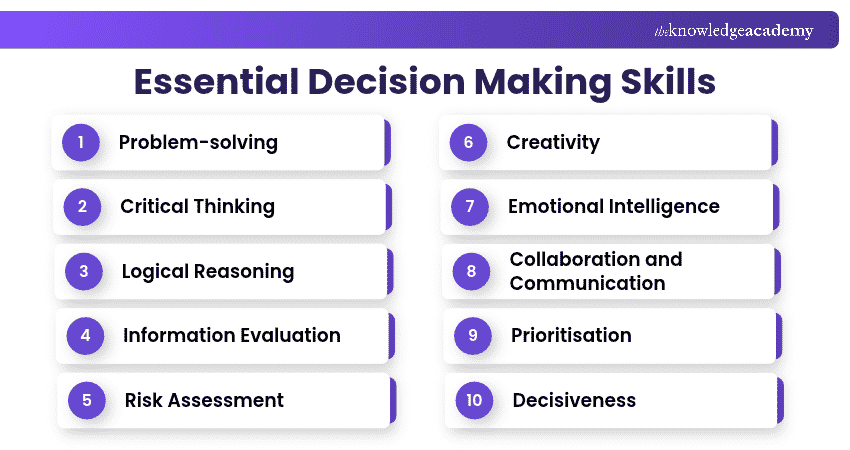
1) Problem-solving
Problem-solving involves identifying challenges, understanding their causes and developing suitable solutions. It helps individuals evaluate situations systematically rather than making decisions based on assumptions.
By exploring possible solutions and taking appropriate action, professionals can address unexpected issues and handle complex workplace challenges more effectively.

2) Critical Thinking
Critical thinking is the skill to evaluate information, question assumptions and examine evidence before reaching conclusions. It helps individuals recognise potential biases and consider different perspectives.
For example, before approving a business proposal, a manager may examine the supporting evidence, identify limitations and question whether the expected benefits are realistic.
3) Logical Reasoning
Logical reasoning involves analysing information and identifying connections between facts to reach well-supported conclusions. It helps professionals understand how different choices may lead to particular outcomes.
By examining how evidence supports a conclusion, individuals can compare alternatives and make decisions that follow a clear line of reasoning.
4) Information Evaluation
Information evaluation involves assessing the accuracy, relevance and reliability of information before using it to make decisions. It helps individuals distinguish trustworthy evidence from incomplete, outdated or misleading information.
For example, when choosing a software solution, a manager may compare product capabilities, costs, security requirements and verified user feedback. Evaluating these sources supports more informed decisions.
5) Risk Assessment
Risk assessment involves identifying uncertainties and evaluating the potential impact of risks associated with different decisions. It helps professionals understand what could go wrong and determine whether additional precautions are necessary.
For example, before introducing a new business system, an organisation may assess implementation costs, security risks and operational disruptions. This allows decisionmakers to compare potential benefits with possible drawbacks.
6) Creativity
Creativity helps individuals explore new ideas and develop solutions beyond conventional approaches. It encourages flexible thinking and allows decisionmakers to consider alternatives that may not be immediately obvious.
Brainstorming, collaborative discussions and experimenting with different approaches can help generate creative solutions, which can then be evaluated for practicality.
Think creatively, analyse smartly and decide confidently with the Creative and Analytical Thinking Training – Join now!
7) Emotional Intelligence
Emotional intelligence involves recognising, understanding and managing your own emotions while considering those of others. It helps individuals maintain perspective and respond thoughtfully during difficult decisions.
For example, a team leader handling a workplace disagreement may consider the concerns of everyone involved before deciding how to proceed. Emotional awareness can reduce unnecessary conflict and support balanced judgement.
8) Collaboration and Communication
Collaboration and communication help individuals gather different perspectives, share information and contribute to individual or collective decisions. They encourage open discussions and allow team members to contribute ideas or raise concerns.
For example, a marketing team planning a new campaign may discuss customer feedback, available resources and possible strategies before selecting an approach. This collaborative process can improve the quality of the decision.
Pro Tip
Set a realistic deadline for important decisions and identify the information you genuinely need. Once you have sufficient evidence, make your choice rather than delaying it in search of perfect certainty.
9) Prioritisation
Prioritisation involves identifying which tasks, problems or decisions require attention first. It helps professionals allocate time and resources according to urgency, importance and potential impact.
By focusing on the most significant priorities, individuals can manage competing responsibilities without overlooking important consequences.
10) Decisiveness
Decisiveness is the ability to make timely choices using available information and sound judgement. It involves evaluating relevant factors, selecting an appropriate course of action and accepting responsibility for the outcome.
Being decisive does not mean acting impulsively. Instead, it requires recognising when sufficient information is available and avoiding unnecessary delays. This skill helps professionals respond confidently while remaining open to adjustments when circumstances change.
Learn how to turn complex problems into clever solutions with the Problem Solving Course – Sign up now!
How to Improve Decision Making Skills?
Improving decision making skills requires regular practice, reflection and a willingness to consider different perspectives. The following practical ways can help you strengthen your judgement and make more informed choices:
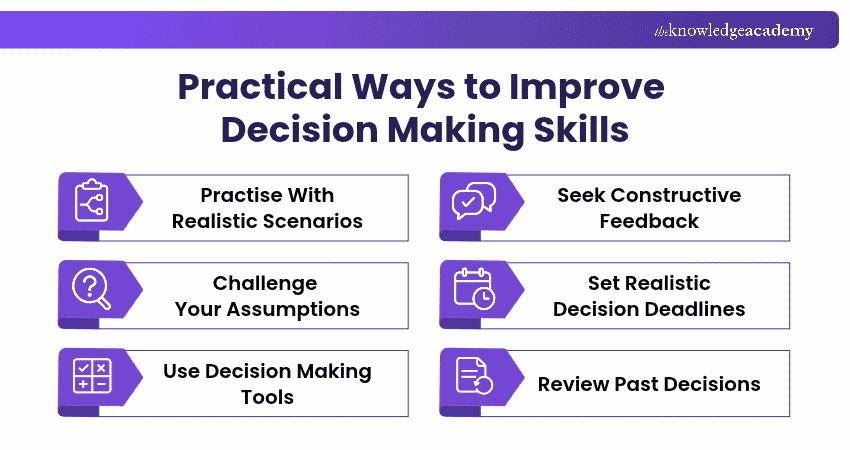
1) Practise With Realistic Scenarios
Use everyday workplace situations to practise making decisions. Consider the available information, possible solutions and potential consequences before selecting an approach. Starting with manageable challenges can help you gradually develop confidence in handling more complex decisions.
2) Challenge Your Assumptions
Before reaching a conclusion, question whether your initial judgement is supported by reliable evidence. Consider alternative explanations and viewpoints to identify information you may have overlooked. This approach can help mitigate bias and improve critical thinking.
3) Use Decision Making Tools
Analytical tools can help you compare alternatives systematically. For example, a decision matrix allows you to evaluate options against selected criteria, while a pros-and-cons list highlights possible advantages and disadvantages. SWOT analysis can also help assess broader strategic decisions by examining strengths, weaknesses, opportunities and threats.
4) Seek Constructive Feedback
Discuss important decisions with colleagues, mentors or experienced professionals. Their perspectives can help identify overlooked risks, alternative solutions and opportunities for improvement. Constructive feedback also helps you understand how your decisions affect others.
5) Set Realistic Decision Deadlines
Establish appropriate timeframes for making decisions to avoid unnecessary delays. Consider the importance and complexity of each situation before deciding how much time to allocate. Clear deadlines can help you remain focused while allowing sufficient time to gather essential information.
6) Review Past Decisions
Reflect on previous decisions to understand what worked and what could have been improved. Compare the expected outcomes with the results and identify any assumptions or information gaps. This process helps strengthen judgement and supports continuous learning.
Pro Tip
Maintain a simple decision journal for important choices. Record the available options, your reasoning and the expected outcome. Review the results later to identify patterns and improve future decisions.
Learn to turn clear thinking into confident action with the Practical Thinking Course – Join today!

The Knowledge Academy develops accessible learning content across Project Management, IT, Cybersecurity, Data Science, Business Analysis, HR, Accounting and Finance, Leadership and Health and Safety. Its resources combine subject research with clear explanations to help professionals build practical knowledge across a wide range of disciplines.
View Detail

 If you wish to make any changes to your course, please


