




We may not have the course you’re looking for. If you enquire or give us a call on 01344203999 and speak to our training experts, we may still be able to help with your training requirements.
Home
 Resources
Business Skills
Creative Thinking Skills: Importance, Examples and How to Improve Them
Resources
Business Skills
Creative Thinking Skills: Importance, Examples and How to Improve Them
Resources
Business Skills
Creative Thinking Skills: Importance, Examples and How to Improve Them
Creative Thinking Skills: Importance, Examples and How to Improve Them
ByThe Knowledge AcademyLast updated on: 11 September 2026
Explore key creative thinking skills, understand their importance, discover practical examples, and learn effective ways to strengthen your creative abilities.
Quick challenge: Think of three completely different ways to use an empty cardboard box. Easy? Now think of ten.
The further you move beyond the obvious answers, the more you begin to exercise creative thinking. It is not simply about having unusual ideas; it involves exploring possibilities, making connections, and finding new approaches to challenges.
Often, creativity begins exactly where the obvious answers end. So, what actually happens when we start thinking creatively? Let’s find out.
What are Creative Thinking Skills?
Creative thinking skills are the abilities that help you generate, explore, connect and develop ideas in ways that go beyond obvious or familiar approaches. They enable you to consider a problem from different perspectives, question assumptions, recognise unexpected connections and test alternative solutions.
Creative thinking is therefore broader than simply "having good ideas". It involves several complementary abilities, including curiosity, open-mindedness, divergent thinking, experimentation, and evaluation.

Why are Creative Thinking Skills Important?
Creative thinking is important because it helps people look at situations differently, explore new possibilities, and find alternative ways to solve problems. They can be useful in everyday situations as well as in professional environments where adaptability and new ideas are valued. Here are some key reasons why creative thinking skills matter:
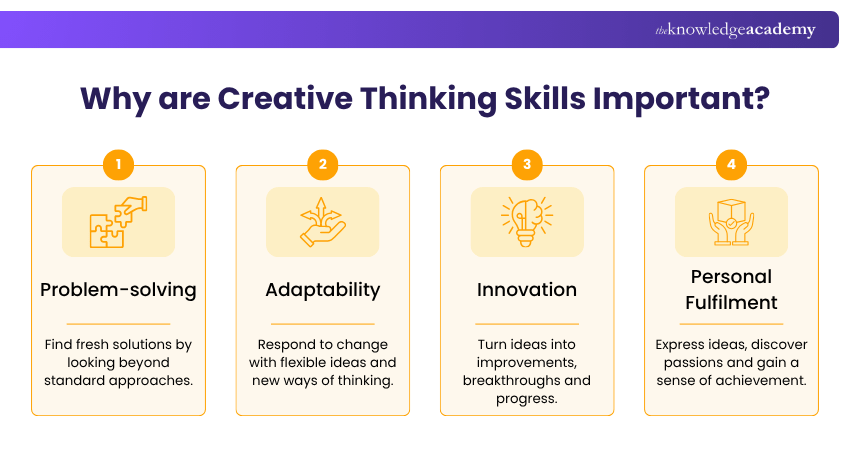
1) Problem-solving
Creative thinking can strengthen problem-solving by helping people look beyond familiar solutions and consider different ways to approach a challenge. Instead of relying only on methods that have worked before, creative thinkers explore alternatives, question assumptions, and examine the problem from different perspectives.
This approach can be particularly useful when a problem is complex, unfamiliar, or cannot be solved effectively using conventional methods.
2) Adaptability
Creative thinking can improve adaptability by helping people adjust their ideas and approaches when circumstances change. Rather than relying solely on familiar methods, creative thinkers are more willing to explore alternatives and reconsider their assumptions when new challenges, information, or requirements emerge.
This flexibility can be particularly valuable in the workplace, where changing priorities, technologies, customer needs, or unexpected challenges may require a different approach.
3) Innovation
Creative thinking can support innovation by encouraging people to question existing approaches, combine ideas, identify opportunities, and develop alternatives.
They challenge the status quo, introduce new paradigms, and pave the way for advancements in every field imaginable. In essence, without creative thinking, progress would stall, leaving us in a perpetual loop of redundancy.
4) Personal Fulfilment
Beyond tangible achievements and global advancements, creative thinking plays a pivotal role in personal well-being. It offers an avenue for self-expression, a way to articulate our deepest emotions, fears, hopes, and dreams.
Through creative endeavours, individuals connect with their inner selves and the world around them, discovering passions and deriving a profound sense of fulfilment. Whether it’s penning a poem, devising a new business strategy, or simply finding an innovative way to organise one’s day, the joy of crafting something unique provides a deep sense of satisfaction.
Build a forward-thinking leadership style that inspires growth and innovation with Creative Leader Training – Sign up now!
Examples of Creative Thinking Skills
Creative thinking involves several skills that help people generate ideas, question familiar approaches, and make new connections. Here are some common examples of creative thinking skills:
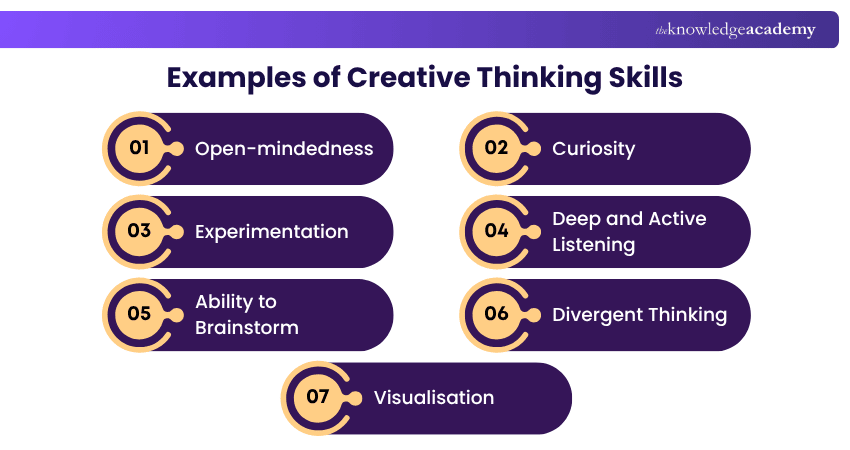
1) Open-mindedness
Open-mindedness is the willingness to consider new ideas, different perspectives, and unfamiliar approaches without dismissing them too quickly. It encourages people to move beyond their existing assumptions and explore alternative ways of thinking.
By remaining receptive to different viewpoints, creative thinkers can discover new possibilities, build on the ideas of others, and develop more varied approaches to problems and situations.
2) Curiosity
Curiosity is the willingness to ask questions, seek new information, and explore why things work the way they do. It encourages creative thinkers to look beyond familiar explanations and investigate possibilities they might otherwise overlook.
Questions such as “Why is this done this way?”, “What if we tried something different?”, or “How could this be improved?” can challenge assumptions and reveal new approaches. By continuously exploring and questioning, individuals can discover useful insights that contribute to more creative ideas and solutions.
3) Experimentation
Creative thinking skills encompass embracing experimentation and novelty. Overcoming judgement and overthinking is crucial for executing new ideas. A proficient experimenter initiates projects, tests hypotheses, and makes informed decisions. Like a painter liberally applying paint, not every experiment needs immediate success; the process yields valuable insights.
Experimentation fosters exploration, discovers functional elements, and advances innovative solutions. It is both generative and enjoyable.
4) Deep and Active Listening
Active listening can support creative thinking by helping people understand different perspectives, identify overlooked information, and build on the ideas of others.
For instance, actively listening and understanding in the workplace can lead to clearer insights and creative solutions that meet everyone's needs. This skill enhances problem-solving, minimises misunderstandings, and ensures individuals feel heard and valued, contributing to a more positive and innovative work environment.
5) Ability to Brainstorm
Problem-solving encompasses various approaches, and brainstorming is a method to articulate and evaluate multiple solutions. This form of lateral thinking prompts consideration of solutions from different angles.
This fosters a mindset that values multifaceted approaches over a singular, linear answer. Brainstorming encourages creativity and divergent thinking, allowing for exploring diverse ideas and perspectives. This, in turn, leads to more comprehensive problem-solving outcomes.
6) Divergent Thinking
Divergent thinking is the ability to generate multiple ideas or possible solutions to a single problem instead of immediately focusing on one answer. It encourages people to explore different directions, consider unusual possibilities, and avoid limiting themselves to the most obvious solution.
7) Visualisation
Visualisation is the ability to mentally picture an idea, situation, process, or possible outcome before it becomes a reality. It can help creative thinkers explore how different concepts might work and identify opportunities or potential challenges before taking action.
For example, a designer might visualise how users will interact with a new interface, while a Project Manager might picture different stages of a proposed workflow to understand how the process could be improved.
Develop a practical approach to everyday challenges with our Practical Thinking Course – Register now!
How to Improve Your Creative Thinking Skills?
Creative thinking can become stronger when you practice specific behaviours deliberately. The aim is not to force yourself to produce brilliant ideas on demand. It is to create better conditions for discovering, exploring, and improving possibilities. Here's how you can improve it:
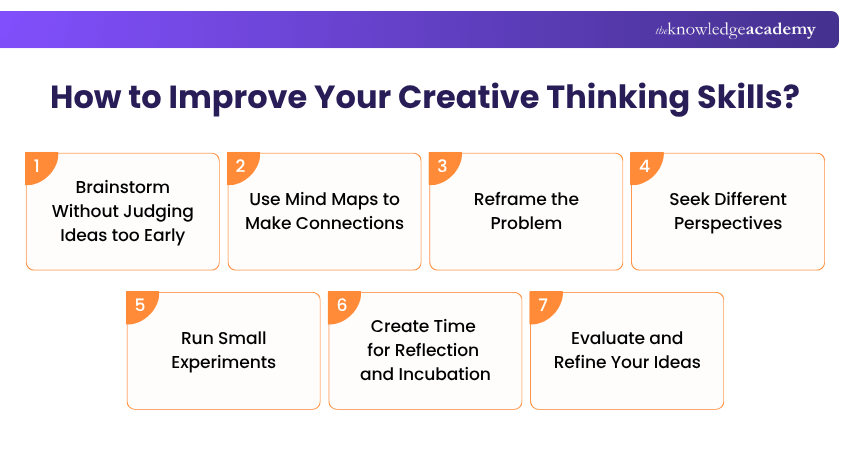
1) Brainstorm Without Judging Ideas too Early
One of the easiest ways to restrict creativity is to evaluate every idea at the moment it appears. Brainstorming is a technique for generating multiple ideas or possible solutions before evaluating them.
For Example:
Problem: How could we improve participation in team meetings?
Initial ideas might include anonymous questions, rotating facilitators, shorter meetings, written contributions, pre-meeting polls or removing meetings that do not require discussion.
Some suggestions may prove unsuitable. That is acceptable at the generation stage.
Once you have enough options, switch to evaluation and compare them against practical criteria.
2) Use Mind Maps to Make Connections
Mind maps can help you see relationships that are difficult to notice in a conventional list. Begin with the problem or objective in the centre, then create branches for related areas such as:
1) People
2) Processes
3) Technology
4) Constraints
5) Customers
6) Risks
7) Resources
Continue adding related ideas to each branch.
For Example:
If you were exploring ways to improve employee onboarding, one branch might focus on communication, another on training and another on technology. Connections between those branches can reveal ideas that would be harder to spot when each area is considered separately.
3) Reframe the Problem
Before trying to solve a problem, examine how it has been framed. A useful method is to rewrite the original question several times.
Instead of:
"How do we respond to customer enquiries faster?"
Try:
1) How could customers get answers without waiting?
2) Which enquiries should never require manual handling?
3) What causes delays before a response is written?
4) How could we prevent common questions from occurring?
5) How might the customer redesign this process?
Each version directs attention towards a different part of the problem. Thus, reframing is especially useful when repeated attempts to solve the original question keep producing similar answers.
4) Seek Different Perspectives
Your experience is useful, but it also influences what you notice and what you assume.
Actively involve people who see the situation differently. Depending on the problem, this could include colleagues from another department, customers, newer employees, specialists or people who are not involved in the existing process.
You can also deliberately adopt different viewpoints yourself by asking:
1) What would a first-time user notice?
2) What would someone with half the budget do?
3) What would happen if this had to be completed in one day?
4) Which part would a customer consider unnecessary?
Different perspectives can expose assumptions that are almost invisible to people who work with the same problem every day.
5) Run Small Experiments
A promising idea does not have to be implemented on a full scale immediately. Create a small experiment that answers one important question about the idea.
For Example:
1) Idea: Replace a weekly status meeting with an asynchronous update.
2) Question: Will the team still have enough information to coordinate effectively?
3) Experiment: Trial the new approach with one project for two weeks.
4) Measure: Check participation, missed information, time saved and team feedback.
A small experiment reduces the cost of learning. If the idea fails, you gain information before making a larger commitment. If it works, you have evidence for developing it further.
6) Create Time for Reflection and Incubation
Continuous concentration does not always produce better ideas. When you have already examined a problem closely, temporarily stepping away can give you space to reconsider it with less fixation on the same solution.
That might mean moving to another task, taking a walk, reviewing the problem the following morning or deliberately leaving time between idea-generation and evaluation sessions.
The important point is not simply to "wait for inspiration". Capture the problem clearly first, then create some distance before returning to it.
You may notice assumptions or connections that were less obvious when you were concentrating intensely on finding an immediate answer.
7) Evaluate and Refine Your Ideas
Creative thinking should eventually move from possibilities towards action. Once several ideas have been generated, define criteria that reflect the problem you are trying to solve.
For Example:
Do not assume the highest-scoring idea must be implemented exactly as proposed. Evaluation can expose opportunities to combine several ideas or refine a promising concept before testing it.
Build the skills to make smarter business decisions with our Decision Making Course – Join now!

The Knowledge Academy develops accessible learning content across Project Management, IT, Cybersecurity, Data Science, Business Analysis, HR, Accounting and Finance, Leadership and Health and Safety. Its resources combine subject research with clear explanations to help professionals build practical knowledge across a wide range of disciplines.
View Detail

 If you wish to make any changes to your course, please


