


We may not have the course you’re looking for. If you enquire or give us a call on 01344203999 and speak to our training experts, we may still be able to help with your training requirements.
Top Cloud Engineer Skills to Build a Successful Career
ByThe Knowledge AcademyLast updated on: 12 November 2026
Cloud Engineer skills are essential for building, managing and securing cloud infrastructure. Explore key skills, from cloud platforms, Linux and networking to DevOps, security and monitoring, and understand how they support modern cloud operations.
What You'll Learn
1. Cloud Platforms: Understand the fundamentals of AWS, Azure and Google Cloud.2. Core Infrastructure: Explore Linux, networking, storage and virtualisation.3. Automation: Learn about scripting, Infrastructure as Code (IaC), DevOps and CI/CD.4. Cloud Security: Discover security controls and disaster recovery practices.5. Cloud Operations: Understand monitoring and troubleshooting techniques.
As businesses continue to move workloads and services to the cloud, skilled Cloud Engineers play an important role in designing, building and maintaining cloud infrastructure. Whether you're already working in the field or looking to become a Cloud Engineer, developing the right skills can help you handle the technical demands of the role.
Cloud engineering involves more than knowing how to use a cloud platform. From configuring systems and automating processes to maintaining security and resolving technical issues, Cloud Engineers apply a wide range of capabilities in their daily work. In this blog, we'll look at these capabilities and how they support effective cloud operations. Let's get started!
Essential Cloud Engineer Skills
Cloud Engineers need a combination of technical and practical skills to deploy, manage and maintain cloud-based infrastructure. Here are the essential Cloud Engineer skills worth developing:
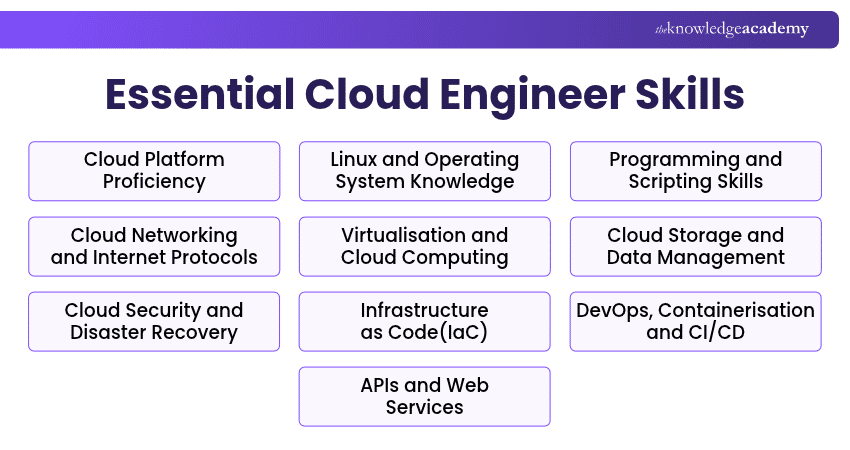
1) Cloud Platform Proficiency
As a Cloud Engineer, it's important to understand major public cloud platforms such as Amazon Web Services (AWS), Microsoft Azure and Google Cloud. Each offers services for computing, storage, networking, security and infrastructure management.
Your choice of platform may depend on your employer's requirements. Developing strong practical knowledge of one platform is often a useful starting point, while familiarity with others can broaden your career opportunities. Cloud Engineers should understand how to deploy resources, configure services and manage cloud environments effectively.

2) Linux and Operating System Knowledge
Linux plays an important role in cloud computing because of its flexibility, reliability and widespread use in server environments. Cloud Engineers often work with Linux-based systems to configure applications, manage services and troubleshoot infrastructure issues.
A strong understanding of Linux commands, file permissions, system processes and shell scripting is particularly valuable. Familiarity with Windows Server and other operating systems may also be useful, depending on the organisation's cloud environment.
3) Programming and Scripting Skills
Programming and scripting skills help Cloud Engineers automate repetitive tasks, manage infrastructure and improve operational efficiency. Familiarity with relevant languages allows professionals to develop scripts, interact with cloud services and simplify administrative activities.
Some useful programming and scripting languages include:
a) Python: Widely used for cloud automation, scripting, interacting with cloud APIs and developing serverless applications.
b) Bash: Useful for automating command-line tasks and managing Linux-based systems.
c) PowerShell: Commonly used for Windows administration, Microsoft Azure automation and infrastructure management.
d) Go: Useful for developing cloud-native applications, services and infrastructure tools.
Other languages, including SQL for database queries and PHP or C# for application-related workloads, may also be valuable. However, Cloud Engineers do not need to master every programming language. The most suitable choice depends on their responsibilities and the technologies they use.
4) Cloud Networking and Internet Protocols
Cloud computing and networking are closely connected because cloud applications depend on secure and reliable communication between systems. Cloud Engineers must understand how networks operate and how cloud resources communicate across different environments.
Knowledge of TCP/IP, Domain Name System (DNS), routing, subnets, firewalls and Virtual Private Networks (VPNs) is important. They should also understand cloud networking services such as Amazon Virtual Private Cloud (VPC), Azure Virtual Network and Google Cloud VPC.
Trainer's Insight
Not every cloud connectivity issue is caused by a network outage. Incorrect routing, firewall rules or DNS configurations can also prevent applications from communicating. Cloud Engineers should check these settings systematically before making changes, as identifying the actual cause helps avoid unnecessary fixes.
5) Virtualisation and Cloud Computing
Virtualisation is a fundamental technology in cloud computing. It enables multiple virtual machines to run on shared physical hardware, helping organisations use computing resources efficiently.
Cloud Engineers should understand virtual machines, hypervisors and virtual resource management. Services such as Amazon EC2 and Azure Virtual Machines allow organisations to provision and manage cloud-based computing instances. They should also recognise how virtual machines differ from containers and serverless computing.
Learn the essentials behind every AWS solution with the AWS Technical Essentials Training – Sign up now!
6) Cloud Storage and Data Management
Cloud storage allows organisations to store, access and manage data using cloud-based services. Understanding the available storage options is important for selecting solutions that meet performance, availability, security and cost requirements.
Three common types of cloud storage include:
a) Object Storage: Stores data as objects and is suitable for backups, media files and large volumes of unstructured data. Amazon S3 is a common example.
b) Block Storage: Provides storage volumes commonly used with virtual machines and databases. Amazon Elastic Block Store (EBS) is an example.
c) File Storage: Provides shared file systems that applications and users can access. Amazon Elastic File System (EFS) is one example.
Cloud Engineers should also understand storage access controls, redundancy, backup policies and data lifecycle management. These capabilities help them select and maintain suitable storage solutions.
7) Cloud Security and Disaster Recovery
Cloud security involves protecting applications, data and infrastructure from unauthorised access, misconfiguration and other threats. Cloud Engineers need to understand security principles and how responsibilities are shared between cloud providers and customers.
Important areas include Identity and Access Management (IAM), encryption, network security, access controls and secure configuration practices. Disaster recovery is equally important for maintaining business continuity. Cloud Engineers should understand backup and restoration procedures, recovery planning and suitable recovery objectives.
8) Infrastructure as Code (IaC)
Infrastructure as Code (IaC) allows Cloud Engineers to define and manage infrastructure through configuration files rather than relying entirely on manual setup. This makes it simpler to deploy consistent environments, track configuration changes, and automate resource provisioning.
Tools such as Terraform, AWS CloudFormation and Azure Bicep help professionals manage cloud infrastructure using code. Knowledge of version control, configuration validation and reviewing proposed infrastructure changes is also valuable.
Pro Tip
Before applying IaC changes, review the proposed changes and validate your configurations. Test significant updates in a suitable non-production environment where practical to identify unexpected modifications before they affect live resources.
9) DevOps, Containerisation and CI/CD
DevOps supports collaboration between development and operations teams through practices such as automation, continuous improvement and shared responsibility for software delivery.
Containerisation packages applications with their required dependencies, helping them run consistently across different environments. Docker is commonly used to build and run containers, while Kubernetes helps automate their deployment, scaling and management.
Continuous Integration (CI) automates the integration and testing of code changes, while Continuous Delivery (CD) prepares software for release. Continuous Deployment takes this further by automatically releasing changes that pass the required checks. Tools such as Jenkins, GitLab CI/CD and GitHub Actions can help automate these activities.
10) APIs and Web Services
APIs and web services play an important role in connecting cloud applications, services and infrastructure. They allow systems to exchange information and enable Cloud Engineers to automate interactions with cloud platforms.
Knowledge of HTTP, REST APIs, JSON and API authentication is valuable for modern cloud environments. Cloud Engineers may use APIs to provision resources, retrieve monitoring information or integrate cloud services with other applications.
11) Cloud Monitoring and Troubleshooting
Cloud Engineers must monitor infrastructure to maintain performance, availability and reliability. This involves reviewing system metrics, examining logs, responding to alerts and investigating operational issues.
Tools such as Amazon CloudWatch, Azure Monitor and Google Cloud Monitoring help professionals monitor resources and identify potential problems. Strong troubleshooting skills are also important for diagnosing connectivity issues, performance bottlenecks and configuration errors.
Go beyond deployment and learn cloud operations with the AWS Certified CloudOps Engineer Associate Course – Sign up today!

The Knowledge Academy develops accessible learning content across Project Management, IT, Cybersecurity, Data Science, Business Analysis, HR, Accounting and Finance, Leadership and Health and Safety. Its resources combine subject research with clear explanations to help professionals build practical knowledge across a wide range of disciplines.
View Detail

 If you wish to make any changes to your course, please


