


We may not have the course you’re looking for. If you enquire or give us a call on 01344203999 and speak to our training experts, we may still be able to help with your training requirements.
Top Blockchain Developer Skills
ByThe Knowledge AcademyLast updated on: 13 November 2026
This blog explores ten essential Blockchain Developer skills, from cryptography and smart contracts to programming languages, consensus mechanisms and security. It explains how each skill supports the development of secure, reliable and efficient blockchain applications.
At a Glance
1. Cryptography and decentralised systems give developers the foundation to understand how blockchain networks work.2. Smart contract development and languages such as Solidity and Rust turn that knowledge into working applications.3. Consensus mechanisms, algorithms and data structures explain how networks agree on, record and verify transactions.4. Security awareness and testing help identify vulnerabilities before applications are deployed.5. Blockchain standards and token development support compatibility with wallets, platforms and services.
A smart contract can run exactly as written and still cause problems if its code contains a flaw. Once deployed, contracts are often difficult to change, so careful development matters from the start. In blockchain applications, such flaws can put funds, data integrity and user trust at risk.
Blockchain Developers therefore need more than coding ability. They combine knowledge of cryptography, networking, security and platforms to build applications that work reliably on decentralised networks. The skills below show what this involves.
Essential Blockchain Developer Skills
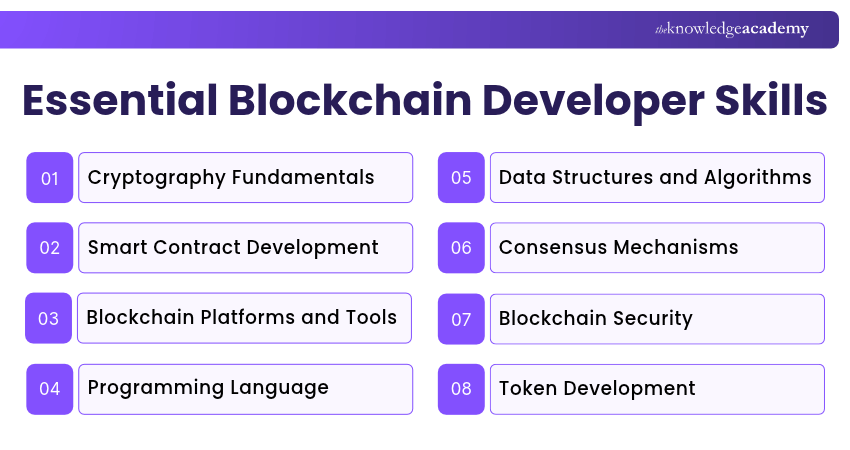
Blockchain development combines programming, cryptography, distributed systems and security knowledge. Developers need these capabilities to create applications, interact with blockchain networks and maintain reliable solutions. Here are ten essential Blockchain Developer skills:
1) Cryptography Fundamentals
Cryptography helps Blockchain Developers understand how transactions are authenticated, and recorded information is protected against undetected changes. Knowledge of cryptographic techniques is essential for working with blockchain networks and digital assets.
Key cryptographic concepts include:
1) Cryptographic Hash Functions: Generate fixed-length outputs from input data, helping detect changes and support blockchain data structures.
2) Public-key Cryptography: Provides the mathematical foundation for public and private key pairs used in blockchain systems.
3) Digital Signatures: Allow networks to verify that transactions have been authorised by the appropriate private key.
4) Key Management: Involves generating, storing and protecting private keys to prevent unauthorised access.
Understanding these principles helps developers use cryptographic mechanisms correctly when building blockchain applications.

2) Smart Contract Development
Smart contracts are programs deployed on compatible blockchain networks that execute instructions according to their programmed logic. Developers need to understand how to design, implement, and manage these contracts for different applications.
Key smart contract development skills include:
1) Contract Programming: Writing functions, defining variables, and implementing business logic using appropriate programming languages.
2) State Management: Understanding how smart contracts store, retrieve and update information on the blockchain.
3) Contract Deployment: Compiling and deploying smart contracts to supported blockchain environments.
4) Contract Interactions: Creating functions that allow smart contracts to communicate with other contracts and external applications.
These capabilities enable developers to create automated blockchain-based processes and implement application-specific functionality.
3) Decentralised Systems and Peer-to-peer Networking
Blockchain networks commonly use distributed systems in which multiple computers communicate and coordinate operations. Understanding decentralised architectures helps developers work with applications that depend on geographically distributed network infrastructure.
Important networking concepts include:
1) Network Nodes: Recognising the roles of nodes that maintain data, relay transactions or validate blockchain information.
2) Peer-to-peer Communication: Exchanging information between network participants without relying entirely on a central communication server.
3) Transaction Propagation: Tracing how submitted transactions spread between nodes before the network processes them.
4) Network Synchronisation: Keeping nodes up to date by downloading and verifying chain data.
These skills help developers understand network behaviour and troubleshoot communication problems in distributed blockchain environments.
Explore Ethereum development, smart contracts and decentralised applications with our Ethereum Developer Training - Join now!
4) Blockchain Platforms and Tools
Blockchain platforms provide the environments in which developers create and operate decentralised applications. Familiarity with development tools helps developers select suitable technologies and manage implementation workflows.
Important platform and tooling skills include:
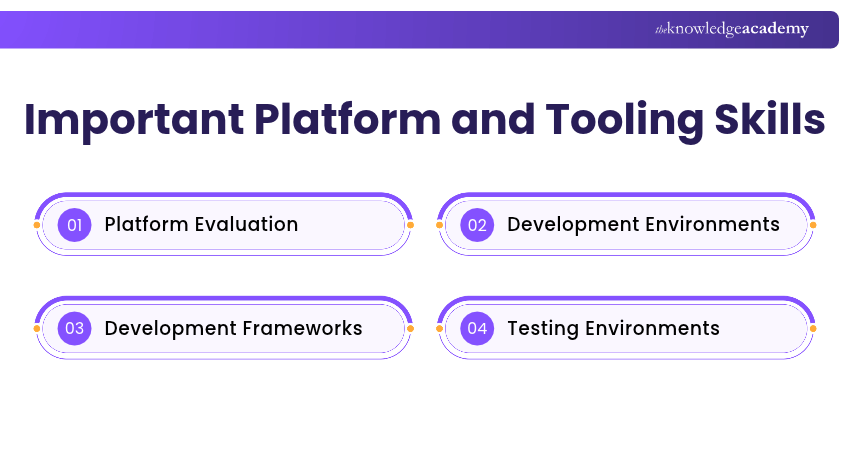
1) Platform Evaluation: Comparing networks such as Ethereum, Solana and Hyperledger Fabric based on their architecture, execution environments and project requirements.
2) Development Environments: Using tools such as Remix IDE to write, compile and interact with Solidity smart contracts.
3) Development Frameworks: Working with frameworks such as Hardhat and Foundry to organise projects and streamline development workflows.
4) Testing Environments: Using local blockchain networks and supported testnets to examine application behaviour before production deployment.
These skills enable developers to establish efficient development workflows and work across different blockchain platforms.
Pro Tip:
Successful transactions are only half the story. Test reverted transactions, insufficient balances, and interrupted wallet interactions to understand how your application responds when operations do not go as planned.
5) Programming Language
Programming languages provide the foundation for implementing smart contracts, application interfaces, and blockchain infrastructure. Developers should choose languages based on their target network and development responsibilities.
Important programming languages include:
1) Solidity: Used to write smart contracts for Ethereum and other Ethereum Virtual Machine (EVM)-compatible blockchains.
2) Rust: Commonly used in Solana program development and blockchain infrastructure requiring efficient systems programming.
3) JavaScript and TypeScript: Used to build decentralised application interfaces and connect web applications with blockchain networks.
4) Python, Java and C++: Support scripting, automation, enterprise integrations and blockchain infrastructure development, depending on project requirements.
Proficiency in suitable languages helps developers implement blockchain functionality and integrate it with supporting software systems.
6) Data Structures and Algorithms
Algorithms and data structures determine how blockchain systems organise, process and retrieve information. Developers need to understand these concepts to interpret blockchain records and implement efficient data-handling operations.
Important concepts include:
1) Mappings and Key-value Structures: Using data structures common in smart contract storage to organise and retrieve information.
2) Merkle Trees: Using hierarchical hash structures to support efficient verification of data inclusion.
3) Transaction-State Models: Distinguishing Bitcoin’s Unspent Transaction Output (UTXO) model from Ethereum’s account-based state model.
4) Algorithmic Efficiency: Applying time and space complexity principles to improve data processing and application performance.
These capabilities help developers work with blockchain information and understand how different networks represent transaction state.
Learn to organise, process and retrieve data efficiently with our Data Structure and Algorithm Training - Join now!
7) Consensus Mechanisms
Consensus mechanisms enable blockchain networks to agree on the accepted state and history of a distributed ledger. Developers need to understand these mechanisms because they influence how transactions are processed and when results can be considered final.
Important consensus concepts include:
1) Proof of Work (PoW): Understanding how computational work supports block production and chain selection in networks such as Bitcoin.
2) Proof of Stake (PoS): Learning how validators participate in consensus by staking assets, as demonstrated by Ethereum.
3) Byzantine Fault Tolerance (BFT): Understanding how distributed systems can reach agreement despite certain participants failing or behaving incorrectly.
4) Transaction Finality: Recognising when transactions are considered settled and how confirmation guarantees vary between networks.
These skills help developers design applications that account for network confirmation requirements and settlement behaviour.
8) Blockchain Security
Blockchain applications can contain vulnerabilities even when their underlying networks use strong cryptographic mechanisms. Developers need practical security knowledge to identify weaknesses and reduce risks during application development.
Important security skills include:
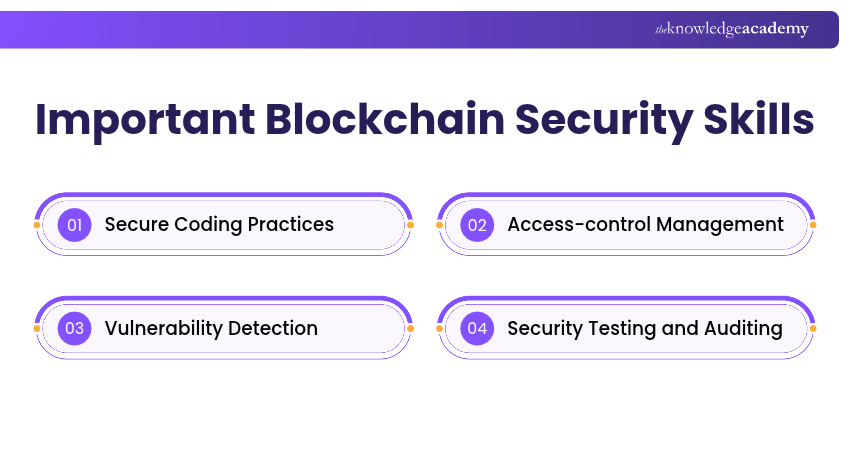
1) Secure Coding Practices: Writing application logic that follows established security principles and avoids unsafe implementation patterns.
2) Access-control Management: Restricting sensitive operations to authorised accounts or roles within smart contracts.
3) Vulnerability Detection: Identifying weaknesses such as reentrancy, oracle manipulation, and transaction-ordering risks.
4) Security Testing and Auditing: Using code reviews, automated analysis and structured testing to identify vulnerabilities before deployment.
These capabilities help developers improve application security and reduce the likelihood of preventable exploits.
Strengthen security governance and risk management skills with our Security Governance and Compliance Training - Register now!
9) Scalability and Layer 2 Solutions
Blockchain networks can face limits on transaction speed, capacity and fees as demand grows. Developers need to know how scaling approaches work so that applications remain practical under heavy use. Many Layer 2 solutions process transactions separately from the main network (Layer 1) while relying on it for security and settlement.
Important scalability skills include:
1) Scalability Trade-offs: Weighing throughput, cost, security and decentralisation when choosing a network or scaling approach.
2) Rollups: Recognising how optimistic and zero-knowledge rollups bundle transactions and submit data or proofs back to Layer 1.
3) Gas and Fee Optimisation: Writing efficient contract code that reduces storage and computation costs.
4) Cross-layer Development: Deploying and testing applications on Layer 2 networks and handling asset transfers between layers.
These skills help developers build applications that stay affordable and responsive as network usage grows.
Trainer’s Pro Tip: Plan for Long-term Maintenance
Deployment is not the end of a Blockchain Developer’s responsibility. Applications may need ongoing monitoring and updates when connected services change, so maintenance plans should be settled before deciding whether contracts should be upgradeable.
10) Token Development
Token standards define common interfaces for digital assets created on blockchain networks. Developers working with token-based applications need to understand how these standards support ownership, transfers, and interactions with other services.
Important token development skills include:
1) ERC-20 implementation: Developing fungible tokens that follow standard interfaces for balances, transfers and allowances.
2) ERC-721 implementation: Creating non-fungible tokens that represent individually identifiable digital assets.
3) ERC-1155 implementation: Managing multiple token types within a single smart contract using a standardised interface.
4) Token integration: Connecting token contracts with compatible wallets, marketplaces, and decentralised applications.
These skills help developers implement token-based functionality and build applications that interact with established blockchain services.

The Knowledge Academy develops accessible learning content across Project Management, IT, Cybersecurity, Data Science, Business Analysis, HR, Accounting and Finance, Leadership and Health and Safety. Its resources combine subject research with clear explanations to help professionals build practical knowledge across a wide range of disciplines.
View Detail

 If you wish to make any changes to your course, please


