


We may not have the course you’re looking for. If you enquire or give us a call on 01344203999 and speak to our training experts, we may still be able to help with your training requirements.
Home
 Resources
Accounting and Finance
Basic Accounting Skills: Essential Skills Every Beginner Should Learn
Resources
Accounting and Finance
Basic Accounting Skills: Essential Skills Every Beginner Should Learn
Basic Accounting Skills: Essential Skills Every Beginner Should Learn
ByThe Knowledge AcademyLast updated on: 17 September 2026
Basic Accounting Skills help individuals record transactions, understand financial information, manage budgets, and make informed financial decisions. Explore the essential Accounting Skills every beginner should learn and discover practical ways to develop them.
A receipt may look like a simple piece of paper, but in accounting, it is the beginning of a much bigger story. It can become a transaction, enter the accounting records, affect financial statements, and eventually contribute to a business decision.
Understanding that journey begins with Basic Accounting Skills. In this blog, we’ll explore the essential skills that help beginners record, organise, and understand financial information with greater confidence.
What are Basic Accounting Skills?
Basic Accounting Skills are the foundational abilities used to record, organise, and understand financial information accurately. They include recording transactions, maintaining financial records, understanding financial statements, managing budgets, reconciling accounts, and using accounting tools.
Together, these skills help professionals follow financial activity from the moment a transaction occurs to the point where it appears in financial records and reports.

Accounting in One Simple FlowTransaction → Record → Classify → Summarise → Report → InterpretThink of it as the journey of financial information. A transaction is first recorded and classified, then summarised into accounting records and financial reports that can be interpreted to understand financial performance and position.
Why are Basic Accounting Skills Important?
Basic Accounting Skills help maintain financial accuracy, monitor business activity, and provide reliable information for planning and reporting. They also make it easier to identify financial issues and understand how everyday transactions affect the organisation.
Key benefits include:
1) Accurate Record-keeping: Maintains reliable records of income, expenses, assets, liabilities, and other transactions.
2) Informed Decision-making: Provides financial information that supports planning, spending, and resource allocation.
3) Better Budget Control: Helps compare actual income and expenses against planned figures and identify variances.
4) Cash Flow Visibility: Provides a clearer picture of money entering and leaving the business.
5) Reliable Financial Reporting: Supports the preparation and interpretation of financial statements.
6) Tax and Regulatory Support: Maintains organised financial records that can support applicable tax and reporting requirements.
Together, these skills create a strong foundation for progressing into areas such as financial accounting, taxation, auditing, and financial management.
Build strong bookkeeping fundamentals and manage financial records confidently with our Bookkeeper Training Course - Join today!
11 Essential Basic Accounting Skills for Beginners
Accounting involves several interconnected skills, from recording everyday transactions to understanding what financial reports reveal. Developing these fundamentals gives beginners a practical foundation for working with financial information accurately and confidently.
1) Bookkeeping
Bookkeeping involves systematically recording a business's financial transactions, including sales, purchases, receipts, and payments.
Accurate bookkeeping keeps financial information organised and provides reliable records for preparing accounts, monitoring financial activity, and checking transactions.
2) Debits, Credits, and Double-entry Accounting
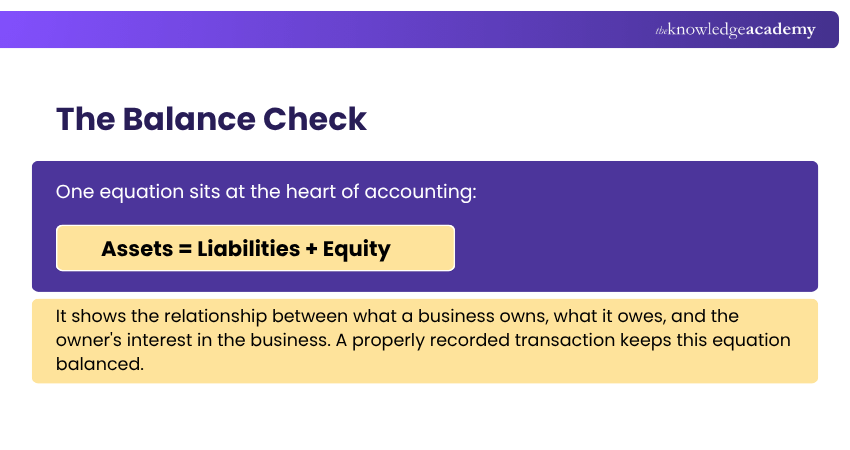
Double-entry accounting records every transaction with corresponding debit and credit entries. This keeps the accounting records balanced and reflects how each transaction affects different accounts.
For example, when equipment is purchased for cash, the equipment account is debited and the cash account is credited. Learning how debits and credits affect different account types is a fundamental accounting skill.
3) Understanding Financial Statements
Financial statements turn accounting records into useful information about a business. Beginners should understand the purpose of three key statements:
1) Balance Sheet: Shows assets, liabilities, and equity at a specific point in time.
2) Income Statement: Shows income and expenses over a period, resulting in a profit or loss.
3) Cash Flow Statement: Shows cash inflows and outflows from operating, investing, and financing activities.
Understanding these statements helps beginners see different aspects of a business's financial position and performance.
4) Budgeting
Budgeting involves estimating future income and expenses and planning how available financial resources will be used.
Basic Accounting Skills help professionals compare actual results with budgeted figures, identify variances, and understand where financial performance differs from expectations.
5) Bank Reconciliation
Bank reconciliation involves comparing accounting records with a bank statement to identify and explain any differences between them.
Differences can arise from outstanding payments, deposits in transit, bank charges, timing differences, or recording errors. Regular reconciliation helps maintain accurate cash records and highlights discrepancies that require investigation.
6) Accounts Payable and Accounts Receivable
Accounts Payable (AP) represents amounts a business owes to suppliers and other creditors, while Accounts Receivable (AR) represents amounts customers owe to the business.
Understanding both helps professionals monitor money due in and out, manage payment schedules, follow up on outstanding amounts, and maintain accurate records.
7) Basic Tax Knowledge
Basic tax knowledge helps professionals understand how financial records support applicable tax calculations, reporting, and compliance responsibilities.
Tax rules, rates, and deadlines vary by jurisdiction. Beginners should therefore focus on maintaining accurate records, recognising relevant financial documents, and understanding how accounting information supports tax-related activities.
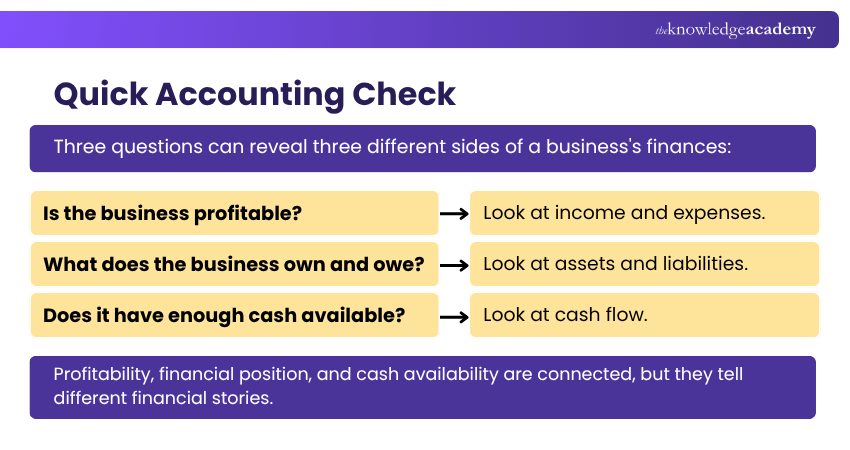
8) Cash Flow Management
Cash flow management involves monitoring money entering and leaving a business and anticipating whether sufficient cash will be available to meet upcoming obligations.
This is important because profit and available cash are not the same thing. A business can report a profit while still experiencing cash flow difficulties if money is not available when payments become due.
9) Accounting Software Skills
Accounting software helps businesses perform activities such as recording transactions, generating invoices, tracking expenses, reconciling accounts, and producing financial reports.
Developing familiarity with platforms such as QuickBooks can help beginners understand how accounting processes are managed in a digital environment.
10) Spreadsheet Skills
Spreadsheets are widely used to organise, calculate, analyse, and present financial information. Useful beginner skills include working with formulas, functions, tables, sorting, and filtering.
Spreadsheet proficiency complements accounting software and can support calculations, financial analysis, reconciliations, and supporting schedules.
11) Attention to Detail and Accuracy
Accounting depends heavily on accurate information. An incorrect amount, date, account, or transaction classification can affect financial records and subsequent reporting.
Attention to detail helps professionals check figures, spot inconsistencies, maintain supporting documentation, and record transactions correctly. In accounting, accuracy is not simply a desirable quality; it is a fundamental working habit.
How to Improve Your Accounting Skills?
Accounting Skills develop through practice, repetition, and applying concepts to realistic financial situations. The aim is to move beyond knowing accounting rules to understanding why a transaction is recorded in a particular way and what effect it has on the accounts.
1) Build the Fundamentals First: Start with the accounting equation, account types, debits and credits, and double-entry accounting. A clear understanding of these concepts makes more advanced accounting tasks easier to follow.
2) Follow Transactions from Start to Finish: Take everyday examples such as a sale, purchase, expense, or customer payment and trace how each transaction moves from the source document into the accounting records.
3) Read Financial Statements Regularly: Use sample statements to practise identifying assets, liabilities, equity, income, expenses, and cash movements. Then consider what those figures reveal about the business.
4) Practise Finding Errors: Work through reconciliation exercises and deliberately investigate figures that do not match. Tracing an error back to its source develops accuracy and strengthens your understanding of how accounts connect.
5) Use Accounting Tools: Build confidence with spreadsheets and accounting software by recording transactions, creating invoices, reconciling accounts, and generating basic reports.
6) Review the ‘Why’ Behind Each Entry: Instead of memorising where a figure goes, ask why an account is debited or credited and how the entry affects the wider financial records. This helps turn accounting rules into practical understanding.
The Beginner's Accounting Test
For any transaction, work through four questions:
What happened? → Identify the transaction.Which accounts changed? → Identify the affected accounts.Debit or credit? → Determine how each account should be recorded.What is the result? → Understand its effect on the financial records.If you can explain all four steps, you are doing more than remembering an entry—you are beginning to think through the accounting behind it.
Learn to track and value inventory for better financial management with our Inventory Accounting And Costing Course – Join now!

The Knowledge Academy develops accessible learning content across Project Management, IT, Cybersecurity, Data Science, Business Analysis, HR, Accounting and Finance, Leadership and Health and Safety. Its resources combine subject research with clear explanations to help professionals build practical knowledge across a wide range of disciplines.
View Detail

 If you wish to make any changes to your course, please


