




We may not have the course you’re looking for. If you enquire or give us a call on 01344203999 and speak to our training experts, we may still be able to help with your training requirements.
DWP Forced to Increase Christmas Bonus for Benefit Claimants
By The Knowledge AcademyLast updated on: 13 December 2024
As the UK’s biggest public service department, the Department for Work and Pensions (DWP) is responsible for welfare, pensions and child maintenance policy. The DWP is currently facing growing calls to increase the Christmas Bonus given to State Pension and benefit claimants by £10. Learn more about this new development!
Table of Content

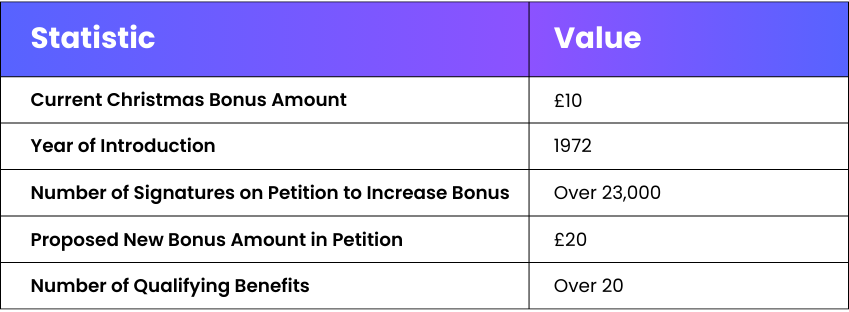
The Department for Work and Pensions (DWP) is being urged to increase the Christmas Bonus for benefit claimants by £10, with mounting calls for the payment to be raised. This bonus, which has remained unchanged since 1972, is seen as outdated given today's economic climate.
A petition led by Adnan Huda has gathered around 23,000 signatures, urging the government to double the bonus to £20. Critics argue that the £10 payment, which was substantial in 1972, is now insufficient, especially during the financially demanding festive season. Adjusted for inflation, the original £10 would be worth nearly £327 today.
Despite the growing support for the petition, the DWP has yet to commit to increasing the bonus. Instead, they emphasise broader initiatives aimed at alleviating poverty, such as extending the Household Support Fund and focusing on reducing child poverty.
What is the Christmas Bonus About?
The annual £10 Christmas Bonus, introduced by the UK government in 1972, is a one-off tax-free payment provided to individuals receiving certain benefits. It is designed to offer additional financial support during the holiday season. However, the payment’s value has remained unchanged for over five decades, prompting widespread criticism amid rising living costs.
The petition launched by Adnan Huda proposes increasing the bonus to £20 to better reflect current economic conditions. If the petition reaches 10,000 signatures, the government is required to issue a formal response, and at 100,000 signatures, it could be debated in Parliament.
Who is eligible for the £10 Christmas Bonus?
The Christmas Bonus is available to individuals receiving certain qualifying benefits during a specific week in December, known as the "qualifying week," which generally occurs in the first full week of December (e.g., December 2-8). To be eligible, recipients must also be residents of the UK, the Channel Islands, Isle of Man, Gibraltar, any European Economic Area (EEA) country, or Switzerland during the qualifying period.
Eligibility criteria include being in receipt of at least one of the designated benefits. The payment is automatic, so eligible individuals do not need to apply or contact the DWP. Importantly, receiving the Christmas Bonus does not affect entitlement to other benefits.
Qualifying Benefits
To receive the Christmas Bonus, claimants must be in receipt of one or more of the following benefits during the qualifying week:
1) Adult Disability Payment (Scotland only)
2) Armed Forces Independence Payment
3) Attendance Allowance
4) Carer’s Allowance
5) Carer Support Payment (Scotland only)
6) Child Disability Payment (Scotland only)
7) Constant Attendance Allowance (paid under Industrial Injuries or War Pensions schemes)
8) Contribution-based Employment and Support Allowance (once the main phase of the benefit is entered after the first 13 weeks of claim)
9) Disability Living Allowance
10) Incapacity Benefit at the long-term rate
11) Industrial Death Benefit (for widows or widowers)
12) Mobility Supplement
13) Pension Age Disability Payment (Scotland only)
14) Pension Credit (the guarantee element)
15) Personal Independence Payment (PIP)
16) State Pension (including Graduated Retirement Benefit)
17) Severe Disablement Allowance (transitionally protected)
18) Unemployability Supplement or Allowance (paid under Industrial Injuries or War Pensions schemes)
19) War Disablement Pension at State Pension age
20) War Widow’s Pension
21) Widowed Mother’s Allowance
22) Widowed Parents’ Allowance
23) Widow’s Pension
The payment is deposited separately from other benefits and does not require any action on the part of claimants. While the £10 bonus serves as a token of goodwill, many argue it is insufficient in today’s economic landscape.
Go on an insightful exploration into the intricate world of retirement planning with our Retirement and Pensions Course - Sign up now!

The Knowledge Academy develops accessible learning content across Project Management, IT, Cybersecurity, Data Science, Business Analysis, HR, Accounting and Finance, Leadership and Health and Safety. Its resources combine subject research with clear explanations to help professionals build practical knowledge across a wide range of disciplines.
View Detail

 If you wish to make any changes to your course, please


