


 Top Rated Course

We may not have the course you’re looking for. If you enquire or give us a call on 01344203999 and speak to our training experts, we may still be able to help with your training requirements.
30 Scala Interview Questions and Answers for Success in 2026
The Knowledge Academy 27 April 2026Scala Interview Questions gauge your grasp on functional and Object-oriented Programming (OOP), covering syntax, collections, concurrency, and more. These questions and answers will help you brush up on your Scala expertise so that you make a good first impression on the hiring manager and stand out from your competition.
Training Outcomes Within Your Budget!
We ensure quality, budget-alignment, and timely delivery by our expert instructors.
Table of Contents

Ever wonder why Scala is a favourite among forward-thinking Developers? It's because Scala is a modern programming marvel that seamlessly blends object-oriented elegance with functional power. Born from the fusion of scalability and language, Scala empowers you to write expressive, concise, and robust code. If you are thinking of stepping into this world as a professional, we've got you covered with the 30 essential Scala Interview Questions.
From function currying and frameworks to Scala map and immutability, this blog on Scala Interview Questions covers all bases so that you can charm your interviewers and seal the deal in one shot. So read on, level up, and walk into that interview as an unparalleled Scala pro!
Table of Contents
1) Top Scala Interview Questions
a) What is Scala?
b) What is the importance of App in Scala?
c) Explain how function currying works
d) What are the key features of Scala?
e) What are some benefits of using Scala?
f) Name some of the frameworks that Scala supports
g) Explain Option and write its usage
h) What is a Scala map?
i) What are different types of Scala variables?
j) How does Scala handle immutability?
2) Conclusion
Top Scala Interview Questions
The following Scala Interview Questions and answers will help you sharpen your skills and boost your confidence. So, dive in, decode Scala’s secrets, and ace that interview:
What is Scala?

This question will test your basic understanding of Scala and its programming paradigm.
Sample Answer:
“Scala is a modern programming Language that blends object-oriented and functional programming. It runs on the Java Virtual Machine (JVM), making it compatible with Java. Scala is concise, expressive, and great for building scalable applications. It’s especially popular in big Data and backend systems for its robust syntax and performance.”

What is the importance of App in Scala?
This question will check your familiarity with Scala’s way of quickly creating executable programs.
Sample Answer:
“The App trait in Scala allows us to quickly write runnable programs without explicitly defining a main method. By extending App, the body of the class becomes the entry point. It's super convenient for small applications or scripts and helps keep code clean.”
Explain how function currying works
This question is intended to test your understanding of functional programming concepts in Scala.
Sample Answer:
“Currying is when a function with multiple parameters is transformed into a series of functions, each taking one parameter. In Scala, it allows for the partial application of arguments. It’s useful when we are reusing functions or working with higher-order functions for cleaner and modular code.”
What are the key features of Scala?
This question is designed to assess your overall knowledge of Scala’s capabilities and advantages.
Sample Answer:
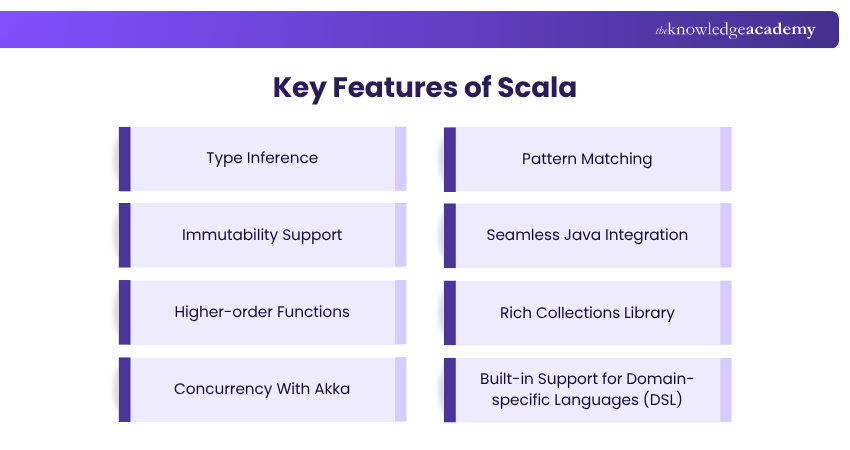
“Scala combines object-oriented and functional programming. Its key features include type inference, immutability, higher-order functions, traits, pattern matching, and seamless Java integration. It is concise yet powerful, and widely used in Data Engineering and Backend Development for writing scalable, maintainable and expressive code.”
What are some benefits of using Scala?
This question will gauge your practical understanding of why Scala is used.
Sample Answer:
“Scala’s syntax is concise and reduces boilerplate code. It supports both functional and object-oriented paradigms, which increases the flexibility. Additionally, it integrates with Java libraries, is great for concurrency and is popular in big data tools such as Apache Spark. It helps us build efficient, scalable and maintainable applications.”
Master lightning-fast data processing and become the spark that powers Big Data innovation. Sign up for our Apache Spark Training now!
Name some of the frameworks that Scala supports
This question will help your interviewer test your awareness of Scala's ecosystem and its commonly used frameworks.
Sample Answer:
“Scala supports several powerful frameworks like Play for web applications, Akka for concurrency and distributed systems, Spark for Big Data Processing, and Slick for functional relational mapping. These frameworks help Developers build high-performance, scalable applications across a variety of domains, ranging from web apps to Data Engineering.”
Explain Option and write its usage
This question will evaluate your knowledge of null safety and safe handling of optional values.
Sample Answer:
“Option in Scala represents a value that may or may not be present. It can be Some(value) or None. It helps us avoid null pointer exceptions. Instead of returning null, we return an Option, making the code safer and more expressive when dealing with optional data.”
What is a Scala map?
This question will help assess your grasp on Scala collections and how key-value pairs are handled.
Sample Answer:
“A Map in Scala is a collection of key-value pairs. It comes in mutable and immutable forms. We can use it to store and retrieve data using keys. It's useful for quick lookups, like storing configuration settings or mapping names to values in a program.”
How does type inference work in Scala, and when should you explicitly declare types?
This question is intended to assess your understanding of Scala’s type inference mechanism and best practices around when to declare types manually for clarity or safety.
Sample Answer:
"Scala uses type inference to determine variable types, reducing verbosity automatically. For example, val name = "Scala" infers a String. However, it’s good practice to declare types explicitly for public APIs, complex expressions, or when clarity matters. It improves readability, especially in collaborative or large-scale projects."
How does Scala handle immutability?
This question is designed to check knowledge of functional programming principles in Scala.
Sample Answer:
“Scala encourages immutability by default. Collections such as List and Map are immutable unless explicitly declared mutable. Using val instead of var prevents reassignment. So, immutability helps with thread safety and makes the code easier to debug, maintain, and test, making it perfect for concurrent and functional programming.”
What's the difference between a statically typed language and a dynamically typed language? Which type is Scala?
This question will assess your understanding of typing systems and Scala's classification.
Sample Answer:
“The key difference lies in the fact that statically typed languages check types at compile time, while dynamically typed ones do it at runtime. Scala is statically typed, meaning type errors are caught early. It also uses type inference, so we don’t always need to declare types. It provides safety without sacrificing code simplicity.”
Transform raw information into game-changing insights. Sign up for our Big Data and Analytics Training now!
What are companion objects in Scala?
This question will test your knowledge of Object-oriented Programming (OOP) in Scala.
Sample Answer:
“A companion object in Scala shares the same name and file as a class. It holds static-like methods and values, since Scala doesn’t have static members. Companion objects can access private members of the class and vice versa, making them perfect for factory methods and utility logic.”
What is the difference between val, var, and def in Scala?
This question is designed to check your familiarity with variable and method declarations.
Sample Answer:
“val defines an immutable value, var defines a mutable one, and def is used to define a method. So, use val for constants, var only if reassignment is needed, and def when defining reusable logic. Scala encourages using val to support immutability and safer code.”
What are traits in Scala, and how do they differ from interfaces in Java?
This question is intended to gauge how well you test understand Scala traits and their functionality.
Sample Answer:
“Traits in Scala are like Java interfaces but more powerful. Unlike interfaces, traits can have concrete method implementations and states. They allow multiple inheritance and are used for code reuse and modular design. They offer a flexible way to share behaviour across unrelated classes.”
What is the purpose of the @tailrec annotation in Scala?
This question will assess your knowledge of recursion and performance optimisation.
Sample Answer:
“The @tailrec annotation ensures a recursive method is optimised into a loop by the compiler, preventing stack overflow errors. If the method isn’t tail-recursive, the compiler throws an error. It’s a great tool for writing efficient recursive functions in a safe, performance-friendly way.”
What do you mean by Closure in Scala?
This question is intended to check your grasp of functional programming and lexical scope.
Sample Answer:
“A closure is a function that uses one or more variables from its enclosing scope. In Scala, it remembers those variables even after the outer function has finished. Closures are useful in functional programming for creating functions on the fly with context-aware behaviour.”
Learn to craft scalable and fast applications with elegance and efficiency in our Play Framework Training With Scala and Java - Sign up now!
What's a lens in Scala?
Your answer to this question will help the interviewer assess your familiarity with functional programming patterns and immutability handling.
Sample Answer:
“A lens in Scala is a functional programming concept used to work with nested immutable data structures. It allows us to focus on and update specific parts of complex data without mutating the original. Libraries like Monocle provide lenses for safe and expressive transformations.”
State the difference between Scala and Java
This question is intended to evaluate your comparative understanding of Scala versus Java.
Sample Answer:
“Scala is more concise, supports both object-oriented and functional paradigms, and has advanced features like pattern matching and immutability. Java is more verbose and strictly object-oriented. Scala runs on the JVM and interoperates with Java but is better suited for modern, expressive, and scalable codebases.”
How do the chief two Scala sets differ from one another?
This question is intended to test your understanding of Scala collections.
Sample Answer:
“Scala offers two main types of sets: mutable and immutable. Immutable sets don’t change once created, while mutable ones allow adding or removing elements. By default, Scala uses immutable sets. Choosing between them depends on whether we want safer, predictable code or flexibility in data manipulation.”
Explain why Scala prefers immutability
This question is designed to gauge how well you understand functional principles and code safety.
Sample Answer:
“Scala prefers immutability because it leads to safer, more predictable code. Immutable data structures help avoid side effects, make code easier to test, and are inherently thread-safe. This approach aligns with functional programming, encouraging pure functions and reliable state management in complex applications.”
What's the difference between Map and HashMap in Scala?
This question will test your grasp of the difference between abstract collection traits and specific implementations.
Sample Answer:
“In Scala, Map is a general trait for key-value collections. HashMap is a specific implementation of a mutable map. By default, Map refers to an immutable version. We can use HashMap when we need fast, mutable key-based access; otherwise, we can stick with Map for safer, immutable operations.”

Explain the different access modifiers that are available in Scala
This question will help the interviewer assess your understanding of encapsulation and visibility rules.
Sample Answer:
“Scala has three main access modifiers: private, protected, and public (default). The private modifier restricts access within the class, protected allows access in subclasses, and public means accessible everywhere. We can also use scope-specific modifiers like private[this] or protected[package] for fine-grained control over visibility.”
Connect, process, and power the future of data with our comprehensive Apache Kafka Training - Register now!
What is the difference between a Future and an Await in Scala?
This question is posed to evaluate your knowledge of asynchronous programming.
Sample Answer:
“A Future represents a computation that runs asynchronously and returns a result later. Await is used to block and wait for that result. While Future is non-blocking and preferred, Await should be used sparingly, typically in testing or edge cases, to avoid freezing threads.”
How do you decide whether to choose between a Scala list or stream?
This question will test your understanding of memory efficiency and lazy evaluation.
Sample Answer:
“I use a List when I need strict evaluation and fast access to the whole collection. I choose a Stream (or LazyList in Scala 2.13+) for large or infinite sequences where elements are generated lazily. Streams save the memory by evaluating items only when needed.”
What is Scala anonymous function?
Your understanding of inline functions and functional syntax will be tested with this question.
Sample Answer:
“An anonymous function in Scala is a function without a name, defined using the => syntax. It's handy when passing small pieces of logic to higher-order functions like map or filter. For example: (x: Int) => x * 2 doubles any number passed to it.”
Explain Implicit Parameter
This question will test how well you understand Scala’s implicit mechanism and function arguments.
Sample Answer:
“The compiler automatically passes an implicit parameter if it's marked as implicit and available in the current scope. We define functions that take such parameters to simplify repeated code, like passing configuration or context. It’s powerful but must be used carefully for clarity.”
How can you compile Scala code?
This question is intended to check your practical knowledge of Scala Development workflow.
Sample Answer:
“We can compile Scala code using the scalac command in the terminal. For example: scalac Hello.scala generates a class file. We can then run it using scala Hello. Alternatively, tools like sbt or IntelliJ IDEA are commonly used for compiling and managing Scala projects.”
What is the difference between RDDs, DataFrames, and Datasets in Spark with Scala?
This question will assess your understanding of Spark data abstractions.
Sample Answer:
“Resilient Distributed Datasets (RDD) are low-level, resilient collections of objects. DataFrames are higher-level, tabular, and optimised. Datasets blend both which means they are type-safe like RDDs and structured like DataFrames. We can use RDDs for fine control, DataFrames for performance, and Datasets when we want type-safety with structured operations in Scala.”
How do you optimise Spark jobs written in Scala?
This question will test your comprehension of performance tuning in Spark with Scala.
Sample Answer:
“To optimise Spark jobs, I use caching wisely, reduce data shuffles, use DataFrames over RDDs, avoid wide transformations, and leverage Spark’s catalyst optimiser. Also, I tune memory settings and partition sizes. Writing transformations efficiently in Scala can significantly improve execution time and resource usage.”
How does pattern matching work in Scala, and why is it useful?
This question is intended to gauge your understanding of control flow and functional constructs.
Sample Answer:
“Pattern matching in Scala is like a powerful switch-case. We can match values against patterns like constants, types, or case classes and execute logic accordingly. It’s extremely useful for writing clean, readable code when handling different scenarios, especially in functional programming or when working with sealed traits.”

The Knowledge Academy


Global Training Provider
The Knowledge Academy is a world-leading provider of professional training courses, offering globally recognised qualifications across a wide range of subjects. With expert trainers, up-to-date course material, and flexible learning options, we aim to empower professionals and organisations to achieve their goals through continuous learning.


 If you wish to make any changes to your course, please


