


 Top Rated Course

We may not have the course you’re looking for. If you enquire or give us a call on 01344203999 and speak to our training experts, we may still be able to help with your training requirements.
Program Management Professional (PgMP)® Exam Study Guide
David Evans 04 September 2026This Program Management Professional Exam Study Guide covers the PgMP Exam format, eligibility requirements and key exam domains. It also provides study priorities and practical tips to help you prepare effectively.

Training Outcomes Within Your Budget!
We ensure quality, budget-alignment, and timely delivery by our expert instructors.
Table of Contents
Key Takeaways
a) PgMP is an advanced certification intended for experienced programme professionals.b) The exam contains 170 questions with 240 minutes available for completion.c) The exam covers five Programme Management domains with different weightings.d) Program Life Cycle Management carries the highest weighting at 44% and deserves substantial preparation.e) Effective preparation combines domain knowledge, programme-level thinking, practice questions and analysis of weaker areas.
Imagine spending years managing complex programmes, coordinating projects and balancing stakeholders, only to face one deceptively simple question:
“So, are you ready for the PgMP Exam?”
Experience gives you a strong foundation, but the exam asks you to turn that experience into programme-level judgement. Knowing what to study, which domains deserve more attention and how to approach scenario-based questions can make preparation feel like a programme of its own.
So, where do you begin?
A Program Management Professional Exam Study Guide can bring structure to that challenge.
This Program Management Professional Exam Study Guide helps you focus your preparation, understand the exam priorities and build a more confident approach to exam day. Let's begin!
What is the Program Management Professional (PgMP)® Exam?
The PgMP Exam is an advanced certification examination administered by the Project Management Institute (PMI). It assesses the knowledge, skills and abilities required to manage multiple related projects and programme activities in a coordinated manner.
The exam is designed for experienced programme professionals who manage complexity, align programmes with organisational objectives and focus on achieving strategic benefits. Unlike Project Management, which focuses on individual projects, Programme Management coordinates related projects to achieve broader organisational goals.

PgMP® Exam Format and Eligibility Requirements
Understanding the PgMP examination requirements before building a study schedule helps ensure that your preparation is based on the current PgMP structure. Let’s look at it below:
1) PgMP Exam Format
The PgMP Exam consists of 170 questions, and candidates have 240 minutes to complete it. The exam is currently available in English and Simplified Chinese and assesses knowledge across five programme-management domains.
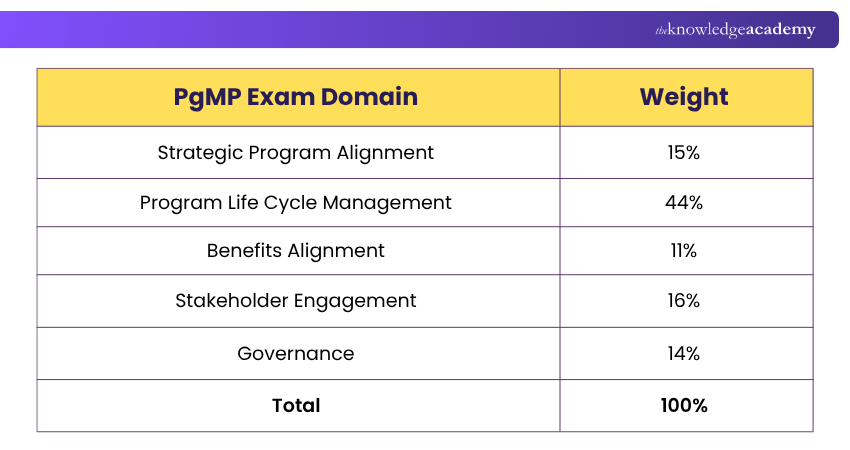
Each domain has a specific percentage weighting that determines its proportion of exam questions. Candidates can use the PgMP Exam Content Outline (ECO) to prioritise their revision based on these weightings while ensuring that all five domains are covered.
2) PgMP Eligibility Requirements
PMI currently provides three eligibility routes, depending on education and professional experience. Let's learn about them in the table below:
PgMP applicants must document relevant project and programme experience and pass a panel review conducted by PgMP-certified professionals. Only after successfully completing this review can candidates schedule the exam, making PgMP an experience-based certification.
What Should You Study for the PgMP® Exam?
The PgMP Examination Content Outline (ECO) divides the exam into five domains, each with a different weighting. These weightings can help you prioritise your preparation while ensuring that every domain is covered. Let’s learn more below:
1) Strategic Program Alignment
Strategic Program Alignment focuses on ensuring that programmes support an organisation’s strategic direction. Candidates should understand how programme objectives, business cases, roadmaps, risks and expected benefits connect with organisational priorities.
Preparation should also cover internal and external influences, stakeholder expectations and opportunities for strategic change. Focus on understanding why a programme exists and how it contributes to broader organisational objectives.
2) Program Life Cycle Management
Program Life Cycle Management has the highest weighting. It covers how Programme Managers initiate, plan, execute, control and close programme activities while coordinating related projects and other programme work.
Give particular attention to programme planning, resources, dependencies, risks, change, performance monitoring and component coordination. Since this domain represents the largest proportion of the exam, it should receive the greatest share of your preparation time.
Trainer’s Insight
Don’t treat the 44% weighting as a reason to neglect the other domains. Use it to allocate study time, then adjust your plan according to your practice performance. A lower-weighted domain may need more attention if it is consistently your weakest area.
3) Benefits Alignment
Benefits Alignment focuses on identifying, planning, delivering and monitoring the benefits expected from a programme. Candidates should understand how programme outputs and outcomes contribute to strategic benefits.
Study areas like benefits identification, measurement and realisation, including the use of Key Performance Indicators (KPIs) and benefits realisation plans. Focus on how benefits are tracked and sustained throughout the programme.
Trainer’s Insight
Keep outputs, outcomes and benefits separate when studying. Ask what the programme delivers, what changes as a result and what value the organisation expects to realise.
4) Stakeholder Engagement
Stakeholder Engagement covers identifying and analysing stakeholders, understanding their expectations and developing appropriate engagement and communication approaches throughout the programme.
Preparation should also consider practical situations involving competing stakeholder interests, changing levels of support and different expectations. Focus on how a Programme Manager can communicate effectively and maintain productive stakeholder relationships.
5) Governance
Governance focuses on the structures, responsibilities and decision-making processes used to oversee a programme. Candidates should understand governance roles, programme controls, compliance, escalation and decision authority.
Rather than learning definitions alone, consider how governance works in practical situations. Practise identifying when an issue should be escalated, who has authority to make decisions and how governance supports programme objectives.
Build your Programme Management expertise with our PMI Project Management Ready Training now!
How to Create an Effective PgMP® Study Plan?
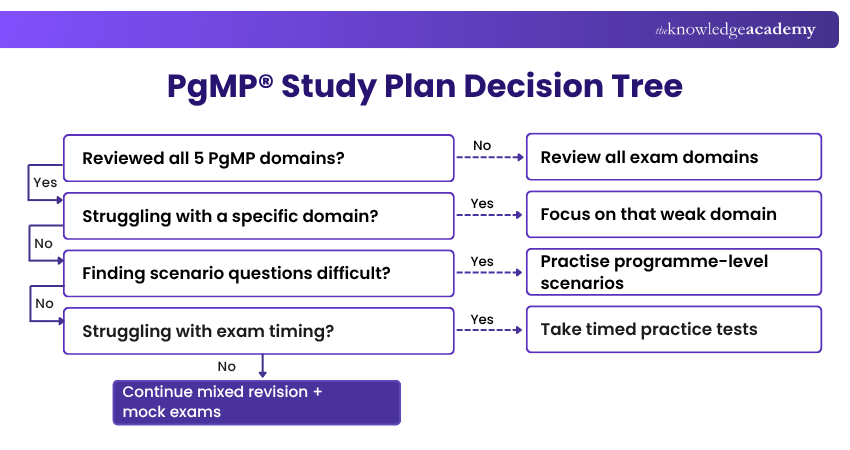
Developing a well-structured study plan is essential for effective preparation for the PgMP Exam. Build your schedule around your current knowledge, professional experience and performance during practice. Here are the key steps:
a) Assess Knowledge Gaps: Evaluate your current understanding of PgMP Exam topics. Identify areas needing improvement to prioritise study efforts. Start with all five ECO domains rather than only the areas you encounter most often at work.
b) Structure Study Around the ECO: Use the five current domains as the backbone of your study plan. This keeps preparation aligned with what PMI says the examination covers.
c) Allocate Time According to Need and Weighting: Program Life Cycle Management deserves the most attention at 44%, but weighting alone should not guide your study. Spend extra time on any domain where your performance is weaker.
d) Set Achievable Goals: Break your study plan into measurable goals and milestones. For example, replace “study Governance” with “review governance tasks, complete practice questions and analyse incorrect answers”.
e) Practise Regularly: Engage in consistent practice sessions, solve sample questions and take mock exams. Practice should test both your understanding and your ability to apply programme-management concepts.
f) Review and Revise: Regularly review studied topics, reinforce understanding, and consolidate knowledge. Use different revision techniques to aid retention.
g) Reassess Your Weak Areas: Your plan should change as your preparation progresses. Use practice results to determine which domains or task areas require another revision cycle.
Pro Tip
Exam weighting tells you how much a domain matters to the test, while practice performance tells you how much attention you need to give it. Use both when deciding where to spend your study time.
Tips to Prepare for the PgMP® Exam
Preparing for the PgMP Exam requires focused study, regular practice and a clear understanding of programme-level concepts. Here are some practical tips:
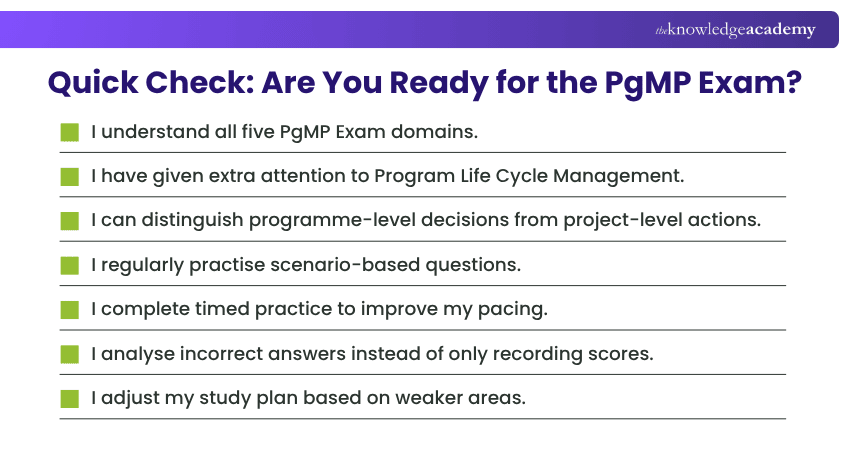
a) Practise With Sample Questions: Use PgMP sample questions to become familiar with the question style and test your understanding. Review why each answer is correct or incorrect, rather than focusing only on your score.
b) Review the Current Exam Domains: Study all five domains: Strategic Program Alignment, Program Life Cycle Management, Benefits Alignment, Stakeholder Engagement and Governance. Align your preparation with the current PgMP Exam Content Outline.
c) Take Mock Exams: Complete mock exams under realistic conditions to assess your readiness and improve your pacing. Practise working within the actual format of 170 questions in 240 minutes.
d) Focus on Weak Areas: Use your practice results to identify topics that need more attention. Spend additional study time on weaker domains instead of repeatedly revising areas you already understand.
e) Practise Programme-level Thinking: Approach scenarios from a programme perspective. Consider strategic alignment, benefits, dependencies, stakeholders and governance rather than focusing only on individual project outcomes.
f) Manage Your Time: Practise answering questions at a steady pace. With 240 minutes for 170 questions, you have an average of about 1 minute 25 seconds per question, although some will naturally require more time than others.
g) Analyse Your Mistakes: Review incorrect answers to understand what went wrong. Identify whether the cause was a knowledge gap, misreading the scenario or confusing project- and programme-level responsibilities.
h) Stay Consistent: Follow a realistic study schedule and break your preparation into manageable goals. Regular, focused study can help you maintain progress and adjust your preparation as your performance improves.
Conclusion
Preparing for the PgMP certification requires focused study, practical preparation and strong programme-level thinking. This Program Management Professional Exam Study Guide can help you focus on key domains, practise effectively and approach the exam with greater confidence.
Enhances Project Management skills and knowledge with our PMP® Training today!
Frequently Asked Questions
How Many Times Can You Take the PgMP® Exam?

PMI states that candidates who do not pass may attempt the examination up to three times within the one-year eligibility period.
How Difficult is the PgMP® Exam?
The PgMP Exam can be challenging because it requires candidates to apply programme-level judgement to complex scenarios involving strategy, governance, benefits and stakeholders. Focused study and scenario-based practice can make it more manageable.
Does the PgMP® Certification Expire?
Yes, the PgMP® Certification operates under PMI's Continuing Certification Requirements (CCR) programme. PgMP holders must earn 60 Professional Development Units (PDUs) during each three-year certification cycle to maintain the certification.

David Evans


Certified Project Trainer and Agile Delivery Expert
David Evans brings over a decade of hands-on experience in project delivery, Agile transformation, and team leadership. With a background in technology and business consulting, David has led cross-functional teams through Agile and Waterfall projects in both public and private sectors. He combines technical knowledge with practical insights to help readers navigate the challenges of modern project environments.


 If you wish to make any changes to your course, please


