


 Top Rated Course

We may not have the course you’re looking for. If you enquire or give us a call on 01344203999 and speak to our training experts, we may still be able to help with your training requirements.
AZ-900 Microsoft Azure Fundamentals Exam Preparation Guide
The Knowledge Academy 02 September 2026The AZ-900 Microsoft Azure Fundamentals Exam preparation guide helps you understand the exam structure, key topics, preparation strategies and how to use practice assessments effectively.

Training Outcomes Within Your Budget!
We ensure quality, budget-alignment, and timely delivery by our expert instructors.
Table of Contents
Key Takeaways
1. Familiarise yourself with the AZ-900 exam structure and understand what to expect before beginning your preparation.2. The AZ-900 exam assesses foundational knowledge of Cloud concepts, Azure architecture and services, and Azure management and governance.3. Effective preparation involves understanding why Azure services are used and when to apply them in different cloud scenarios.4. Practice assessments are most useful when you analyse incorrect answers and use the results to identify areas requiring further study.5. A structured study plan with regular revision can help reinforce key concepts and improve your overall exam readiness.
Before opening another AZ-900 video or set of notes, ask yourself one question: Do you know what the exam actually expects you to understand?
Knowing the answer can make your preparation much more focused. You can concentrate on the concepts that matter, understand how they apply in different scenarios, and identify where you need more practice. The goal is simple: study smarter, close your knowledge gaps, and walk into the exam knowing you have prepared for the right things. So, read on and make your Microsoft Azure AZ-900 Fundamentals Exam Preparation count!
What is the AZ-900 Microsoft Azure Fundamentals Exam?
The AZ-900 Microsoft Azure Fundamentals Exam is an entry-level certification exam designed to validate a candidate’s foundational understanding of Cloud Computing and Microsoft Azure. It covers areas such as Cloud concepts, Azure architecture and services and Azure management and governance.
Unlike advanced Azure Certification exams, AZ-900 does not require deep technical expertise or extensive hands-on experience. Instead, it focuses on understanding what Azure services do, why they are used, and where they fit within common Cloud scenarios.
What Does the AZ-900 Exam Cover?
The AZ-900 Exam covers the fundamental concepts and services you need to understand when working with Microsoft Azure. Rather than testing advanced configuration or administration skills, it assesses whether you understand core Cloud concepts, major Azure services, and how Azure environments are managed and governed. The exam content is organised into three main areas:
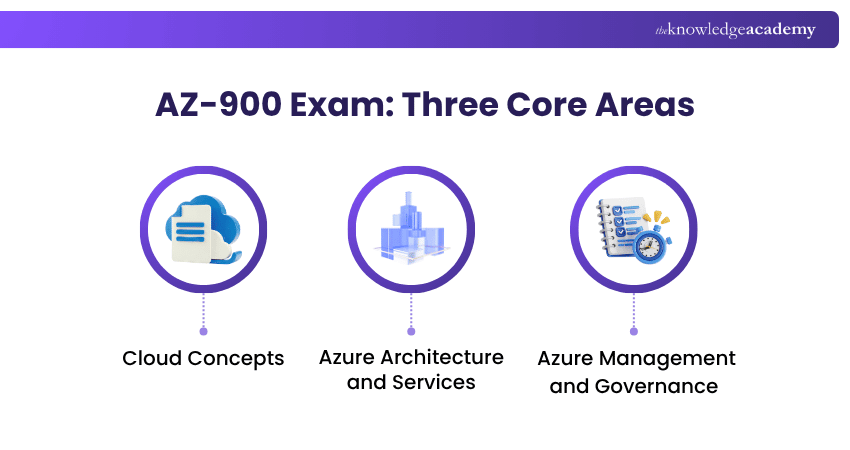
1) Describe Cloud Concepts
Start with the foundations. This area tests whether you understand the ideas behind Cloud Computing rather than Azure products alone. Topics include concepts such as Cloud Computing, the shared responsibility model, Cloud deployment models and common Cloud service models. You should be comfortable distinguishing between public, private and hybrid Cloud environments and understanding when each model may be appropriate.
You should also understand:
a) Infrastructure as a Service (IaaS)
b) Platform as a Service (PaaS)
c) Software as a Service (SaaS)
d) Consumption-based pricing models
e) Serverless computing
f) Availability and scalability
g) Reliability and predictability
h) Security and governance
i) Manageability
Study Approach
Instead of memorising three definitions for IaaS, PaaS and SaaS, practise comparing the level of responsibility shared between the customer and the Cloud provider in each model.
2) Describe Azure Architecture and Services
Once the Cloud fundamentals are clear, move into Azure concepts. This is where you need to understand how Azure is structured and what its principal services are designed to accomplish. Important areas to study include:
a) Azure regions and availability zones
b) Azure datacentres and resource groups
c) Subscriptions and management groups
d) Virtual machines, availability sets, and containers
e) Azure Functions
f) Virtual networks, subnets and network peering
g) Azure DNS
h) VPN Gateway and ExpressRoute
i) Azure Storage
j) Storage redundancy
k) Azure migration options
l) Azure directory services
m) Authentication and Entra Conditional Access
n) Role-Based Access Control (RBAC)
o) Zero Trust and defence-in-depth
p) Microsoft Defender for Cloud
Study Approach
For every service you encounter, ask three questions:
What problem does it solve? When would I use it? What similar Azure service could I confuse it with?
This approach turns a long list of Azure services into practical choices you can reason through, making it easier to distinguish between similar services in exam scenarios.
3) Describe Azure Management and Governance
The final area focuses on how organisations manage, govern, deploy and monitor their Azure environments. You need to understand the tools Azure provides for controlling costs, organising resources, enforcing organisational standards and maintaining visibility across Cloud resources.
The emphasis is on understanding what each tool does and when it may be appropriate rather than performing advanced administrative tasks. Important areas to cover can include:
a) Factors that affect Azure costs
b) Azure Pricing Calculator
c) Microsoft Cost Management
d) Resource tags and locks
e) Microsoft Purview
f) Azure Policy
g) Azure portal
h) Azure Cloud Shell, PowerShell and CLI
i) Azure Arc
j) Infrastructure as Code (IaC)
k) Azure Resource Manager (ARM) and ARM templates
l) Azure Advisor and Service Health
m) Azure Monitor and Application Insights
Trainer’s Insight
When two Azure tools seem similar, focus on what they control, protect, or monitor. That distinction often points you towards the right answer.
Understand how Artificial Intelligence and Azure are shaping the future of organisations in our Microsoft Azure AI Fundamentals AI-900 Course - Sign up now!
How to Prepare for the AZ-900 Exam?
Good AZ-900 Microsoft Azure Fundamentals Exam preparation does not require you to know everything about Azure. It requires you to know the right fundamentals well enough to distinguish between concepts and apply them to straightforward scenarios. Here is a practical way to organise your preparation:
1) Start With the Current AZ-900 Study Guide
Before choosing any AZ-900 videos, books or practice questions, establish exactly what Microsoft currently expects you to know. Microsoft's study guide is particularly important because exam objectives can change over time. Use the objectives as a checklist.
As you study, classify each objective as:
Confident → Needs revision → Not yet understood
That gives you a simple way to prioritise your remaining study time.
2) Build Your Cloud Fundamentals First
Do not rush directly into Azure product names. First make sure you understand:
a) What Cloud Computing means
b) Shared responsibility
c) Public, private and hybrid Cloud models
d) IaaS, PaaS and SaaS
e) Consumption-based pricing
f) Scalability and availability
g) Basic security and governance principles
These concepts become the vocabulary for the rest of the exam. If you cannot confidently explain the difference between IaaS, PaaS and SaaS, for example, learning dozens of Azure services on top of that weak foundation can make preparation unnecessarily difficult.
3) Learn Azure Services by Purpose and Use Case
A long list of Azure services can look intimidating. Instead of asking: “Can I remember what Azure Service X is?” ask: “What requirement would make me choose Azure Service X?”
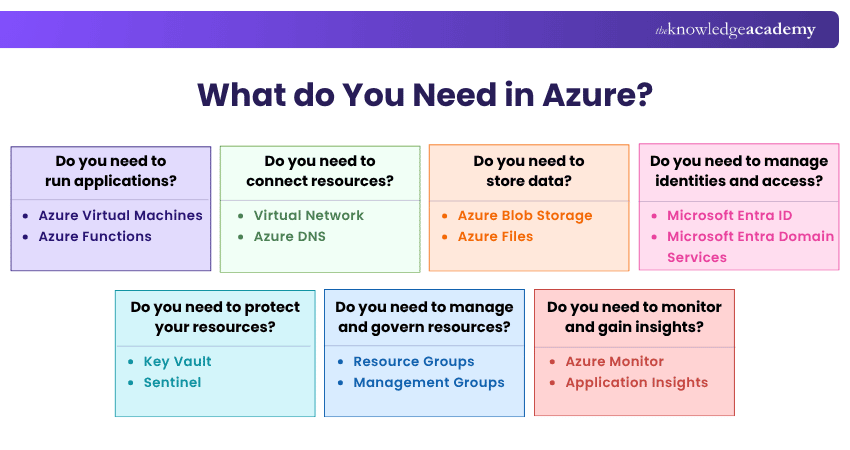
For example, group your learning around purposes such as:
Compute → Networking → Storage → Identity → Security → Governance → Monitoring
Then compare services within each group. This makes it easier to recognise differences when an exam question presents several plausible Azure technologies.
4) Get Hands-on Experience with Azure
AZ-900 assesses foundational knowledge rather than advanced administration, but seeing Azure concepts in context can make abstract terminology easier to understand. Where practical, familiarise yourself with areas such as:
a) Azure portal navigation
b) Resource groups
c) Virtual machines
d) Storage accounts
e) Virtual networks
f) Microsoft Entra ID
g) Azure Monitor
The aim is not to become an Azure Administrator before taking a fundamentals exam. It is to connect the terminology in your learning material with what Azure actually looks like.
5) Use Practice Assessments and Questions
Practice questions are most valuable when you use them to identify your knowledge gaps. Microsoft's Practice Assessments are designed to provide an overview of the style, wording and difficulty of the questions you are likely to experience on the AZ-900 Exam. After completing an assessment, you can check answers, review rationales, access related learning resources and see a breakdown of your performance.
Do not simply record your percentage. For every wrong answer, determine why you got it wrong. Was it because you:
1) Did not know the concept?
2) Confused two similar services?
3) Misread the requirement?
4) Remembered outdated information?
5) Guessed rather than reasoning through the options?
That diagnosis tells you what to study next.
6) Review Weak Areas
Your final revision should become narrower, not broader. If your practice results consistently show that you understand Cloud models and compute services but struggle with governance or networking, spending equal time on every topic is inefficient. Concentrate on the weaker areas while continuing short reviews of your stronger ones.
Consider this preparation cycle:
Learn the objective → Test your understanding → Diagnose mistakes → Review the weak concept → Test again
Repeat this cycle until your weaknesses become more specific. “I struggle with Azure” is difficult to fix. “I keep confusing Azure Policy and RBAC” gives you a precise revision task.
7) Check Your Readiness Before the Exam
Do not judge your readiness from a single high practice score. Look for consistent performance across different topics and assessments and make sure you can explain why an answer is correct rather than simply recognising it. Once your weaker areas have improved and your results are consistent, you are in a stronger position to attempt the exam.
AZ-900 Readiness Check
Before scheduling or sitting the exam, ask yourself:
Can I explain the three major assessed areas without looking at my notes? Can I explain Azure's basic resource hierarchy? Can I compare common compute, networking and storage options? Do I understand foundational identity, security and governance concepts? When I get practice questions wrong, are the remaining gaps relatively specific? Have I reviewed Microsoft's current study guide for recent changes? Am I comfortable with the exam interface?
If several questions above produce an uncertain answer, identify those areas and perform another Learn → Test → Diagnose → Review cycle before treating your preparation as complete.
Enrich the fundamentals of Azure data technologies with DP-900 Azure Data Fundamentals Course – Sign up soon!
Common AZ-900 Preparation Mistakes to Avoid
Even a good collection of study resources can become ineffective if you use them poorly. Here are some mistakes to avoid when preparing for the AZ-900 Microsoft Azure Fundamentals Exam:
1) Memorising Without Understanding
Knowing that a service exists is not enough if you cannot distinguish its purpose from another service. Focus on relationships, differences and use cases.
2) Relying on One Learning Format
Using only videos, reading material or practice questions can leave gaps in your understanding. Combine different learning formats where useful, such as reading concepts, watching explanations, exploring Azure, and testing yourself with practice questions. This can help reinforce the same concepts from different perspectives and reveal areas that need more attention.
3) Ignoring Incorrect Practice Answers
Failing to review your practice answers beyond simply checking your score means missing a valuable learning opportunity. Review every incorrect answer, understand why your choice was wrong, and revisit the underlying concept. This helps prevent you from repeating the same mistake in future questions.
4) Trying to Learn Every Azure Service
AZ-900 does not require detailed knowledge of every Azure service. Trying to learn everything can waste time and distract you from the actual exam objectives. Use the current AZ-900 study guide to define your scope and focus on understanding the services and concepts included in it.
5) Leaving Practice Until the End
Do not wait until you believe you have “finished studying” before testing yourself. Early practice can expose misconceptions before they become established. A better readiness check combines several signals.
Conclusion
The AZ-900 Exam is less about how many Azure services you can remember and more about whether you understand the fundamentals behind them. A focused approach built around the current exam objectives, clear conceptual understanding, and regular practice can make preparation far more manageable. With the right preparation strategy, you can approach the AZ-900 Microsoft Azure Fundamentals Exam with greater clarity and confidence.
Looking to take the next big leap in your Cloud career? Sign up for our comprehensive Microsoft Azure Certification Training now!
Frequently Asked Questions
Is Hands-on Azure Experience Required for AZ-900?

AZ-900 focuses on foundational knowledge, but practical exposure can make concepts easier to understand. Exploring resources, storage, networking, identity and monitoring in context can reinforce what you learn through study materials.
How Many Attempts are Allowed for the AZ-900 Exam?
You can attempt the AZ-900 exam up to five times within 12 months from your first attempt. After a failed first attempt, you must wait 24 hours before retaking it. Subsequent failed attempts require a 14-day waiting period.
Is the AZ-900 Exam All Multiple Choice?
No. While multiple-choice questions are common, the exam includes a variety of question formats designed to assess your understanding of Azure concepts in different ways. You may face single-choice and multiple-response questions, yes/no questions or drag-and-drop or ordering questions.
Can a Non-IT Person Learn Azure?
Yes, a non-IT person can learn Microsoft Azure, especially by starting with foundational concepts that require no coding or prior technical background.

The Knowledge Academy


Global Training Provider
The Knowledge Academy is a world-leading provider of professional training courses, offering globally recognised qualifications across a wide range of subjects. With expert trainers, up-to-date course material, and flexible learning options, we aim to empower professionals and organisations to achieve their goals through continuous learning.


 If you wish to make any changes to your course, please


