




We may not have the course you’re looking for. If you enquire or give us a call on 01344203999 and speak to our training experts, we may still be able to help with your training requirements.
PMP® Exam Changes 2026: Latest Updates, Format and Requirements
ByThe Knowledge AcademyLast updated on: 26 November 2026
PMP® exam changes introduced in July 2026 include revised domain weightings, updated question formats and expanded eligibility pathways. Explore the updated exam format, greater emphasis on business value, revised training requirements and how to prepare for the PMP® exam.
At a Glance
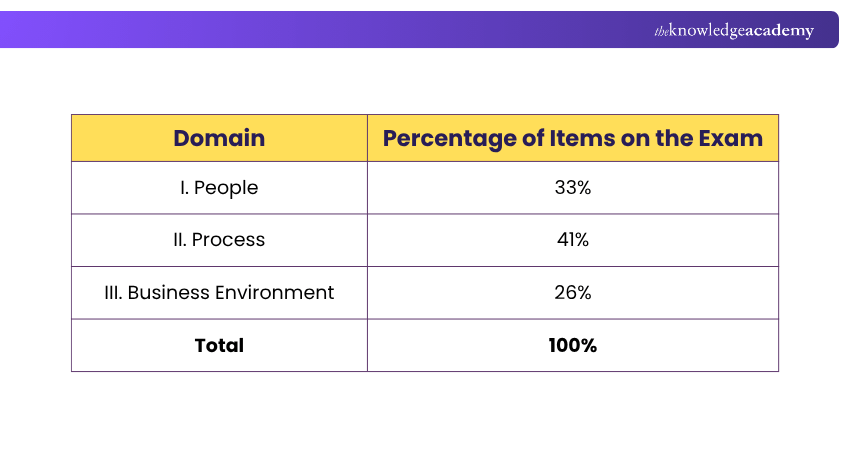
1. Exam Launch: PMI introduced the updated PMP® exam on 9 July 2026, emphasising business value, AI and sustainability.2. Domain Weightings: People accounts for 33%, Process for 41% and Business Environment for 26%, up from 8%.3. Exam Format: The exam has 180 questions, including 170 scored questions, and lasts 240 minutes. New formats include case-based and graphic-based questions.4. Eligibility and Training: PMI expanded eligibility pathways and the experience window to ten years. New live training-provider rules take effect on 1 December 2026.5. Preparation: Study the updated exam outline and practise interpreting project data and answering linked questions under timed conditions.
Imagine spending months preparing for an important professional examination. You've reviewed the study materials, completed practice questions and planned your examination date. But what if your preparation is based on an outdated exam structure?
This is why staying informed about examination updates matters, especially with the PMP® exam changes introduced in July 2026. These updates can affect your preparation strategy and what to expect on exam day. So, what has changed, and how can you prepare effectively? Let's explore.
PMP® Exam Content Changes
The 2026 PMP® exam follows an updated Examination Content Outline (ECO) that defines the responsibilities and tasks assessed during the examination.
Although the three existing domains remain, their weightings have changed to reflect current professional practice. The exam also covers predictive, adaptive/agile and hybrid approaches across all three domains, with approximately 40% of questions focused on predictive approaches and the remaining 60% divided between adaptive/agile and hybrid approaches.
1) People Domain – 33%
The People domain has decreased from 42% to 33% of the examination.
It evaluates the ability to lead project teams, maintain effective relationships, and establish shared expectations.
Key topics include:
a) Developing a common project vision
b) Managing conflicts and resolving disagreements
c) Leading and empowering project teams
d) Engaging stakeholders effectively
e) Aligning and managing stakeholder expectations
f) Facilitating knowledge transfer and project communication
The domain assesses how candidates address interpersonal challenges and support collaboration throughout project delivery.
2) Process Domain – 41%
The Process domain now represents 41% of the examination, compared with 50% previously.
It focuses on planning, delivering and monitoring project activities using suitable project management approaches.
Key topics include:
a) Developing integrated project management plans
b) Defining and managing project scope
c) Planning resources and procurement
d) Managing project finances and schedules
e) Maintaining deliverable quality
f) Evaluating project status and managing closure
g) Ensuring value-based project delivery
This domain examines how candidates select, implement and monitor appropriate project management practices.
3) Business Environment Domain – 26%
The Business Environment domain has increased substantially from 8% to 26%.
It examines how Project Managers operate within organisational requirements and external business conditions.
Key topics include:
a) Establishing project governance
b) Managing project compliance
c) Evaluating changes in the external business environment
d) Supporting organisational change
e) Managing project changes and resolving impediments
f) Planning and managing project risks
g) Contributing to continuous improvement
The increased weighting reflects the importance of understanding the wider organisational context in which projects are delivered.
4) Emerging Areas of Project Management
The revised examination also addresses developments influencing modern project management.
a) Artificial Intelligence: Exam scenarios may explore the application and implications of AI-enabled technology in project activities.
b) Sustainability: Candidates are expected to consider relevant sustainability requirements when evaluating project decisions.
c) Business Value: Greater attention is given to benefits, outcomes and whether projects deliver worthwhile results.
These topics are integrated into relevant examination tasks rather than assessed as independent domains.
PMP® Exam Format Changes
The 2026 examination introduces changes to its duration, scored questions and assessment methods. The following sections explain the revised structure and question formats.
1) Updated Exam Structure
The revised PMP® exam contains 180 questions to be completed within four hours.
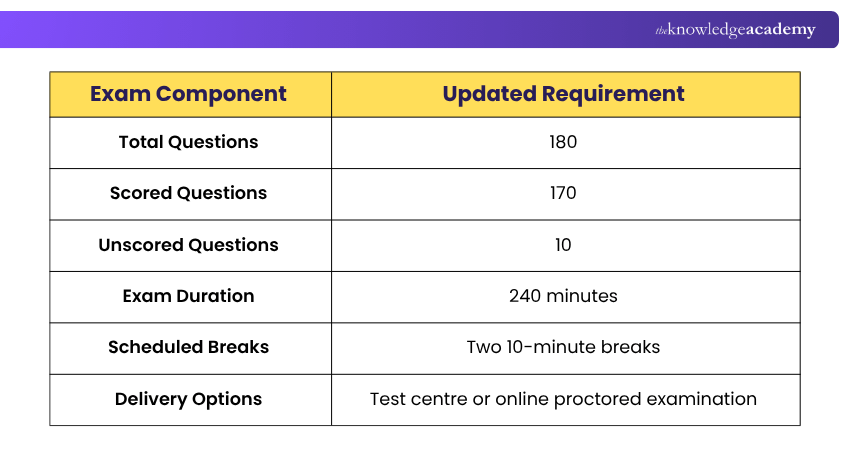
The 10 unscored questions are included to evaluate potential future examination content and do not affect the candidate's score.
The first scheduled break occurs after the case-study section, while the second takes place approximately midway through the independent-question section. Once candidates review their responses and begin a break, they cannot return to questions from the previous section. Candidates should also review the break rules for their chosen examination delivery method.
2) Updated Question Formats
The revised PMP® exam uses different question types to assess practical reasoning and the application of project management knowledge.
These include:
a) Multiple-choice Questions: Candidates select one correct response from the available options.
b) Multiple-response Questions: Candidates identify more than one correct answer based on the question requirements.
c) Case-study Questions: Candidates analyse detailed project scenarios and answer related questions using the information provided.
d) Graphic-based Questions: Candidates interpret charts, graphs, diagrams or images to answer questions.
e) Enhanced Matching Questions: Candidates use interactive matching controls to associate information within more complex visual or structured scenarios.
f) Point-and-click Questions: Candidates identify the correct area within an image by selecting the appropriate location.
g) Matching Questions: Candidates match corresponding items across lists or columns.
h) Pull-down List Questions: Candidates select the correct response from a drop-down list.
Some interactive question formats are available only in computer-based testing. The exact combination may vary depending on the examination form and delivery method.
Trainer’s Insight
In case-study questions, read the scenario carefully before answering the linked questions. Identify the project objective, key constraints and stakeholder concerns, then use the relevant information to evaluate each response. Avoid making assumptions beyond the details provided.
PMP® Eligibility and Training Requirements
The updated PMP® certification requirements introduce expanded educational pathways and a ten-year window for qualifying project management experience. The required experience depends on the candidate's educational qualifications.
|
Educational Qualification |
Required Project Management Experience |
|---|---|
|
Secondary school qualification |
5 years (60 months) |
|
Recognised associate-level or vocational qualification |
4 years (48 months) |
|
Bachelor's degree or higher, or recognised equivalent |
3 years (36 months) |
|
Bachelor's or postgraduate degree from a PMI GAC-accredited programme |
2 years (24 months) |
All qualifying experience must be non-overlapping and gained within the previous ten years.
Training Requirements
Candidates generally need 35 hours of project management education or an accepted alternative, such as an active CAPM® certification. From 1 December 2026, live instructor-led training must come from a PMI Authorised Training Partner (ATP) or another PMI-eligible provider. Eligible self-paced training remains an option.
How to Prepare for the Updated PMP® Exam?
The revised examination requires candidates to apply project management knowledge when evaluating realistic workplace situations. A structured preparation approach can help candidates develop the reasoning and examination skills needed.
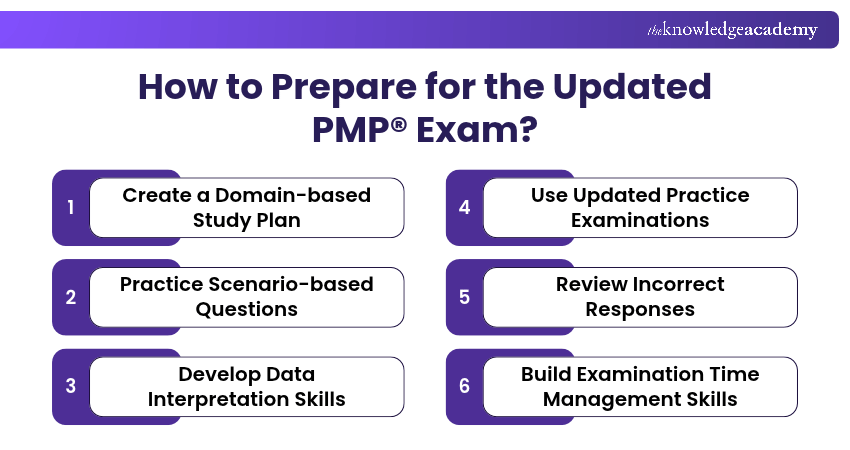
1) Create a Domain-based Study Plan
Use the July 2026 Examination Content Outline (ECO) to identify the tasks assessed across the People, Process and Business Environment domains.
Develop a study schedule that addresses each domain while allocating additional attention to unfamiliar topics.
2) Practice Scenario-based Questions
Work through realistic project situations involving competing priorities, stakeholder concerns, and changing requirements.
Focus on selecting appropriate management responses and understanding the reasoning behind each decision.
3) Develop Data Interpretation Skills
Practise analysing project schedules, financial information, performance indicators, and risk reports. Strengthen the ability to identify relevant information and draw conclusions from project data.
4) Use Updated Practice Examinations
Select mock examinations aligned with the July 2026 PMP® Examination Content Outline. Complete full-length practice tests under timed conditions to assess your readiness and identify areas that need further revision.
5) Review Incorrect Responses
Examine incorrect answers to understand whether mistakes result from misunderstood concepts, misinterpreted scenarios, or incorrect assumptions.
Use these findings to refine your understanding of project management principles and improve decision-making accuracy.
6) Build Examination Time Management Skills
Establish a question-handling strategy that accounts for the 240-minute examination duration. Practice recognising when to move on from difficult questions while allowing sufficient time for the remaining sections.
Build your project management foundations with PMI Project Management Ready® Training - Join now!

The Knowledge Academy develops accessible learning content across Project Management, IT, Cybersecurity, Data Science, Business Analysis, HR, Accounting and Finance, Leadership and Health and Safety. Its resources combine subject research with clear explanations to help professionals build practical knowledge across a wide range of disciplines.
View Detail

 If you wish to make any changes to your course, please


