




We may not have the course you’re looking for. If you enquire or give us a call on 01344203999 and speak to our training experts, we may still be able to help with your training requirements.
How to Pass the NEBOSH Exam: Tips and Preparation Strategies
ByThe Knowledge AcademyLast updated on: 26 November 2026
Passing the NEBOSH exam requires a clear understanding of assessment requirements, effective preparation and practical application of health and safety knowledge. This blog covers essential study tips, revision strategies and techniques for approaching exam questions and assessments with confidence.

At a Glance
Passing a NEBOSH exam requires a clear understanding of the syllabus, effective preparation and the ability to apply knowledge. Here's a quick overview:
1. Know Your Syllabus: Understand the learning outcomes and assessment requirements for your chosen qualification.2. Prepare Consistently: Follow a realistic study plan and revise important concepts regularly.3. Understand the Questions: Pay attention to instructions, available marks and the information requested.4. Apply Your Knowledge: Connect relevant health and safety principles to workplace situations.5. Follow Assessment Requirements: Check the rules for your specific examination or practical assessment.
Imagine preparing thoroughly for a NEBOSH exam, only to encounter a workplace scenario that seems unfamiliar. You recognise the safety concepts but struggle to connect them to the questions. This highlights why exam preparation involves more than memorising information. It requires understanding health and safety principles and applying them to practical situations.
So, how can you prepare to tackle such challenges? This blog explores how to pass the NEBOSH exam through effective revision techniques, question-answering strategies and practical assessment preparation tips. Let's get started!
Top Tips to Pass the NEBOSH Exam
Preparing for a NEBOSH exam requires consistent study, practical understanding and regular revision. Here are eight tips to help you prepare effectively:
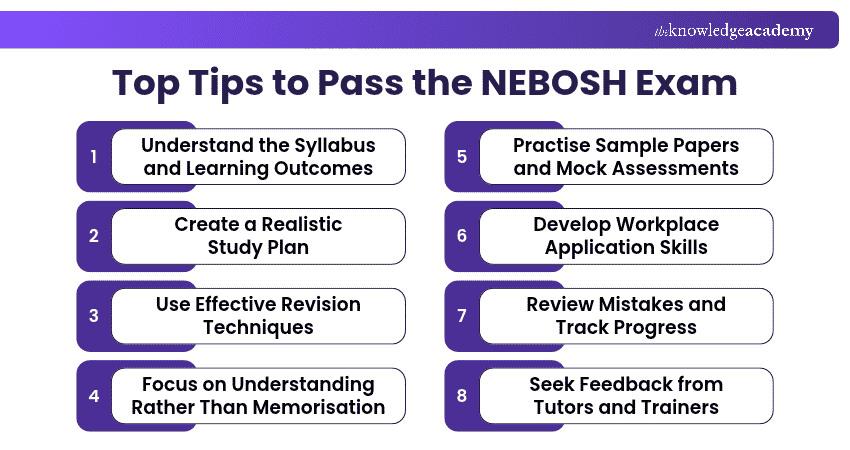
1) Understand the Syllabus and Learning Outcomes
Start by reviewing the official syllabus for your chosen NEBOSH qualification. The syllabus outlines the subjects you need to study and the learning outcomes you are expected to achieve. Identify the topics covered, understand the expected depth of knowledge and check how the learning outcomes relate to your assessment.
For example, if your qualification covers risk assessment, you should understand the principles involved, including recognising hazards, evaluating risks and selecting appropriate control measures. NEBOSH publishes syllabus guides and qualification-specific resources on its official website. These should form the starting point for your preparation.

2) Create a Realistic Study Plan
A well-organised study plan helps you manage your preparation and avoid unnecessary pressure before the assessment. Set achievable goals based on the amount of material, your available study time and the difficulty of each topic. Allocate regular study sessions and include short breaks to maintain concentration.
You should also allow time to revisit challenging subjects rather than studying every topic only once. For instance, you could schedule sessions for learning new material during the week and reserve another session for reviewing previously covered topics. Adjust your plan according to your progress and upcoming assessment deadlines.
3) Use Effective Revision Techniques
Different revision techniques can help you retain information and recall important health and safety principles. Rather than repeatedly reading the same notes, use methods that require you to engage actively with the material.
Some useful revision techniques include:
a) Active Recall: Test your knowledge by answering questions without looking at your notes.
b) Spaced Repetition: Revisit important concepts at intervals to strengthen long-term retention.
c) Flashcards: Create question-and-answer cards for terminology, principles and important concepts.
d) Mind Maps: Organise related topics visually to understand connections between different health and safety principles.
Choose techniques that suit your learning preferences and the topics you are studying. Combining different methods can make revision more engaging and productive.
4) Focus on Understanding Rather Than Memorisation
NEBOSH assessments can require learners to demonstrate how health and safety principles apply in different situations. Simply memorising textbook explanations may not provide the understanding needed to answer unfamiliar questions. Instead, focus on why particular hazards occur, how they can cause harm and why certain preventive measures are appropriate.
For example, when studying manual handling, understand how load characteristics, working conditions and individual capabilities influence injury risks. This helps you explain the reasoning behind suitable precautions.
NEBOSH specifically advises learners to develop a thorough understanding of their subject so they can apply their knowledge to unfamiliar assessment scenarios.
5) Practise Sample Papers and Mock Assessments
Sample papers and mock assessments help you understand the types of questions you may encounter and the level of detail expected in your responses. Use official NEBOSH sample papers that match your qualification and syllabus. Practise under suitable assessment conditions, allowing sufficient time to complete the questions independently.
After each practice session, evaluate how effectively you addressed the questions and whether your responses covered the required information. NEBOSH provides sample question papers for several qualifications, including the General Certificates.
6) Develop Workplace Application Skills
Develop your ability to identify workplace hazards, assess risks and recommend appropriate control measures by applying health and safety principles to realistic situations. Observing workplace activities, where safe and appropriate, can help you understand how these principles work in practice.
For example, in a warehouse, examine potential hazards involving moving vehicles, pedestrian walkways, storage arrangements and manual handling. Consider the existing safety measures and identify where additional precautions may be necessary.
7) Review Mistakes and Track Progress
Reviewing mistakes helps you identify knowledge gaps and improve your understanding before the final assessment. After completing revision exercises, examine the questions you answered incorrectly or found difficult.
Determine whether the problem resulted from insufficient subject knowledge, misunderstanding the question or providing incomplete explanations. Keep a simple progress record showing the topics you have studied, areas needing improvement and subjects that require further revision.
Bonus Tip
Use a simple traffic-light system to prioritise your revision. Mark topics green when you can explain and apply them independently, amber when you need occasional help, and red when you struggle to understand or apply them. Focus your next revision sessions on red topics, while regularly reviewing amber and green ones.
8) Seek Feedback from Tutors and Trainers
Feedback from experienced tutors and trainers can help you understand areas for improvement that may not be immediately obvious during independent study. They may help you identify weaknesses in subject understanding, interpretation or explanation.
For example, if your responses contain accurate information but do not fully address the question, a tutor can explain how to make them more focused. Use the feedback to adjust your preparation and strengthen the skills that need further development.
Learn to spot risks before they strike by joining the NEBOSH National General Certificate in Occupational Health and Safety Training now!
How to Answer NEBOSH Exam Questions Effectively?
Understanding health and safety principles is important, but explaining them clearly is equally essential. Here are the techniques to help you interpret questions and develop relevant answers:
1) Understand NEBOSH Command Words
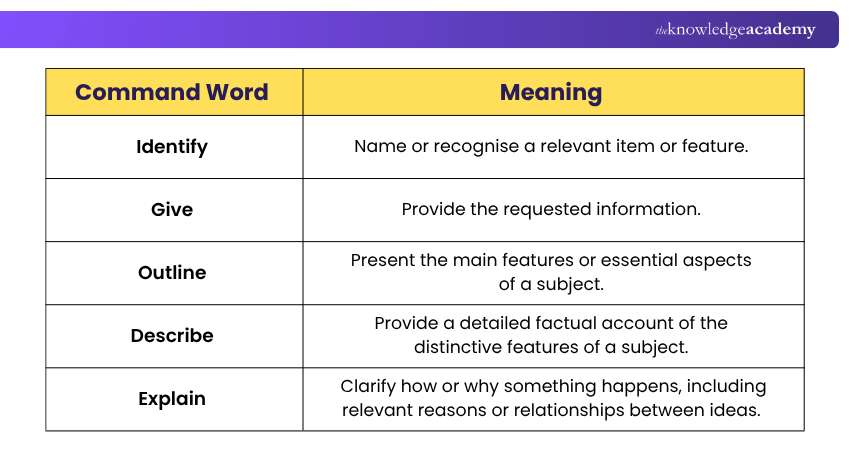
Understanding question wording helps learners identify what information an assessment requires. NEBOSH's scenario-based assessments use plain-English questions, and learners should pay attention to instructions that ask them to identify, describe, explain or evaluate information.
The wording of each question, its context and the available marks can help learners determine the appropriate response.
The following table explains commonly used question words and the types of responses they generally require:
2) Apply Knowledge to Workplace Scenarios
Scenario-based questions assess how effectively you can use health and safety knowledge in a particular workplace situation. Your response should therefore address the circumstances described rather than provide only generic explanations.
Support your response with appropriate information from the scenario. For example, imagine a scenario where employees regularly use a damaged ladder to access stored materials. If asked to explain why the activity is unsafe, consider the ladder's condition, the possibility of falls and the consequences for workers.
However, not every assessment question requires evidence from the scenario. If a question asks for general health and safety knowledge, answer it according to the instructions rather than introducing unnecessary scenario details.
Take your safety knowledge to global heights with the NEBOSH International General Certificate in Occupational Health and Safety Training now!
3) Structure Clear and Relevant Answers
A clear answer helps communicate your understanding and makes it easier to demonstrate that you have addressed the assessment requirements. Begin with a relevant point, develop it with sufficient explanation and include supporting scenario information when required. Ensure that each point contributes something distinct to your answer.
Worked Answer Comparison
|
Weak Answer |
Improved Answer |
|---|---|
|
Obstructed walkways are dangerous and can cause accidents. |
Materials left in warehouse walkways can create trip hazards. Workers may trip over these obstructions while moving goods, potentially resulting in falls and injuries. |
NEBOSH Open-book Exam Tips
NEBOSH uses scenario-based digital open-book examinations for several certificate qualifications. These allow learners to consult permitted resources, but they still require independent understanding and application of knowledge. The following tips are particularly relevant to learners completing these assessments:
1) Analyse the Exam Scenario
Read the complete assessment scenario carefully before developing your answers. Pay attention to the workplace setting, activities, individuals involved, existing arrangements and any problems described. Separate information from assumptions and identify details relevant to each assessment task.
For example, a scenario may describe frequent equipment breakdowns, incomplete maintenance records and inadequate supervision. These details can provide important evidence when considering questions about health and safety management. Avoid making unsupported assumptions that are not stated or reasonably supported by the scenario.
2) Organise Study Materials
An open-book examination allows you to consult permitted reference materials, so having them organised can help you locate relevant information efficiently. Arrange your course notes, textbooks and other authorised resources by topic. Use descriptive file names, bookmarks or a contents page to make important sections easier to find.
Prepare a suitable assessment environment with adequate lighting, a comfortable workspace and a reliable internet connection. NEBOSH recommends preparing a distraction-free environment and familiarising yourself with its online assessment platform before the examination.
3) Manage Assessment Time
Managing your available assessment time helps you complete all required tasks and review your responses before submission. Begin by checking the assessment instructions and deadline. Review the questions, consider their relative complexity and allocate sufficient time to each task.
Reserve time for checking your work, preparing the required submission file and uploading it successfully. For certificate digital assessments, NEBOSH states that submissions must be in PDF format and that submissions received after the deadline will not be accepted for marking.
Consider the marks available and any question-specific instructions when deciding how much time and detail to allocate to each response. Higher-mark questions may require more developed answers, but the question's requirements should guide your approach.
4) Reference Sources Correctly
When using books, course materials or online resources during an open-book assessment, acknowledge the sources you have consulted or quoted in accordance with NEBOSH's instructions.
Record source details while preparing your answers to avoid overlooking references. Depending on the material, these may include the title, author, publication year, website address or relevant course provider.
For certificate digital assessments, NEBOSH guidance explains that learners should include a reference list of materials used. Follow the current learner guide for the precise requirements applicable to your assessment.
Trainer Insight
The closing interview is an important part of NEBOSH certificate-level scenario-based digital assessments. Although it is not separately marked, learners must complete it before their assessment marks can be awarded. Review your submitted answers so you can explain the reasoning behind your responses and demonstrate that the work is your own.
How to Pass the NEBOSH Practical Risk Assessment?
The practical risk assessment evaluates your ability to apply health and safety principles to a real workplace. For the revised NEBOSH National and International General Certificates, the GNC2 and GIC2 units require learners to complete a workplace risk assessment and develop an action plan.
To complete this assessment successfully, you need to identify relevant workplace hazards, recommend appropriate controls and document your findings according to the official assessment guidance. Let's learn more about it below:
1) Identify Workplace Hazards and Risks
Begin by examining the selected workplace or assessment area to identify activities, conditions and equipment that could cause harm. Consider who might be affected and how injuries or ill health could occur.
For example, a workshop may contain hazards involving moving machinery, hazardous substances, excessive noise or obstructed walkways. Consider the existing precautions and whether they adequately address the identified risks.
Record your observations accurately and ensure the assessment includes the range of hazards required by your qualification's practical assessment guidance.
2) Recommend Appropriate Control Measures
Once you have identified workplace risks, consider what additional measures could reduce the likelihood or severity of harm. Use the hierarchy of control to guide your recommendations. Where reasonably practicable, prioritise eliminating hazards before considering substitution, engineering controls, administrative controls or Personal Protective Equipment (PPE).
For example, if workers are exposed to hazardous dust, suitable measures might include replacing the material with a less hazardous alternative or introducing effective local exhaust ventilation. Recommendations should be realistic, relevant to the workplace and appropriate for the hazards identified.
3) Document and Justify Your Findings
Clear documentation demonstrates how you assessed the workplace and developed recommendations. Use the official assessment template for your qualification and complete each required section. Explain your findings, justify recommended actions and identify suitable responsibilities and implementation timescales where required.
For example, a recommendation to install a machine guard should explain the hazard being controlled and why the proposed measure is appropriate. The revised General Certificates have dedicated GNC2 and GIC2 practical assessment guidance and submission templates. Follow the requirements for the relevant unit rather than assuming the same template applies to every NEBOSH practical assessment.
Spot the workplace hazards and make every workplace safer by signing up with the NEBOSH Award in Health and Safety at Work Training now!

The Knowledge Academy develops accessible learning content across Project Management, IT, Cybersecurity, Data Science, Business Analysis, HR, Accounting and Finance, Leadership and Health and Safety. Its resources combine subject research with clear explanations to help professionals build practical knowledge across a wide range of disciplines.
View Detail

 If you wish to make any changes to your course, please


