




We may not have the course you’re looking for. If you enquire or give us a call on 01344203999 and speak to our training experts, we may still be able to help with your training requirements.
How Hard is the PMP Exam: Format, Challenges and Preparation
ByThe Knowledge AcademyLast updated on: 26 November 2026
The PMP exam tests how candidates apply project management knowledge in different situations. This blog explores exam difficulty, format, question types and passing standards. Discover practical preparation strategies to approach the exam with confidence.
At a Glance
1. Candidates may need to evaluate project scenarios and select appropriate responses rather than simply recall definitions.2. Scenario-based questions, different project approaches and time constraints can influence exam difficulty.3. The exam includes 180 questions across three domains, with 240 minutes available for completion.4. PMI does not publish a fixed passing percentage. Targeted practice and reviewing mistakes can support exam preparation.
Imagine managing a project where unexpected risks emerge, stakeholders disagree and deadlines suddenly change. You need to make the right decision quickly, often with several reasonable options available. Now imagine facing similar situations in an examination that tests your project management judgement.
The Project Management Professional (PMP)® exam requires candidates to evaluate situations and select appropriate actions. However, how demanding these decisions feel can depend on their practical experience and preparation.
So, how hard is the PMP exam in practice? Understanding what makes certain questions demanding can help you assess what to expect and where to focus your preparation.
How Hard is the PMP Exam?
The PMP exam assesses candidates' ability to apply project management knowledge to practical situations. How difficult candidates find it can depend on several factors, including:
a) Scenario-based Questions: Candidates must interpret realistic project situations involving stakeholder concerns, changing requirements and unexpected risks before answering questions.
b) Practical Decision-making: Questions often present multiple reasonable answers, requiring candidates to select the most suitable action based on the project context.
c) Different Project Management Approaches: The exam assesses predictive, Agile, and hybrid approaches, requiring candidates to understand how decisions vary across project environments.
d) Time Constraints: Candidates must complete 180 questions within 240 minutes while maintaining accuracy and concentration.
e) Professional Experience and Preparation: Exam difficulty varies depending on candidates' practical project management experience, familiarity with different approaches, and preparation strategies.

PMP Exam Format and Structure
Understanding the PMP exam format can help candidates plan their preparation and manage expectations before examination day. The exam includes 180 questions and provides 240 minutes for completion, along with two scheduled 10-minute breaks.
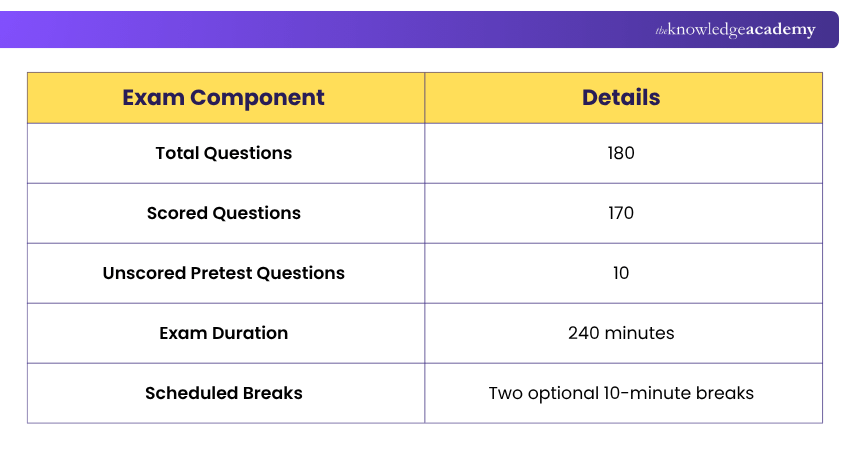
The first break occurs after the case-study section, while the second takes place approximately midway through the independent-question section. Once candidates review their answers and begin a break, they cannot return to questions from the previous section.
PMP Exam Domain Distribution
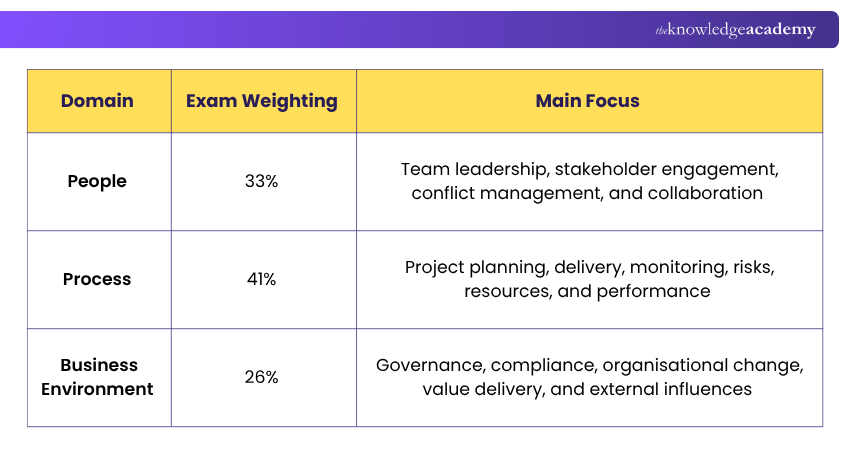
The PMP exam assesses three domains that reflect the responsibilities of project management professionals.
Types of Questions in the PMP Exam
Candidates can encounter different question formats that assess their ability to apply project management knowledge to real-world situations. These include:
a) Multiple-choice Questions: Select one correct answer from the available options.
b) Multiple-response Questions: Identify more than one correct answer based on the question requirements.
c) Case-study Questions: Analyse a detailed project scenario and answer related questions using the information provided.
d) Graphic-based Questions: Interpret charts, graphs, diagrams or images to answer questions.
e) Enhanced Matching Questions: Match information using interactive controls, which may involve charts, diagrams or drag-and-drop elements.
f) Point-and-click Questions: Identify the correct area within an image by selecting the appropriate location.
g) Matching Questions: Match corresponding items across different lists or columns.
h) Pull-down List Questions: Select the correct response from a drop-down list.
Some interactive question formats are available only in computer-based testing. Becoming familiar with these formats can help candidates understand what to expect during the examination.
Strengthen your project management fundamentals with our CAPM® Certification Training- register today!
How to Prepare for the PMP Exam
Start with a short set of practice questions across the three PMP exam domains. Note where you lack knowledge, where you misread the scenario and where you take too long to decide. Use those findings to decide what to study first.
1) Build Your Study Plan Around the Exam Content Outline
Use PMI’s July 2026 PMP® Examination Content Outline (ECO) to map out your study sessions. Give more time to areas that carry substantial weight in the exam and where your practice shows gaps. Set a specific goal for each session, such as deciding when a project issue needs escalation.
2) Practise Across Predictive, Agile and Hybrid Projects
Take one situation, such as a stakeholder requesting a change close to delivery, and work through it in different project environments. In a predictive project, you might assess the impact and follow formal change control.
In an Agile team, you might work with the Product Owner to assess the request and consider its priority in the Product Backlog. In a hybrid project, check which parts of the work are subject to formal approval.
3) Track Patterns in Your Practice Answers
Keep a short record of missed or guessed questions. For each one, identify the clue you overlooked or the concept you need to revisit. If you repeatedly miss questions about what to do first, practise identifying what the Project Manager needs to establish before acting. Then try a fresh set of questions on the same topic to see whether the pattern improves.
4) Rehearse Your Timing with a Full-Length Mock Exam
Take a full-length mock under timed conditions and use the scheduled breaks to rehearse your exam-day routine. Afterwards, check where you lost time and whether your accuracy dropped towards the end. Use that information to adjust your pace, especially on longer scenarios and questions that require additional review.
PMP Exam Preparation Checklist
□ Review the July 2026 PMP® Examination Content Outline.□ Understand all three examination domains.□ Study predictive, Agile and hybrid approaches.□ Practise scenario-based and graphic-based questions.□ Complete full-length mock examinations.□ Review incorrect answers and weaker topics.□ Practise managing time across examination sections.□ Become familiar with examination rules, breaks and question formats.
Understand key concepts of project management frameworks and best methodologies with the PMP® Certification Training – Join now!

The Knowledge Academy develops accessible learning content across Project Management, IT, Cybersecurity, Data Science, Business Analysis, HR, Accounting and Finance, Leadership and Health and Safety. Its resources combine subject research with clear explanations to help professionals build practical knowledge across a wide range of disciplines.
View Detail

 If you wish to make any changes to your course, please


