


We may not have the course you’re looking for. If you enquire or give us a call on 01344203999 and speak to our training experts, we may still be able to help with your training requirements.
CISSP Exam Changes: Latest Updates, Format and Domains
ByThe Knowledge AcademyLast updated on: 19 November 2026
Explore the latest CISSP exam changes, including updates to the exam format, domain weightings and key requirements, to understand what to expect and prepare effectively.

At a Glance
1. The CISSP exam duration was reduced from four hours to three hours.2. The CAT question range changed from 125–175 to 100–150 questions, depending on candidate performance.3. Security and risk management increased from 15% to 16%, while software development Security decreased from 11% to 10%.4. Computerised Adaptive Testing (CAT) was extended to all available exam languages.5. A revised CISSP exam outline will take effect on 15 April 2027, introducing new domain weightings and updated content.
Preparing for the CISSP exam can feel challenging, especially when you come across conflicting information about exam duration, question counts and domain weightings. Which details are still accurate, and what has actually changed?
The latest examination updates revised domain weightage and introduced changes to the examination format across supported languages. Understanding the actual CISSP exam changes can help you select relevant study materials, focus on the right topics, and approach your preparation with greater confidence. Let’s learn more about it in this blog!
What is the CISSP Exam?
The Certified Information Systems Security Professional (CISSP) exam evaluates an individual's understanding of information security principles, practices and management. It is administered by the International Information System Security Certification Consortium (ISC2).
Passing the CISSP exam is an important step towards certification, but it does not automatically grant the credential. Candidates must also meet ISC2's professional experience and endorsement requirements, along with other applicable certification conditions.

What are the Latest CISSP Exam Changes?
The CISSP examination follows the outline that became effective on 15 April 2024. The changes affected exam duration, question count, domain emphasis and the availability of adaptive testing across examination languages. The following sections explain the key changes introduced in 2024 and how they affect the current examination.
1) CISSP Exam Structure and Length
Previously, the CISSP examination was delivered in different formats depending on the examination language. Before the April 2024 changes, the adaptive English-language exam allowed up to four hours and contained 125–175 questions, while certain other language versions followed a longer linear format.
From 15 April 2024, ISC2 standardised the examination around Computerised Adaptive Testing (CAT). The current exam includes:
a) A maximum duration of three hours
b) A minimum of 100 and a maximum of 150 questions
c) Multiple-choice questions and advanced item types
d) A passing score of 700 out of 1,000 scaled points
2) Changes in CISSP Domain Weightage
The CISSP examination continues to cover eight major areas of information security. However, the 2024 update adjusted the weighting assigned to two domains. The official change is shown in the table below:
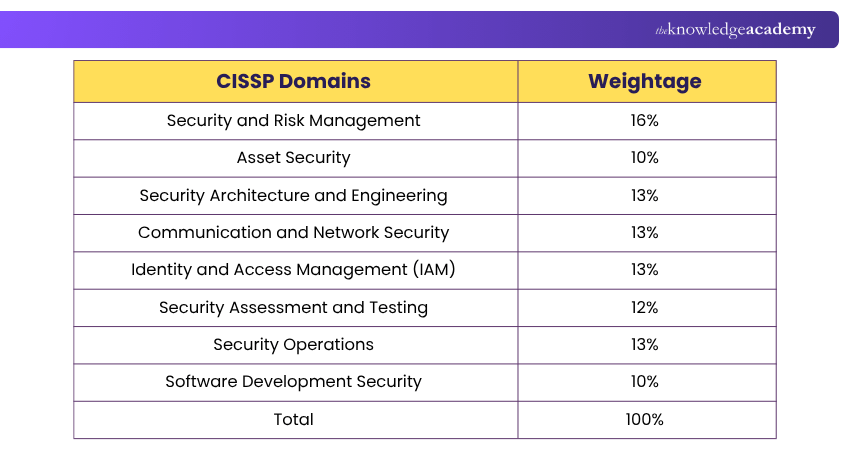
These percentages represent the emphasis placed on each domain. They should help candidates distribute their study time, but they do not mean that lower-weighted domains can be ignored. All eight domains remain relevant because the exam evaluates how different areas of cybersecurity work together within an organisation.
Trainer's Insight
Don't let domain percentages become your only study strategy. Security and risk management carries the highest weighting at 16%, but a lower-weighted domain can still be important to your overall performance. Focus on understanding all eight domains, identify your weaker areas and spend additional revision time where you need it most.
3) CISSP Exam Content and Domain Coverage
CISSP examination content is periodically reviewed to reflect the evolving responsibilities of information security professionals. The current outline covers the following areas:
a) Security and Risk Management: Governance, risk assessment, security policies, legal requirements, professional ethics, supply chain risk management and business continuity.
b) Asset Security: Information classification, asset ownership, data handling, ownership, retention and secure disposal.
c) Security Architecture and Engineering: Secure design principles, security models, cryptography and system vulnerabilities.
d) Communication and Network Security: Secure network architecture, network protocols, secure communication channels and network components.
e) Identity and Access Management: Identity lifecycle management, authentication, authorisation and access control.
f) Security Assessment and Testing: Security control assessments, testing strategies, audit activities and reporting.
g) Security Operations: Incident management, investigations, monitoring, disaster recovery and operational security.
h) Software Development Security: Secure development processes, software security controls and security testing.
4) CISSP Computerised Adaptive Testing (CAT) Format
Computerised Adaptive Testing (CAT) is not a new introduction. The English-language CISSP exam adopted CAT in 2017, and ISC2 extended the format to all available examination languages in April 2024.
CAT uses a computer-based system that adapts the examination according to a candidate's answers. Instead of presenting every candidate with the same fixed sequence of questions, the testing system selects subsequent questions based on the candidate's estimated proficiency and other examination requirements. Some key characteristics of the CAT format are:
a) Adaptive Difficulty: The system uses responses to select questions appropriate to the candidate's estimated ability.
b) Variable Question Count: Candidates may receive between 100 and 150 questions.
c) Continuous Ability Assessment: The system continually evaluates performance against the examination's required proficiency standard.
d) No Backtracking: Candidates cannot return to previously answered questions to change their responses.
The examination may end after the minimum number of questions once the system determines, with the required statistical confidence, whether the candidate's estimated ability is above or below the passing standard. Otherwise, testing continues until an applicable stopping rule is reached.
Quick Check: Does More Than 100 Questions Mean You Are Failing?
Imagine you are taking the CISSP exam. You have completed 100 questions, but the system continues presenting additional questions. Does this mean you are failing?Answer: No. The system may require additional responses to determine whether your estimated ability meets the passing standard. Receiving more than 100 questions does not indicate that you are failing, nor does it guarantee that you will pass.
Learn security concepts and unlock bigger opportunities with the CISSP Courses - Register now!
Upcoming CISSP Exam Changes in 2027
The CISSP examination currently follows the exam outline introduced by ISC2 on 15 April 2024. However, ISC2 has confirmed another revision, with an updated examination outline scheduled to take effect on 15 April 2027.
The revision introduces changes to domain weightings and updates the topics covered to reflect developments in cyber security. These changes are intended to ensure that the examination continues to reflect the knowledge and responsibilities expected of today's cyber security professionals.
How to Prepare for the Current CISSP Exam?
Understanding the latest CISSP exam changes is only the starting point. Effective preparation requires a study plan that covers all eight domains and reflects the style of questions candidates may encounter. Here are the practical preparation strategies to implement:
1) Review the Official Examination Outline
Start with the current CISSP examination outline. Use its domains, tasks and subtasks to create a checklist of topics you need to understand. Compare the checklist with your existing knowledge and professional experience to identify areas requiring further study.
2) Use Updated Study Materials
Choose books, training courses and practice resources that reflect the April 2024 exam outline. Older materials may still contain useful explanations, but candidates should compare their coverage with the current official requirements.
3) Focus on Understanding Rather Than Memorisation
The CISSP exam requires candidates to apply security knowledge to professional situations. Practise understanding why a particular security decision may be appropriate, what risks it addresses and how it supports an organisation's security objectives.
4) Practise Under Current Exam Conditions
Use practice questions and timed assessments to become familiar with the examination's difficulty and time constraints. Although practice exams cannot fully reproduce ISC2's adaptive testing algorithm, they can help you identify weaker areas and improve your approach to complex questions.
5) Review Your Progress Across All Eight Domains
Give extra attention to topics you find difficult while ensuring that no domain is neglected. Domain weightage should help guide your preparation, but learning about the relationships between security governance, technical controls and operational decisions is equally valuable.
Bonus Tip
When practising CISSP questions, don't just check whether your answer is correct. Ask yourself three questions:a) What is the main security problem in this scenario?b) Which security principle or control best addresses it?c)Why is that approach more appropriate than the alternatives?This approach helps you develop the analytical thinking needed for scenario-based examination questions instead of simply memorising answers.
Go beyond security knowledge and learn security architecture by joining the CISSP-ISSAP Training now!

The Knowledge Academy develops accessible learning content across Project Management, IT, Cybersecurity, Data Science, Business Analysis, HR, Accounting and Finance, Leadership and Health and Safety. Its resources combine subject research with clear explanations to help professionals build practical knowledge across a wide range of disciplines.
View Detail

 If you wish to make any changes to your course, please


