CIPR Courses

accredited by

Our CIPR course is accredited by CIPR

Online Self-paced (48 hours)

CIPR Professional PR Certificate Course Outline

Unit 1: Public Relations and Communication Planning and Evaluation

  • Public Relations and Communication in Societal Context
  • Organisational Context of Public Relations and Communication
    • Internal Relationships
    • Types of Public Relations
    • Contribution to Organisational Objectives
  • Areas of Practice in Communication
    • Corporate Communications
    • Internal Communications
    • Investor Relations
    • Public Affairs
    • Marketing Communications

Unit 2: Communication and Content Management

  • Role of Multi-Channel Communication Strategies in Public Relations and Communication
  • Contextual, Cross-Cultural and Diversity Considerations in Content Management
  • Truth-Telling and Fact-Checking for Effective Relationship Building
  • Power and Relevance of Storytelling in Communication
  • Impact of Misinformation, Fake News and Persuasion Theory on Reputation and Relationships

Show moredown

Who Should Attend this CIPR Professional PR Certificate Course?

This CIPR Professional PR Certificate Course is ideal for individuals looking to build their strategic communication capabilities and advance in public relations roles. However, it is especially beneficial for:

  • PR Executives
  • Communication Officers
  • Media Relations Professionals
  • Press Officers
  • Corporate Communication Professionals
  • Internal Communications Specialists
  • Marketing and PR Assistants

Prerequisites of the CIPR Professional PR Certificate Course

To attend this CIPR Professional PR Certificate Course, you must meet any of the following criteria:

  • Completion of the CIPR Foundation Qualification
  • Possession of any UK-recognised degree or an equivalent international qualification
  • A minimum of two years' relevant full-time employment in public relations or related sectors such as marketing or journalism

CIPR Professional PR Certificate Course Overview

The CIPR Professional PR Certificate is a widely respected qualification designed for professionals aiming to deepen their understanding of strategic public relations. This course provides delegates with the tools and knowledge to manage communications effectively, build reputations, and influence public perception across different channels. Effective communication is vital in today’s fast-paced and media-driven world. This CIPR-accredited course is tailored to help professionals think more strategically, apply PR theory to practice and handle communication challenges with confidence. It is perfect for those looking to move beyond tactical execution and into more advisory or management-level roles.

This comprehensive training offered by The Knowledge Academy focuses on core PR principles, stakeholder engagement, media relations, ethical practice, and the strategic planning process. Delegates will benefit from interactive sessions, real-world case studies, and expert instruction designed to bridge the gap between theory and day-to-day practice.

Course Objectives

  • To understand the strategic role of public relations within organisations
  • To apply communication theories and planning models effectively
  • To develop impactful PR campaigns based on audience insights
  • To explore ethical considerations and reputation management
  • To analyse media environments and build positive media relations
  • To enhance writing and messaging for different platforms and stakeholders

After completing the course, delegates will be equipped with advanced knowledge and practical skills to progress in their PR careers and contribute more strategically to their organisation's communication goals.

Show moredown

What’s Included in this CIPR Professional PR Certificate Course?

  • CIPR Professional PR Certificate Assessment
  • World-Class Training Sessions from Experienced Instructors
  • CIPR Professional PR Certificate Qualification
  • Digital Delegate Pack

Show moredown

accredited by

Our CIPR course is accredited by CIPR

Online Self-paced (60 hours)

CIPR Professional PR Diploma Course Outline

Unit 1: PR Strategy and Planning

  • Introduction to PR Strategy
    • What is PR Strategy?
    • Role of Strategy in Organisations
    • Distinction Between Strategy and Tactics
    • Ethical Responsibilities in Strategy
    • Strategic Thinking in Practice
  • Organisational Branding and Reputation
    • Importance of Organisational Branding
    • Reputation as a Strategic Asset
    • Challenges in Reputation Management
    • Linking Reputation to PR Objectives
    • Evaluating Brand Perceptions
  • PR and Organisational Integration
    • PR in the Strategic Management Framework
    • Interface with Other Organisational Functions
    • Contribution to Corporate Objectives
    • Effective Collaboration Across Functions
    • Value Creation Through PR
  • Research and Environmental Analysis
    • Role of Secondary Research
    • Situation Analysis Techniques
    • Environmental Monitoring and Scanning
    • Issues Identification and Risk Assessment
    • Producing Evidence-Based Summaries
  • Stakeholder Identification and Mapping
    • Defining Stakeholders
    • Mapping Influence and Relationships
    • Prioritising Stakeholder Needs
    • Managing Stakeholder Expectations
    • Tools for Stakeholder Analysis
  • PR Planning Models
    • Key Planning Frameworks (RACE, ROPE, etc.)
    • Application to PR Strategy
    • Linking Models to Organisational Objectives
    • Strengths and Limitations of Each Model
    • Creative Approaches to Problem Identification
  • Setting PR Objectives
    • Role of SMART Objectives
    • Linking to Corporate and Functional Goals
    • Long-Term vs Short-Term Objectives
    • Balancing Strategic and Tactical Targets
    • Measuring Objectives for Evaluation
  • Executive Report Writing
    • Structure of an Executive Report
    • Presenting Research and Findings
    • Communicating Insights Clearly
    • Justifying Strategic Decisions
    • Professional Style and Evidence Use

Unit 2: PR Content, Communications and Engagement

  • Contemporary Media Landscape
    • Transformation of Digital Media
    • Traditional vs Digital Platforms
    • ICT Developments in PR
    • Convergence of Media Channels
    • Impact on Stakeholder Engagement
  • Strategic Communication Approaches
    • Principles of Strategic Communication
    • Developing Audience-Centred Messages
    • Managing Complex Communication Needs
    • Integrating PR with Broader Communications
    • Aligning Communication to Organisational Goals
  • Storytelling and Strategic Narratives
    • Importance of Storytelling in PR
    • Constructing Organisational Narratives
    • Emotional Connection with Stakeholders
    • Storytelling in Digital and Traditional Media
    • Case Studies of Effective Narratives
  • Content Creation and Curation
    • Developing Multimedia Content
    • Writing Effective Thought-Leadership Articles
    • Curating and Repurposing Content
    • Ensuring Authenticity and Consistency
    • Tailoring Content for Different Audiences
  • Stakeholder Engagement Practices
    • Importance of Long-Term Engagement
    • Building Trust and Relationships
    • Creating Online Communities
    • Leveraging Influencers and Advocates
    • Evaluating Engagement Effectiveness
  • Issues and Crisis Communication
    • Principles of Issues Management
    • Crisis Preparedness and Strategic Response
    • Ethical Dimensions of Crisis Communication
    • PR’s Role in Protecting Reputation
    • Lessons from Case Studies
  • Reflection and Learning in PR Practice
    • Role of Professional Reflection
    • Models of Reflective Practice
    • Learning from Campaigns and Case Studies
    • Critical Self-Assessment in PR Practice
    • Developing a Continuous Learning Mindset
  • Producing Thought Leadership
    • Defining Thought Leadership in PR
    • Establishing Credibility and Authority
    • Writing for Reputable Business Titles
    • Using Evidence to Support Insights
    • Communicating with Persuasion and Clarity

Unit 3: PR Management, Measurement and Evaluation

  • PR as a Management Function
    • Leadership Roles in PR
    • Advising and Coaching Senior Management
    • Ethical Responsibilities in PR Management
    • Strategic Decision-Making by PR Leaders
    • Integrating PR into Corporate Leadership
  • Campaign and Project Management
    • Managing Integrated Campaigns
    • Applying Project Management Tools
    • Resource Planning and Allocation
    • Timelines and Milestones in PR Projects
    • Identifying and Mitigating Risks
  • Budget and Resource Management
    • Principles of Budget Planning
    • Cost Management and Allocation
    • Balancing Budgets with Outcomes
    • Monitoring and Controlling Costs
    • Optimising Resources for Impact
  • Team and Stakeholder Management
    • Skills for Leading PR Teams
    • Building Competent and Motivated Teams
    • Coaching and Developing Talent
    • Managing Internal Stakeholders Effectively
    • Agency and Client Relationship Management
  • Measurement and Evaluation
    • Importance of PR Measurement
    • Outputs vs Outcomes in PR Campaigns
    • Frameworks and Models of Evaluation
    • Using Data for Strategic Insights
    • Assessing Return on Investment (ROI)
  • Research in PR Evaluation
    • Qualitative Research Methods
    • Using Surveys, Interviews, and Feedback
    • Stakeholder Perceptions and Insights
    • Ethical Considerations in Research
    • Integrating Research into Evaluation
  • Producing Management Reports
    • Purpose of Professional Management Reports
    • Structuring Recommendations Effectively
    • Communicating Results and Findings
    • Supporting Proposals with Data
    • Reviewing Reports for Professional Standards

Show moredown

Who Should Attend this CIPR Professional PR Diploma Course?

This CIPR Professional PR Diploma Course is ideal for mid- to senior-level professionals looking to deepen their expertise in strategic public relations. However, it will be especially beneficial for:

  • PR and Communications Managers
  • Senior Executives in Marketing or Media
  • Corporate Affairs Professionals
  • Reputation and Stakeholder Engagement Specialists
  • Government and Public Sector Communicators
  • Experienced Practitioners transitioning into strategic roles

Prerequisites of the CIPR Professional PR Diploma Course

To attend in the CIPR Professional PR Diploma Course, one of the following is required:

  • A CIPR Professional Certificate
  • Or A degree in Public Relations or related discipline, and two years’ relevant full-time employment
  • Or at least five years’ relevant full-time professional experience in PR or communications

CIPR Professional PR Diploma Course Overview

The CIPR Professional PR Diploma is an advanced qualification that builds strategic and critical thinking in public relations. Designed and accredited by the Chartered Institute of Public Relations (CIPR), this diploma focuses on leadership in PR, reputation management, stakeholder engagement, and ethical communication practices. It equips learners to navigate complex communication challenges and lead with confidence in dynamic, high-stakes environments.

In today’s fast-paced and media-saturated world, the ability to develop integrated communication strategies is essential. This course enables experienced professionals to explore the theory behind PR, understand communication models, and apply these in practical contexts. From managing crises to building public trust, learners gain tools to influence organisational reputation at the highest level.

This comprehensive training, offered by The Knowledge Academy in the United Kingdom, combines academic theory with real-world application. Through a mix of case studies, group work, and expert-led discussions, delegates develop strategic insights and practical skills that directly enhance their performance in senior PR roles.

Course Objectives

  • To explore the strategic role of public relations within organisations
  • To analyse communication models and apply them to professional practice
  • To evaluate and manage reputational risks effectively
  • To understand ethics and professionalism in communication strategy
  • To build frameworks for stakeholder engagement and relationship management
  • To critically assess PR campaigns using appropriate measurement techniques

After completing the CIPR Professional PR Diploma, delegates will be able to lead PR strategies with authority, offer informed counsel to senior stakeholders, and drive communication that aligns with business objectives and public expectations.

Show moredown

What’s Included in this CIPR Professional PR Diploma Course?

  • CIPR Professional PR Diploma Assessment
  • World-Class Training Sessions from Experienced Instructors
  • CIPR Professional PR Diploma Certificate
  • Digital Delegate Pack

Show moredown

accredited by

Our CIPR course is accredited by CIPR

Online Self-paced (15 hours)

CIPR Public Relations and Communication Foundation Training Course Outline

Component 1: Discussion Paper

  • Role of Public Relations and Communication Within Organisations
  • Contribution of PR Practitioners to Organisational Objectives
  • Interaction Between PR and Other Organisational Functions
  • Ethical Responsibilities in Public Relations Practice
  • Continuous Professional Development for PR Practitioners
  • Content Portfolio Supporting PR Team Objectives

Component 2: Portfolio of Content

  • Development of Written, Audio-Visual and Digital PR Content
  • Content Strategies for Building Organisational Reputation
  • Targeting Content for Stakeholders and Audiences
  • Selection of Appropriate Communication Channels
  • Content Planning and Portfolio Development
  • Content Creation Skills in Public Relations

Show moredown

Who Should Attend this CIPR Public Relations and Communication Foundation Training?

This CIPR Public Relations and Communication Foundation Training is designed for individuals starting or developing their careers in Public Relations and Communication. It is particularly suitable for professionals such as:

  • Junior PR Professionals
  • PR Assistants
  • Communications Assistants
  • Marketing and Communications Professionals
  • Content Creators
  • Communications Coordinators
  • Aspiring PR Professionals

Prerequisites of the CIPR Public Relations and Communication Foundation Training

There are no formal prerequisites to attend this CIPR Public Relations and Communication Foundation Training. However, having a basic understanding of Public Relations, communication, or content creation can be beneficial when undertaking the course.

CIPR Public Relations and Communication Foundation Training Overview

The CIPR Public Relations and Communication Foundation Training in the United Kingdom introduces delegates to the role of Public Relations and Communication within organisations. It covers PR practitioners’ responsibilities, organisational objectives, ethics, professional development, and content creation.

Delegates will develop skills in producing written, audio-visual, and digital PR content. They will also learn to target stakeholders, select appropriate communication channels, plan content, and support organisational reputation.

This training by The Knowledge Academy enables delegates to apply PR and communication knowledge in real-world organisational settings. They will be better equipped to support PR objectives, create audience-focused content, and contribute to effective organisational communication.

CIPR Public Relations and Communication Foundation Training Course Objectives

  • To explain the role of Public Relations and Communication within organisations
  • To examine how PR practitioners contribute to organisational objectives
  • To recognise ethical responsibilities and the importance of professional development
  • To develop written, audio-visual, and digital PR content for different purposes
  • To identify stakeholders and select appropriate communication channels
  • To plan content that supports PR objectives and organisational reputation

Upon completion of this course, delegates will be equipped to support PR and communication activities within organisations. They will be able to create targeted content, select suitable communication channels, consider ethical responsibilities, and contribute to PR team objectives and organisational reputation.

Show moredown

What’s Included in this CIPR Public Relations and Communication Foundation Training?

  • CIPR Foundation Assessment
  • World-Class Training Sessions from Experienced Instructors
  • CIPR Foundation Certificate
  • Digital Delegate Pack

Show moredown

Not sure which course to choose?

Speak to a training expert for advice if you are unsure of what course is right for you. Give us a call on 01344203999 or Enquire.

Benefits of CIPR Courses

CIPR Courses strengthen key PR, communication, and reputation-management skills, giving learners the strategic and practical ability needed for today’s PR roles. Key benefits include:

  • Stronger understanding of PR Strategy: Professionals gain confidence in campaign planning, communication frameworks, and understanding how PR supports wider organisational goals.
  • Improved Media and Stakeholder Management: Learn how to work effectively with journalists, prepare media materials, and engage stakeholders constructively.
  • Confidence in Digital and Social Media PR: Learners build skills in online reputation management, digital communication planning, and evaluating engagement across key platforms.
  • Enhanced Communication and Writing Skills: Develop the ability to create persuasive messages, write for varied audiences, and produce clear, high-impact content.
  • Career Progression and Professional Recognition: CIPR qualifications are respected across the PR and communications fields, helping professionals move into senior roles.
  • Stronger Strategic Thinking and Leadership Skills: Professionals develop capabilities in crisis communication, planning and decision-making for complex environments.
  • Progression to CIPR Membership Grades: CIPR learning contributes towards the professional development required to work towards MCIPR/FCIPR status.
     

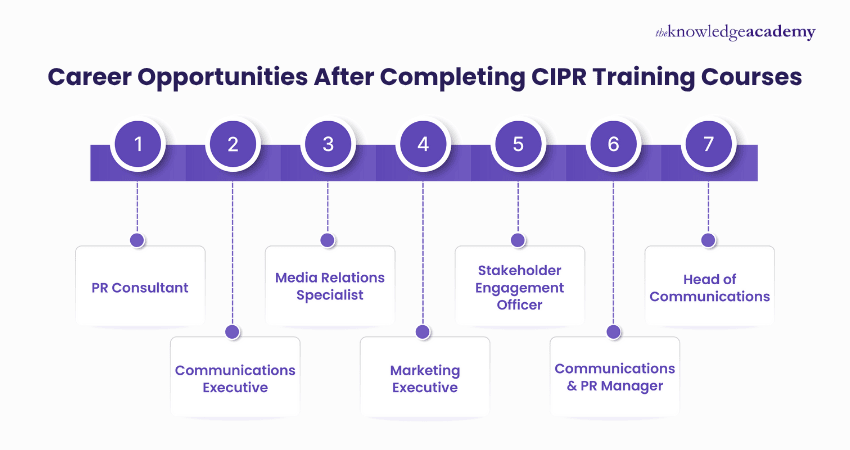
Career Opportunities After Completing CIPR Training Courses

Career Opportunities After Completing CIPR Training Courses

Completing CIPR Training opens pathways to a wide range of communication and media roles across agencies, corporates, public sector organisations and non-profits. Delegates can progress into roles like

  • PR Consultant: Advise clients on PR strategy, campaign planning, stakeholder engagement, and communication best practices across sectors.
  • Communications Executive: Develop communication content, coordinate messaging, and maintain internal and external communication channels.
  • Media Relations Specialist: Handle press interactions, write press releases, manage journalist relationships, and oversee media inquiries.
  • Marketing Executive: Support marketing strategy, oversee promotional content, and integrate PR activity with wider marketing campaigns.
  • Stakeholder Engagement Officer: Build and maintain relationships with key stakeholders, support outreach activities, and help communicate organisational objectives clearly.
  • Communications & PR Manager: Manage multi-channel communication activity, supervise PR teams, coordinate campaigns, and ensure consistent brand reputation.
  • Head of Communications: Direct all internal and external communication functions, manage senior stakeholders, lead crisis response, and set long-term comms priorities.
Show more blue-arrow

CIPR Courses FAQs

There hasn't been any questions asked about this Topic

Please see our available in the United Kingdom

The Knowledge Academy is one of the Leading global training provider for .

The training fees for in the United Kingdom starts from £3995

Show more down

Why we're the go to training provider for you

icon

Best price in the industry

You won't find better value in the marketplace. If you do find a lower price, we will beat it.

icon

Trusted & Approved

Recognised by leading certification bodies, we deliver training you can trust.

icon

Many delivery methods

Flexible delivery methods are available depending on your learning style.

icon

High quality resources

Resources are included for a comprehensive learning experience.

barclays Logo
deloitte Logo
Thames Water Logo

"Really good course and well organised. Trainer was great with a sense of humour - his experience allowed a free flowing course, structured to help you gain as much information & relevant experience whilst helping prepare you for the exam"

Joshua Davies, Thames Water

santander logo
bmw Logo
Google Logo

Looking for more information on CIPR Courses

cross

Upgrade Your Skills. Save More Today.

superSale Unlock up to 40% off today!

WHO WILL BE FUNDING THE COURSE?

close

close

Thank you for your enquiry!

One of our training experts will be in touch shortly to go over your training requirements.

close

close

Press esc to close

close close

Back to course information

Thank you for your enquiry!

One of our training experts will be in touch shortly to go overy your training requirements.

close close

Thank you for your enquiry!

One of our training experts will be in touch shortly to go over your training requirements.