


We may not have the course you’re looking for. If you enquire or give us a call on 01344203999 and speak to our training experts, we may still be able to help with your training requirements.
Scrum Roles and Responsibilities: A Complete Guide
ByVishnu SankarLast updated on: 17 September 2026
Scrum roles commonly refer to three specific accountabilities within a Scrum Team: the Product Owner, Scrum Master and Developers. Each has a distinct focus, but they work together as one self-managing and cross-functional team to create value.

What happens when everyone on a team is busy, but nobody is clear on who should decide what, who removes blockers, or who owns the outcome? Progress slows down, priorities become unclear, and even Agile teams can become reactive.
That’s where Scrum Roles make a difference.
Scrum addresses this by defining clear areas of accountability without creating separate internal hierarchies. Understanding how these accountabilities work together can help a team collaborate more effectively and remain focused on value.
Let’s explore the key Scrum Roles and what each contributes to the team.
What are the Three Scrum Accountabilities?
Scrum defines three specific accountabilities: the Product Owner, Scrum Master and Developers. These are also commonly referred to as Scrum Roles. Together, they form one Scrum Team and work towards the product goal.
1) Product Owner: Accountable for maximising the value of the product and ensuring effective Product Backlog management.
2) Scrum Master: Accountable for establishing Scrum and helping the Scrum Team improve its effectiveness.
3) Developers: Accountable for creating the Sprint plan, maintaining quality, adapting their plan towards the Sprint Goal and holding one another accountable as professionals.
Although each has different accountabilities, they work together as one cross-functional and self-managing Scrum Team rather than as separate teams or levels of hierarchy.
Trainer Insight
Think of Scrum accountabilities as areas of ownership rather than job titles. Scrum defines what people are accountable for without requiring organisations to replace their existing professional titles.

Who is a Product Owner?
The Product Owner is accountable for maximising the value of the product resulting from the Scrum Team's work. How this is achieved can vary between organisations, products and teams.
The Product Owner is also accountable for effective Product Backlog management. They provide clarity about product direction and ensure that the Product Backlog supports the Product Goal.
Responsibilities of a Product Owner
The key responsibilities of a Product Owner include:
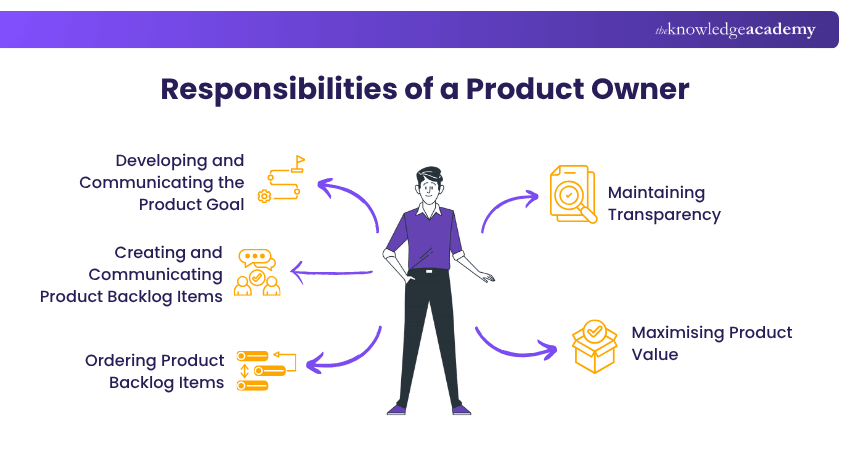
1) Developing and Communicating the Product Goal: The Product Owner develops and clearly communicates the Product Goal so the Scrum Team understands the product's longer-term objective.
2) Creating and Communicating Product Backlog Items: The Product Owner is accountable for clearly defining and communicating Product Backlog items.
3) Ordering Product Backlog Items: The Product Owner determines the order of Product Backlog items to support product value and direction.
4) Maintaining Transparency: They ensure that the Product Backlog is transparent, visible and understood.
5) Maximising Product Value: The Product Owner is accountable for maximising the value of the product resulting from the Scrum Team's work.
The Product Owner may delegate some Product Backlog management activities to others, but they remain accountable for the outcome.
Pro Tip
A strong Product Owner does not treat the Product Backlog as a simple task list. Product Backlog items should contribute towards the Product Goal and the value the product aims to create.
Desirable Qualities of a Product Owner
Scrum does not prescribe a specific set of personal qualities for a Product Owner. However, effective Product Owners often demonstrate the following characteristics:
1) Decisive when making product-related choices
2) Clear when communicating goals and expectations
3) Open to stakeholder and Scrum Team input
4) Able to balance different product needs
5) Focused on value rather than simply completing more work
6) Available to provide clarity when required
The Product Owner should also understand that stakeholder engagement does not mean accepting every request. Their responsibility is to make decisions that support the Product Goal and maximise product value.
Master Agile principles and enhance your ability to lead successful Product Development with our Scrum Product Owner Certification – Join now!
Who is a Scrum Master?
The Scrum Master is accountable for establishing Scrum by helping the Scrum Team and the wider organisation understand its theory and practice.
Rather than assigning tasks or directing team members, the Scrum Master supports self-management and helps improve the effectiveness of the Scrum Team.
Responsibilities of a Scrum Master
Some important responsibilities include:
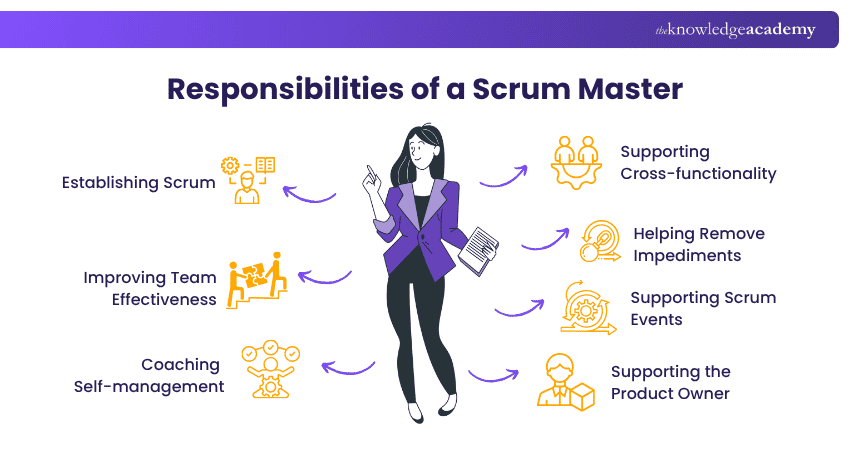
1) Establishing Scrum: Helping the Scrum Team and wider organisation understand and apply Scrum effectively.
2) Improving Team Effectiveness: Supporting the Scrum Team in continuously improving how effectively it works.
3) Coaching Self-management: Helping Scrum Team members develop their ability to organise and manage their own work.
4) Supporting Cross-functionality: Helping Scrum Team members strengthen the cross-functional capabilities needed to create value during each Sprint.
5) Helping Remove Impediments: Supporting the removal of obstacles that affect the Scrum Team's progress.
6) Supporting Scrum Events: Ensuring Scrum events take place and remain positive, productive and within their timeboxes.
7) Supporting the Product Owner: Helping with Product Goal definition, Product Backlog management and stakeholder collaboration when needed.
Desirable Qualities of a Scrum Master
Scrum does not prescribe specific personality traits for a Scrum Master, but effective Scrum Masters often demonstrate qualities such as:
1) Strong communication
2) Active listening
3) Empathy
4) Facilitation skills
5) Coaching ability
6) Patience
7) Adaptability
8) Problem-solving skills
A Scrum Master should create an environment where people can collaborate, learn and take responsibility rather than becoming the person who controls every team decision.
Trainer Insight
If every decision has to go through the Scrum Master, the team is not truly self-managing. A good Scrum Master builds the team's capability to make effective decisions without depending on constant direction.
Who are the Developers in Scrum?
Developers are the members of the Scrum Team who are committed to creating any aspect of a usable Increment during each Sprint.
The term does not refer only to Software Developers. The specific skills required depend on the nature of the product and can vary significantly between Scrum Teams.
Responsibilities of Developers
Developers are responsible for:
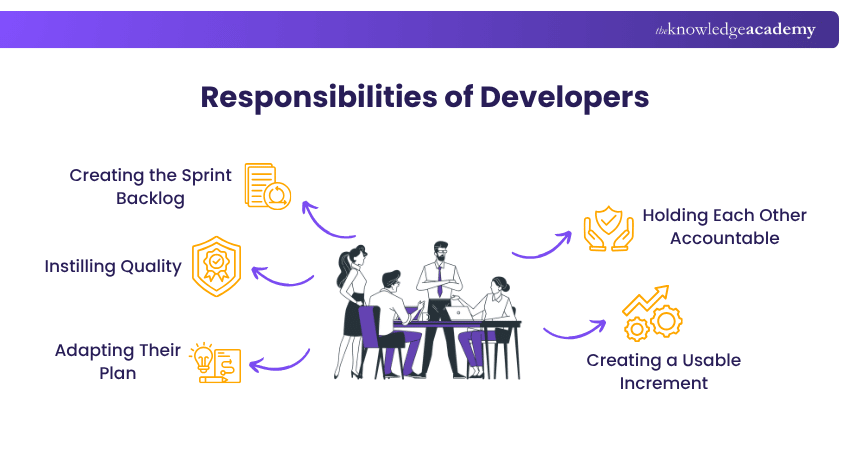
1) Creating the Sprint Backlog: Developers create and adapt the Sprint Backlog, which consists of the Sprint Goal, the selected Product Backlog Items and the actionable plan for delivering the Increment.
2) Instilling Quality: Developers instil quality by adhering to the Definition of Done.
3) Adapting Their Plan: Developers inspect progress and adapt their plan each day towards achieving the Sprint Goal.
4) Holding Each Other Accountable: They hold each other accountable as professionals.
5) Creating a Usable Increment: Developers work towards creating a usable Increment that meets the Definition of Done.
Desirable Qualities of Developers
Effective Developers should demonstrate:
1) Collaboration
2) Adaptability
3) Professional accountability
4) Commitment to quality
5) Problem-solving ability
6) Openness to feedback
7) Ability to self-manage
Individual Developers may possess different specialist skills, but they collaborate towards the same Sprint Goal rather than operating as isolated sub-teams.
Remember
“Developer” in Scrum describes an accountability, not necessarily a software engineering job title.
Learn to achieve flexibility and balance Scrum with stability with our Scrum Developer Training – Register now!
How is a Scrum Team Structured?
The Scrum Team forms the core unit of Scrum. It consists of one Product Owner, one Scrum Master and Developers working together towards the Product Goal.
A Scrum Team is typically 10 or fewer people. Keeping the team relatively small supports communication and adaptability while maintaining enough capabilities to create value during each Sprint.
A Scrum Team has several important characteristics:
1) Cross-functional
The team collectively has the skills needed to create value during each Sprint rather than depending on separate functional teams for every activity.
2) Self-managing
Team members internally decide who does what, when and how. Scrum does not require a manager or Scrum Master to distribute individual tasks.
3) No Sub-teams or Hierarchies
Scrum does not divide the Scrum Team into separate internal teams. The Product Owner, Scrum Master and Developers form one cohesive unit.
4) Focused on One Product Goal
The Scrum Team works towards a shared Product Goal, helping maintain alignment around the product's longer-term direction.
5) Accountable for Creating Value
The Scrum Team is collectively accountable for creating a valuable, usable Increment each Sprint.
How to Build an Effective Scrum Team?
Building an effective Scrum Team involves more than assigning people to the three Scrum accountabilities. The team also needs suitable skills, shared goals and an environment that supports collaboration and self-management.
Here are some important considerations:
1) Make Accountability Boundaries Clear
Ensure team members understand the accountabilities of the Product Owner, Scrum Master and Developers and how they interact. Clear boundaries help prevent confusion, such as expecting the Scrum Master to assign individual work or treating the Product Owner as someone who simply passes stakeholder requests to Developers.
2) Build a Cross-functional Team
Bring together the capabilities needed to create value during each Sprint. The exact skills will depend on the product, but the Scrum Team should collectively have the capabilities required to carry out its work.
3) Enable Self-management
Allow team members to decide internally who does what, when and how rather than relying on someone else to assign every activity. Self-management encourages accountability, adaptability and collective problem-solving.
4) Establish a Clear Product Goal
A clear Product Goal provides the Scrum Team with a shared longer-term objective. It helps connect Product Backlog decisions and Sprint Goals to the wider direction of the product.
5) Create Working Agreements
The Scrum Team can establish practical agreements around communication, collaboration and ways of working. These agreements can support transparency, consistency and effective teamwork.
6) Encourage Scrum Values
Scrum is built around five values: Commitment, Focus, Openness, Respect and Courage.
Applying these values to everyday interactions and decisions can strengthen trust, collaboration and the team's ability to work effectively.
Pro Tip
Do not judge a Scrum Team only by how much work it completes. Consider whether it creates value, progresses towards meaningful goals, maintains quality and learns from each Sprint.
How do Scrum Teams Work?
Scrum Teams work in Sprints, creating a regular rhythm for turning ideas into value. Within each Sprint, the team plans, collaborates, inspects results and adapts based on what it learns. Here is how the Scrum events and ongoing Product Backlog management activities work together:
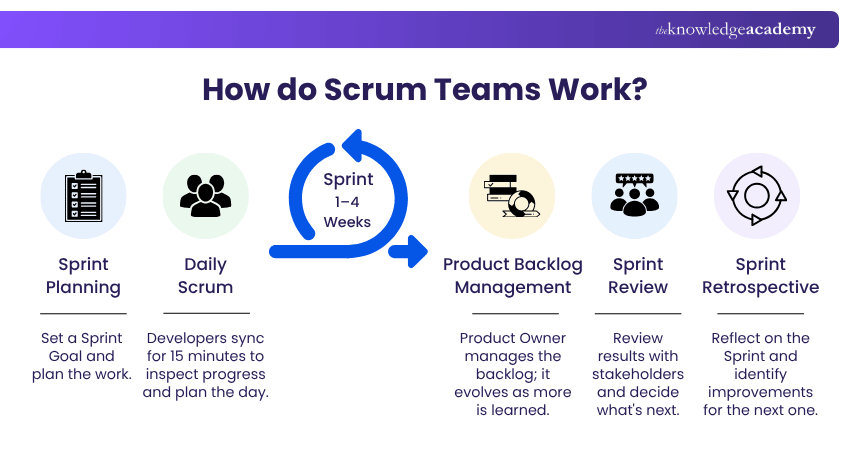
1) The Sprint
All other Scrum events occur within the Sprint, which is a fixed-length event that lasts one month or less. During the Sprint, the Scrum Team works towards the Sprint Goal while inspecting progress and adapting its approach as needed. Each new Sprint starts as soon as the previous Sprint is completed.
2) Sprint Planning
Sprint Planning starts the Sprint by establishing the work to be carried out.
During Sprint Planning, the Scrum Team considers why the Sprint is valuable, what can be achieved during the Sprint and how the selected work will be carried out.
The resulting Sprint Goal provides a single objective for the Sprint, while Developers create the plan needed to achieve it.
3) Daily Scrum
The Daily Scrum helps Developers assess progress towards the Sprint Goal and adapt the Sprint Backlog as required. Developers can choose a structure and techniques that help them focus on progress and produce an actionable plan for the next day of work.
The Daily Scrum should not simply become a status-reporting meeting for a manager or Scrum Master.
4) Product Backlog Management
The Product Backlog is a continuously evolving, prioritised list of work needed to improve the product.
The Product Owner is accountable for effective Product Backlog management. Others can contribute to refinement and related activities while the Product Owner remains accountable.
As more is learned about the product and its environment, the Product Backlog can evolve accordingly.
5) Sprint Review
The Sprint Review helps the team inspect the Sprint outcome and determine appropriate future adaptations.
During the event, the Scrum Team and key stakeholders review what was accomplished and discuss what has changed. They then collaborate on what could be done next based on what has been learned.
The Product Backlog may also be adjusted to reflect new opportunities or changing needs.
6) Sprint Retrospective
The Sprint Retrospective focuses on ways to increase quality and effectiveness.
The Scrum Team reflects on how the Sprint went regarding individuals, interactions, processes, tools and the Definition of Done. The team identifies useful changes that can improve its effectiveness in future Sprints.
Learn Agile frameworks to lead projects with confidence and clarity with our Scrum Master Certification – Join now!

Vishnu Sankar is a Senior Content Writer with 5+ years of experience across content development, software development, web development and system administration. His technical background and professional training support his expertise in IT and Tech, while his extensive research and writing experience covers Project Management and Health and Safety.
View Detail

 If you wish to make any changes to your course, please


