


We may not have the course you’re looking for. If you enquire or give us a call on 01344203999 and speak to our training experts, we may still be able to help with your training requirements.
Scrum Master Career Path: An Overview
ByThe Knowledge AcademyLast updated on: 05 November 2026
Explore Scrum Master career progression, from senior Scrum roles and Agile coaching to opportunities in product management, project delivery and organisational transformation.
What's in This Guide?
1. Discover Scrum Master career paths, from senior positions to Agile coaching and leadership opportunities.2. Understand how Scrum Master skills can open doors to careers in product ownership, project management and Agile delivery.3. Learn the core responsibilities of a Scrum Master and their role in improving team effectiveness.4. Identify the essential skills required to progress into advanced Scrum and Agile roles.
Becoming a Scrum Master can feel like a major career milestone. You study the framework, develop your facilitation skills and gradually become more confident in supporting teams. As your experience grows, familiar challenges may give way to new ambitions and opportunities beyond your current responsibilities.
That's where the career story becomes interesting. Scrum Master career paths can lead towards advanced coaching, product decisions, project delivery and organisational change. Each direction offers a different opportunity to apply what you've learned, making career progression less about following a fixed ladder and more about creating your own professional journey.
Scrum Master Career Paths
A Scrum Master is a professional who helps a Scrum team understand and apply the Scrum framework effectively. They facilitate team collaboration, help remove obstacles, coach team members in Scrum practices and support continuous improvement to enhance team effectiveness.
As they gain experience, they can pursue senior positions, Agile coaching or other career opportunities, depending on their skills and career goals. Here are the key Scrum Master career paths to explore:
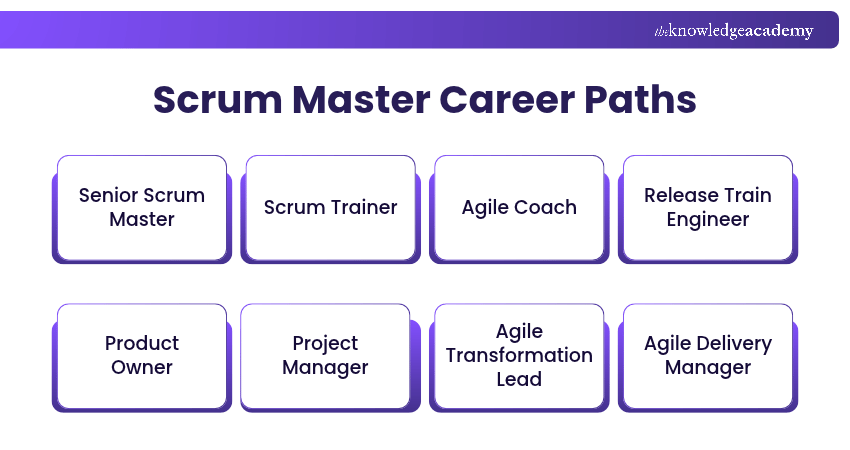
1) Senior Scrum Master
A Senior Scrum Master supports Scrum teams in improving collaboration, overcoming complex impediments and applying Scrum practices effectively. This role may involve mentoring less experienced Scrum Masters and helping teams strengthen their self-management capabilities. Professionals can progress into this position by developing advanced coaching, facilitation and problem-solving skills.
2) Scrum Trainer
A Scrum Trainer helps professionals and teams understand and apply Scrum through training sessions and workshops. They develop learning materials and guide participants in Scrum practices. Experienced Scrum Masters can pursue this role by strengthening their Scrum knowledge, facilitation and training skills.
3) Agile Coach
An Agile Coach supports teams and organisational leaders in applying Agile principles and improving ways of working. They focus on coaching teams, encouraging collaboration and helping organisations navigate changes in their practices.
Experienced Scrum Masters can transition into this role by strengthening their knowledge of Agile approaches, coaching techniques and organisational change.
4) Release Train Engineer
A Release Train Engineer (RTE) serves as a leader and coach for an Agile Release Train (ART) within the Scaled Agile Framework (SAFe). They facilitate ART planning events, coordinate dependencies, help address impediments and support continuous improvement.
Scrum Masters interested in large-scale Agile delivery can pursue this position by developing expertise in SAFe practices and cross-team coordination.
5) Product Owner
A Product Owner is accountable for maximising product value through effective Product Backlog management. This role involves developing and communicating the Product Goal, ordering Product Backlog items and ensuring the backlog remains transparent and understood.
Scrum Masters interested in product strategy and value delivery can transition into this role by strengthening their product management and decision-making skills.
6) Project Manager
A Project Manager oversees project planning, coordination and delivery to achieve defined business objectives. Responsibilities commonly include managing schedules, budgets, risks, resources and stakeholder communication.
Scrum Masters can explore this alternative career direction by developing project governance, financial planning and delivery management skills alongside their existing Agile experience.
7) Agile Transformation Lead
An Agile Transformation Lead supports organisations in adopting Agile approaches and improving collaboration across departments. This position involves developing transformation strategies, engaging leadership teams and assessing the effectiveness of organisational changes.
Experienced Scrum Masters can pursue this role by building expertise in change management, organisational strategy and enterprise-wide Agile practices.
8) Agile Delivery Manager
An Agile Delivery Manager supports the delivery of products and services by coordinating activities, managing delivery risks and helping teams address dependencies. Scrum Masters can move into this role by developing delivery planning, stakeholder management and cross-team coordination skills.
Develop the confidence to lead product development initiatives with Scrum Product Owner Certification Training – Register now!
Responsibilities of a Scrum Master
A Scrum Master helps teams understand and apply the Scrum framework effectively. Their primary responsibility is to support the Scrum team's effectiveness by coaching members, facilitating collaboration and helping remove impediments to progress. Although specific activities may vary across organisations, common Scrum Master responsibilities include:
1) Ensuring Scrum events take place and remain productive and within their timeboxes.
2) Coaching team members in self-management and cross-functional collaboration.
3) Helping identify and remove impediments that affect the Scrum Team's progress
4) Mentoring the team on Scrum principles, practices and values.
5) Helping the Scrum team focus on creating valuable product Increments that meet the Definition of Done
6) Promoting effective communication, collaboration and teamwork.
7) Supporting the developers in understanding how to inspect progress towards the Sprint Goal and adapt their plans
8) Supporting the Product Owner in effective Product Backlog management and stakeholder collaboration.
9) Coaching the wider organisation in Scrum adoption and helping remove barriers between stakeholders and Scrum teams.
Tips for Advancing Your Scrum Master Career
Advancing as a Scrum Master requires continuous learning, practical experience and strong leadership capabilities. By developing advanced Scrum knowledge, improving coaching skills and exploring new professional opportunities, Scrum Masters can prepare for more senior and specialised roles. Here are some practical tips for career growth:
1) Strengthen Your Scrum Knowledge: Deepen your understanding of Scrum principles, values and practices. Stay updated with the Scrum Guide and learn how to apply Scrum in different team environments.
2) Develop Advanced Coaching Skills: Improve your facilitation, active listening and conflict resolution skills. Focus on helping teams become self-managing and overcome challenges independently.
3) Gain Experience Across Different Teams: Work with teams of varying sizes, experience levels and organisational contexts. Exposure to different challenges can prepare you for senior Scrum Master and Agile coaching roles.
4) Pursue Relevant Certifications: Consider certifications relevant to Scrum or advanced credentials that align with your career goals.
5) Build Leadership and Communication Skills: Strengthen your ability to engage stakeholders, facilitate discussions and influence positive changes without relying on formal authority.
6) Expand Your Agile Expertise: Explore other Agile approaches, such as Kanban and SAFe, to broaden your knowledge and prepare for opportunities in scaled Agile delivery.
7) Seek Feedback and Mentorship: Learn from experienced Scrum professionals and regularly seek feedback on your performance. Use these insights to identify development areas and improve your effectiveness.
Apply Scrum principles effectively and deliver value through iterative development with Scrum Certification Training – Join now!

The Knowledge Academy develops accessible learning content across Project Management, IT, Cybersecurity, Data Science, Business Analysis, HR, Accounting and Finance, Leadership and Health and Safety. Its resources combine subject research with clear explanations to help professionals build practical knowledge across a wide range of disciplines.
View Detail

 If you wish to make any changes to your course, please


