


We may not have the course you’re looking for. If you enquire or give us a call on 01344203999 and speak to our training experts, we may still be able to help with your training requirements.
Home
 Resources
Project Management
Risk Manager Job Description: Responsibilities, Skills and Qualifications
Resources
Project Management
Risk Manager Job Description: Responsibilities, Skills and Qualifications
Risk Manager Job Description: Responsibilities, Skills and Qualifications
ByThe Knowledge AcademyLast updated on: 04 November 2026
Considering a career in risk management? Get familiar with the job responsibilities, qualifications, essential skills and professional expectations of a Risk Manager.
At a Glance
1. Risk Managers help organisations identify, assess and manage risks that could affect business objectives.2. Their responsibilities include developing risk strategies, reviewing controls and reporting risks to stakeholders.3. Essential skills include analytical thinking, communication, problem-solving and knowledge of risk management frameworks.4. Practical experience in risk analysis, compliance, auditing or related fields can support progression into Risk Manager roles.5. Risk Managers work across industries such as finance, healthcare, insurance, manufacturing and technology to support informed business decisions.
A company is just weeks away from launching a new product when sudden supply chain disruptions put its delivery schedule at risk. How can it identify potential problems, reduce their impact and keep operations running? This is where a Risk Manager comes into the picture.
A Risk Manager helps organisations identify, assess and manage uncertainties that could affect their objectives. However, the role goes beyond identifying potential threats. Let's take a closer look at a Risk Manager job description and discover what this profession entails.
Who is a Risk Manager?
A Risk Manager is responsible for identifying, analysing and evaluating potential risks an organisation might face. These risks may involve threats to business objectives or opportunities arising from uncertainty. By assessing the likelihood and consequences of such risks, Risk Managers recommend suitable strategies to minimise threats, manage uncertainty and support informed decision-making.
Even more, Risk Managers work closely with stakeholders at all levels to support the implementation of risk management policies, procedures and controls. They also monitor changing risk conditions and provide recommendations to decision-makers.
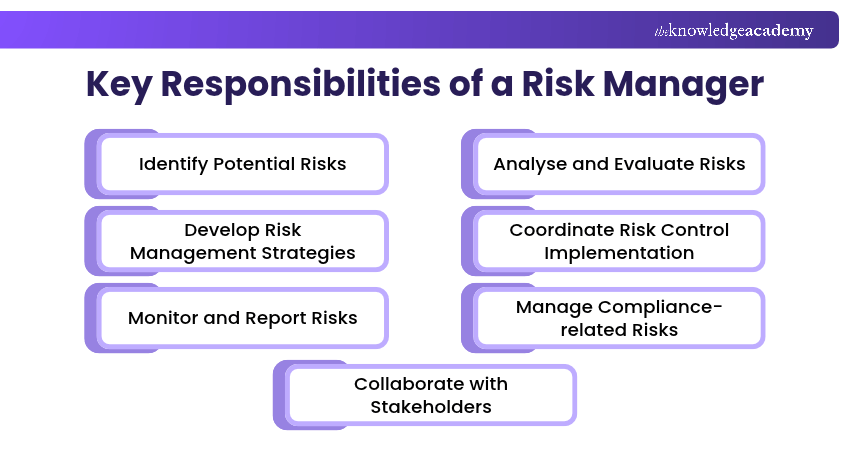
Key Responsibilities of a Risk Manager
Risk Managers have various responsibilities aimed at effectively managing risks within the organisation. Here are their key responsibilities:
1) Identify Potential Risks
Risk Managers identify events and circumstances that could affect organisational objectives. These may include financial uncertainty, operational disruptions, cybersecurity incidents, supply chain problems and regulatory changes.
They gather information from business processes, internal reports, stakeholder discussions and external developments to identify emerging risks. Early identification enables organisations to consider suitable responses before potential issues escalate.
2) Analyse and Evaluate Risks
Risk Managers analyse identified risks to understand their likelihood, potential consequences and overall significance to the organisation. They consider relevant internal and external factors, examine existing controls and estimate the level of risk to support informed decisions.
Risk evaluation involves comparing the results of risk analysis against established risk criteria to determine which risks require further treatment or monitoring. Risk Managers may use risk matrices, scenario analysis and other suitable techniques to support this process.
3) Develop Risk Management Strategies
Once risks are identified and assessed, Risk Managers develop strategies and action plans to manage them effectively. They may recommend avoiding certain activities, reducing the consequences of risks, sharing risks through suitable arrangements or retaining risks through informed decisions or taking calculated risks to pursue opportunities.
Risk Managers also work with relevant stakeholders to ensure proposed treatments align with organisational objectives, established risk criteria and available resources.
4) Coordinate Risk Control Implementation
Risk Managers oversee or coordinate the implementation of risk controls designed to manage identified risks. These may include approval procedures, access restrictions, business continuity arrangements, financial controls and monitoring activities.
They collaborate with responsible departments to define control responsibilities and evaluate whether the measures operate as intended.
Trainer's Insight: Who Owns the Risk?
Risk Managers advise on risk treatments, coordinate assessments and monitor controls. However, designated Risk Owners are generally accountable for managing risks within their areas. Understanding this distinction helps organisations assign responsibilities clearly.
5) Monitor and Report Risks
Risk Managers regularly review risk exposure, emerging concerns and the effectiveness of existing controls. Their monitoring and reporting responsibilities include:
a) Track Risk Indicators: Monitor relevant metrics and changes in risk exposure.
b) Review Control Effectiveness: Assess whether existing controls and treatments remain suitable.
c) Maintain Risk Registers: Update documented risks, assessments, owners and treatment plans.
d) Prepare Risk Reports: Communicate significant risks, emerging concerns and recommendations to management.
Regular monitoring helps organisations respond when risk conditions change and provides information for ongoing decision-making.
6) Manage Compliance-related Risks
Risk Managers support organisations in identifying and managing risks arising from applicable laws, regulations and industry standards. They work with compliance, legal and operational teams to evaluate regulatory exposure, review relevant controls and recommend improvements where necessary.
However, responsibility for legal compliance is shared across the organisation. Risk Managers support and monitor compliance-related risk management rather than independently guaranteeing regulatory compliance.
7) Collaborate with Stakeholders
Effective risk management requires collaboration across business functions. Risk Managers communicate with senior leadership, department heads, employees, auditors and other relevant stakeholders to understand risks and coordinate appropriate responses.
They explain assessment findings, discuss treatment options and encourage employees to recognise and report potential risks.
Turn uncertainty into strategy and risk into readiness by joining the MoR® 4 Practitioner Risk Management Certification Training now!
Essential Skills for Risk Managers
Risk Managers need a combination of technical knowledge, analytical abilities and interpersonal skills to assess risks and support organisational decisions. Here are the essential skills for the role:
a) Analytical Skills: Strong analytical skills help Risk Managers examine data, identify trends and evaluate potential risks. They use these insights to assess risk exposure and make evidence-based recommendations.
b) Communication Skills: Risk Managers must explain complex risks clearly to stakeholders. Strong written and verbal communication helps them present assessment findings, recommend mitigation strategies and prepare accurate risk reports.
c) Problem-solving Skills: Problem-solving skills help Risk Managers investigate issues, identify possible causes and develop practical solutions. They must consider business objectives, available resources and potential consequences when recommending actions.
d) Decision-making Skills: Risk Managers evaluate available evidence, compare possible outcomes and recommend suitable responses to uncertainty. Effective decision-making ensures their recommendations align with organisational objectives and risk appetite.
e) Risk Assessment and Management: Knowledge of risk assessment methods and frameworks, such as ISO 31000, helps Risk Managers evaluate likelihood, impact and control effectiveness.
f) Regulatory and Compliance Knowledge: Risk Managers need to understand relevant laws, regulations and industry standards. This knowledge helps them identify compliance risks, evaluate regulatory exposure and recommend appropriate controls.
g) Attention to Detail: Attention to detail helps Risk Managers identify inconsistencies, maintain accurate risk registers and review assessment findings. It also reduces errors in risk documentation and management reports.
Bonus Tip: Practise With a Risk Register
Create a simple risk register for a hypothetical project. Record potential risks, assess their likelihood and impact, identify responsible owners and suggest suitable treatments. This exercise helps build practical risk assessment and documentation skills.
Qualifications Required to Become a Risk Manager
Becoming a Risk Manager usually involves a combination of relevant education, professional knowledge and practical experience. Let's check the qualifications required:
1) Educational Qualifications
A bachelor's degree in risk management, finance, business administration, economics, accounting or a related discipline can provide a useful foundation for this career.
Some employers may prefer postgraduate qualifications for senior or specialised positions. However, no single degree is universally required, and relevant professional experience may also be considered.
2) Professional Certifications
Professional risk management qualifications can help demonstrate knowledge of risk frameworks, assessment methods and organisational risk practices.
One relevant qualification pathway is MoR® (Management of Risk), which covers structured approaches to managing risk across organisational and delivery environments. For example, MoR® 4 Practitioner focuses on applying an integrated risk management framework, supporting risk-aware decision-making and creating organisational value.
Certifications can support career development but do not guarantee employment or replace relevant experience. Individuals should check the current syllabus and assessment requirements before selecting a qualification.
3) Relevant Work Experience
Practical experience is important because Risk Managers must understand how risks affect business operations and strategic objectives. Professionals may develop relevant experience in risk analysis, internal auditing, governance, compliance, finance, insurance or operational management.
Experience in preparing risk assessments, maintaining risk registers, evaluating controls and communicating findings can support progression towards Risk Manager positions.
4) Technical Training and Industry Knowledge
Technical training helps professionals develop familiarity with risk management methods, reporting tools and industry-specific requirements. Relevant areas include risk identification, qualitative and quantitative assessment, risk treatment, control evaluation and business continuity planning. Familiarity with spreadsheets, data analysis and risk management software also supports accurate assessments and reporting.
Go beyond risk awareness and develop advanced risk expertise by joining the Risk Management Black Belt Training today!
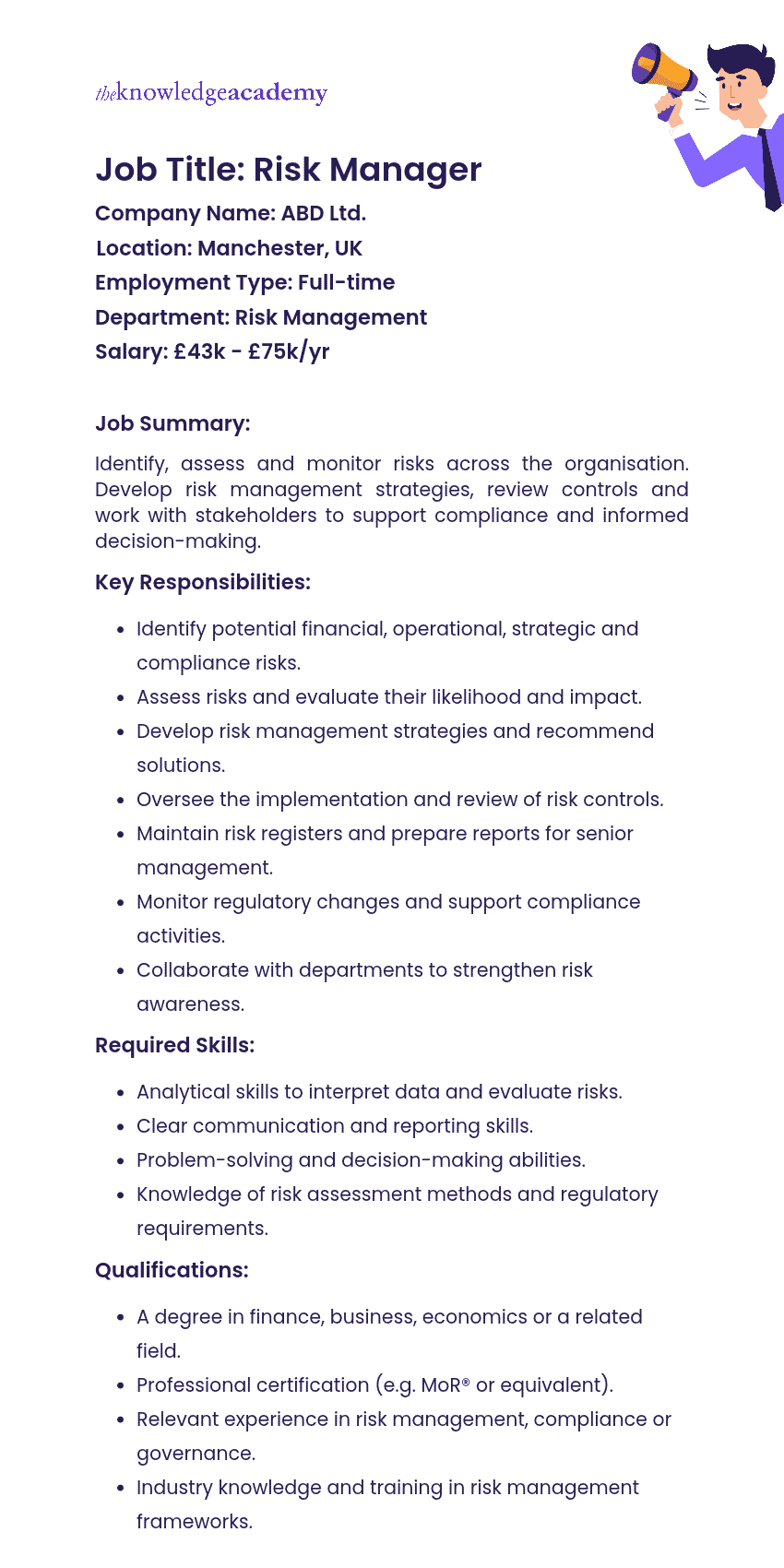
Risk Manager Job Description Example
A Risk Manager job description outlines the responsibilities, skills and qualifications required to identify and manage organisational risks. Let's look at the example below:

The Knowledge Academy develops accessible learning content across Project Management, IT, Cybersecurity, Data Science, Business Analysis, HR, Accounting and Finance, Leadership and Health and Safety. Its resources combine subject research with clear explanations to help professionals build practical knowledge across a wide range of disciplines.
View Detail

 If you wish to make any changes to your course, please


