


We may not have the course you’re looking for. If you enquire or give us a call on 01344203999 and speak to our training experts, we may still be able to help with your training requirements.
PRINCE2® Roles and Responsibilities
ByNilotpal SarmahLast updated on: 17 September 2026
PRINCE2 Roles and Responsibilities define who directs, manages, supports and delivers a project. Explore each key role, how responsibilities connect, and how the structure can be adapted to different projects.

Projects can become difficult to manage when accountability and decision-making authorities are unclear. PRINCE2® Project Management (Version 7) addresses this by defining responsibilities across project direction, management, assurance, support and delivery.
This blog explains the key PRINCE2 Roles and Responsibilities, how the roles work together, and how they can be adapted to different project environments.
What are PRINCE2® Roles and Responsibilities?
PRINCE2 defines specific roles to establish accountability and clear decision-making across a project. These roles represent different project interests and ensure responsibilities are assigned to the appropriate level rather than concentrated with one person.
In simple terms, each role clarifies who owns a decision, activity, or outcome.

PRINCE2® Project Management Structure
PRINCE2 separates project direction from day-to-day management and product delivery. This allows senior decision-makers to maintain oversight without becoming involved in every operational activity.
A simplified project structure can therefore be shown as:
Project BoardExecutive | Senior User | Senior Supplier↓Project Manager↓Team Manager / Delivery Teams
Project Assurance provides independent oversight on behalf of the Project Board, while Project Support assists the Project Manager and wider project management team. Change Authority may also be delegated responsibility for specified change decisions.
Understanding Key PRINCE2® Roles and Responsibilities
Different PRINCE2 roles handle different aspects of project direction, management, oversight and delivery. Understanding these distinctions helps prevent duplicated responsibilities and unclear decision-making. Here is what each key PRINCE2 role is responsible for:
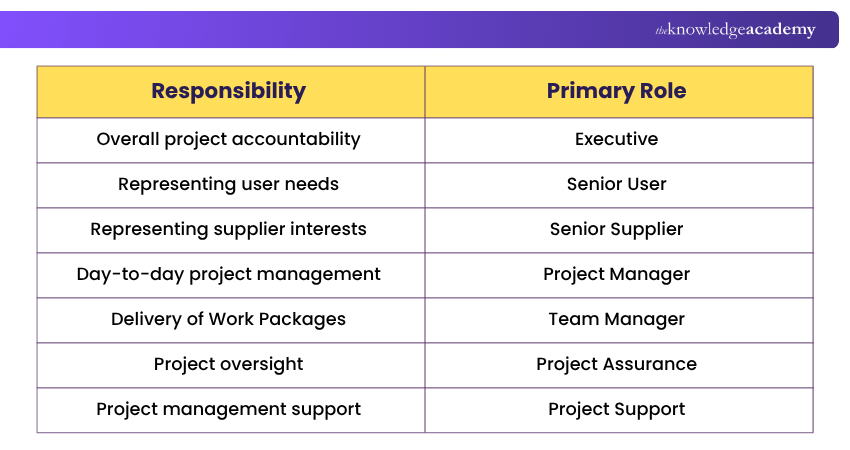
1) Project Board
The Project Board provides overall project direction and brings together business, user, and supplier interests. It makes important project-level decisions and provides the Project Manager with authority to manage within agreed limits.
Key Responsibility: Provides overall direction and makes significant project-level decisions.
a) Executive: The Executive leads the Project Board and represents the business interest. This role maintains overall accountability for the project and helps ensure that it continues to support its intended business objectives.
b) Senior User: The Senior User represents those who will use the project's products or benefit from its outcomes. This role helps ensure that user requirements and expected benefits remain properly represented in project decisions.
c) Senior Supplier: The Senior Supplier represents those providing the specialist resources, expertise, or products required by the project. This role brings the supplier perspective into Project Board decisions and supports technical feasibility.
2) Project Manager
The Project Manager manages the project on a day-to-day basis on behalf of the Project Board. Responsibilities include coordinating plans, resources, risks, issues, reporting and delivery within the authority delegated to the role.
Key Responsibility: Coordinates and manages the project's everyday activities.
Advance your project expertise with PRINCE2® Practitioner Course and apply the method confidently and successfully- Sign up today!
3) Team Manager
The Team Manager coordinates the work required to produce products assigned by the Project Manager. In PRINCE2 delivery, the Project Manager can authorise a Work Package and the Team Manager manages its execution.
Key Responsibility: Manages the delivery of agreed Work Packages.
4) Project Assurance
Project Assurance provides the Project Board with confidence that the project is being managed and controlled appropriately. Its purpose is oversight rather than carrying out the day-to-day management or administrative work of the project.
Key Responsibility: Provides assurance that the project remains appropriately controlled.
Trainer's Tip: Do not confuse Project Assurance with Project Support. Project Assurance focuses on oversight and confidence, while Project Support assists with project management and administrative activities.
5) Project Support
Project Support assists the Project Manager and wider management team with activities needed to keep the project organised. Depending on the project's needs, this can include administration, information management, reporting, planning assistance and coordination.
Key Responsibility: Provides practical support for project management activities.
6) Change Authority
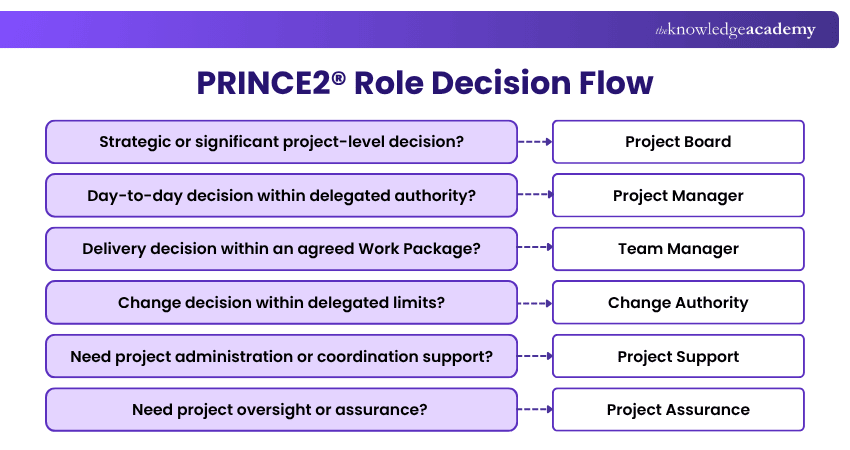
Change Authority is a delegated role that can make specified change decisions without referring every matter to the full Project Board. The scope and limits of this delegated authority should be clearly understood.
Key Responsibility: Makes specified change decisions within delegated authority.
In PRINCE2 Project Management (Version 7), change is handled within the wider Issues Practice, reflecting that an issue does not always require a change to the project baseline.
How Do PRINCE2® Roles Work Together?
PRINCE2 roles work within a connected management structure, with the Project Board providing direction, the Project Manager handling day-to-day management, and Team Managers coordinating delivery. Project Assurance provides oversight, while Project Support assists with essential project activities.
In simple terms, information and responsibility can move in two directions:
Direction ↓
Project Board → Project Manager → Team Manager
Progress and Escalation ↑
Team Manager → Project Manager → Project Board
This supports the PRINCE2 approach of delegating authority within defined limits rather than requiring senior management to make every project decision.
Adapting PRINCE2® Roles to Different Projects
Not every project requires the same number of people or exactly the same organisational arrangement. PRINCE2 Project Management can be tailored to suit factors such as scale, complexity, delivery approach, organisational context, and project needs. PRINCE2 Project Management (Version 7) places particular emphasis on flexibility and tailoring.
This means responsibilities that are distributed among several people on a complex project may sometimes be combined on a smaller project. Tailoring should keep the structure proportionate while preserving clear accountability, authority, and any responsibilities that need to remain independent. The way roles are applied can therefore differ according to the project:
1) Small Internal Project: The Project Manager may coordinate some product delivery responsibilities directly.
2) Large Technical Project: Different Team Managers may coordinate separate specialist areas.
3) Supplier-focused Project: Senior Supplier representation helps maintain attention on specialist resources and technical considerations.
4) User-focused Project: The management structure can place greater emphasis on regular user input and feedback.
Regardless of the arrangement used, responsibilities and decision-making authority should remain clearly understood.
Test Your Understanding
Which PRINCE2 role represents those who will use or benefit from the project's products?A. ExecutiveB. Senior UserC. Senior SupplierD. Project SupportAnswer: B. Senior User
Common Mistakes When Assigning PRINCE2® Roles
Having the correct role names on an organisation chart does not automatically create clear accountability. Problems can still occur when responsibilities overlap, authority is poorly defined, or important interests are not properly represented. Some common mistakes to avoid include:
1) Making the Project Manager Responsible for Everything
The Project Manager handles day-to-day management, but overall project direction and accountability should remain with the appropriate Project Board roles.
2) Weak User Representation
Projects can lose sight of practical user requirements when the Senior User role does not provide meaningful representation of those affected by the project's products.
3) Confusing the Executive and Project Manager
The Executive maintains business-level accountability, while the Project Manager is responsible for managing the project day to day.
4) Leaving Assurance Responsibilities Unclear
If assurance responsibilities are poorly defined, the Project Board may lack confidence that appropriate project controls and performance are being reviewed.
5) Leaving Delegated Authority Unclear
Poorly defined decision limits can result in unnecessary escalation or decisions being made by people who do not have the required authority.
6) Overcomplicating the Project Structure
Adding more people, layers or controls than the project needs can create unnecessary complexity. Tailoring should help maintain suitable governance while keeping the management approach proportionate.
Prepare confidently for another attempt with the PRINCE2® Foundation Exam Resit and achieve your qualification- join now!

Nilotpal Sarmah is a Senior Content Writer with 11+ years of overall experience spanning engineering, operations and content development. His technical knowledge and extensive writing experience enable him to simplify specialised topics across IT and Tech, Business Skills, Project Management, Health and Safety, and ISO and Compliance.
View Detail

 If you wish to make any changes to your course, please


