


We may not have the course you’re looking for. If you enquire or give us a call on 01344203999 and speak to our training experts, we may still be able to help with your training requirements.
Six Sigma Roles and Their Responsibilities
ByThe Knowledge AcademyLast updated on: 17 November 2026
Explore the key Six Sigma roles and responsibilities, from Executive Leadership and Deployment Leaders to different Belt levels and understand how each contributes to process improvement and organisational success.

Key Highlights
1. Six Sigma relies on clearly defined responsibilities to plan, implement and sustain process improvements.2. Executive Leadership and Deployment Leaders provide strategic direction, resources and implementation oversight.3. Champions and Project Sponsors help align improvement projects with business priorities and support project teams.4. Master Black Belts, Black Belts and Green Belts provide different levels of technical expertise, project leadership and analytical support.5. Yellow Belts, White Belts, Process Owners and team members contribute to improvement activities and help sustain results.
One recurring problem. Several possible causes. Different professionals working towards a solution.
Who decides which problem deserves attention? Who investigates the causes? And who ensures that improvements continue to deliver results? The answer lies in clearly defined Six Sigma roles.
Six Sigma is a data-driven methodology that helps organisations improve processes and reduce defects. However, its success depends on clearly defined roles and effective collaboration. Let's explore the key Six Sigma roles and their contributions to process improvement.
Key Six Sigma Roles and Their Responsibilities
Six Sigma involves several roles, each contributing to planning, executing and sustaining process improvements. From senior leaders setting strategic priorities to team members implementing solutions, everyone has specific responsibilities. Here are the key Six Sigma roles and their respective responsibilities:
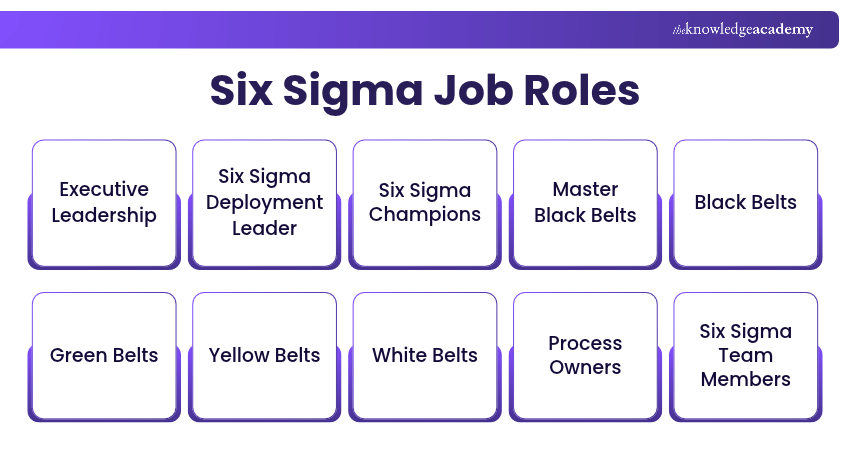
1) Executive Leadership
Executive Leadership includes senior management professionals, such as Chief Executive Officers (CEOs) and other executives, who establish the overall direction for Six Sigma initiatives. They ensure that process improvement activities align with organisational objectives and receive the necessary support.
Responsibilities:
a) Establish Six Sigma goals and strategic priorities.
b) Allocate budgets, resources and organisational support.
c) Promote a culture of quality and continuous improvement.
d) Review overall performance and improvement outcomes.

2) Six Sigma Deployment Leader
A Six Sigma Deployment Leader is responsible for coordinating and overseeing the implementation of Six Sigma across an organisation. While Executive Leadership provides strategic direction, the Deployment Leader focuses on turning that strategy into an actionable programme.
Responsibilities:
a) Develop and coordinate the Six Sigma deployment plan.
b) Align improvement projects with organisational priorities.
c) Coordinate training, resources and implementation activities.
d) Monitor deployment progress and report performance to leadership.
3) Six Sigma Champions
Six Sigma Champions are senior managers who act as a link between project teams and organisational leadership. Their involvement helps projects maintain management support and progress towards agreed business outcomes.
Responsibilities:
a) Identify and prioritise suitable improvement opportunities.
b) Support project selection and approve project objectives.
c) Remove organisational barriers affecting project progress.
d) Review project performance and support improvement teams.
4) Master Black Belts
Master Black Belts are highly experienced Six Sigma practitioners who oversee methodological excellence across improvement programmes. Their expertise is particularly valuable when organisations manage multiple projects or face complex analytical challenges.
Responsibilities:
a) Develop and guide organisation-wide Six Sigma practices.
b) Train and mentor Black Belts and Green Belts.
c) Provide expertise in statistical analysis and improvement methods.
d) Support project selection, performance measurement and technical reviews.
5) Black Belts
Black Belts lead Six Sigma improvement projects and guide teams through structured problem-solving activities. They apply analytical techniques to identify root causes, evaluate process performance and implement improvements. Black Belts typically lead complex or cross-functional initiatives and may work full-time in improvement roles, depending on organisational requirements.
Responsibilities:
a) Plan and manage complex or cross-functional improvement projects.
b) Analyse process data and identify root causes of problems.
c) Guide project teams through the DMAIC methodology.
d) Coach team members and coordinate improvement implementation.
6) Green Belts
Green Belts possess working knowledge of Six Sigma techniques and contribute to improvement activities alongside their regular responsibilities. They may lead smaller projects within their departments or assist Black Belts with more complex initiatives. Their involvement helps organisations apply improvement methods directly to operational challenges.
Responsibilities:
a) Lead smaller improvement projects within their areas of work.
b) Collect and analyse data to identify process problems.
c) Support Black Belts on larger improvement initiatives.
d) Apply Six Sigma tools to evaluate and improve processes.
Learn how to improve business performance through Six Sigma Green Belt Training – Register today!
7) Yellow Belts
Yellow Belts have foundational knowledge of Six Sigma principles and participate in improvement activities as project team members. They understand basic problem-solving concepts and help project leaders examine existing processes, collect information and implement changes.
Responsibilities:
a) Assist with data collection and process documentation.
b) Identify problems and improvement opportunities.
c) Support Green Belts and Black Belts during projects.
d) Participate in implementing and monitoring process changes.
8) White Belts
White Belts have a basic awareness of Six Sigma principles, terminology and objectives. This introductory role helps employees understand how continuous improvement works and how they can contribute to small-scale problem-solving activities.
Responsibilities:
a) Understand basic Six Sigma concepts and terminology.
b) Recognise how routine activities affect process quality.
c) Participate in introductory improvement discussions.
d) Follow established improvement practices within their work areas.
9) Process Owners
A Process Owner is responsible for managing and maintaining a specific business process. In Six Sigma projects, they work with improvement teams to understand existing operations, support process changes and ensure that improvements remain effective after project completion.
Responsibilities:
a) Monitor the performance of assigned business processes.
b) Collaborate with project teams to identify operational issues.
c) Approve and integrate agreed process changes into daily operations.
d) Maintain process controls and sustain improvement outcomes.
10) Six Sigma Team Members
Six Sigma Team Members are employees or subject matter experts who contribute their operational knowledge and experience to improvement projects. They work alongside project leaders to identify process problems, evaluate solutions and implement changes.
Responsibilities:
a) Contribute operational knowledge and expertise to Six Sigma improvement projects.
b) Collaborate with project leaders to complete assigned activities.
c) Support the testing and implementation of process improvements.
d) Provide feedback on proposed changes and their practical effectiveness.
A project needs expert guidance on a complex statistical technique. Who should provide it?
1. Yellow Belt2. Master Black Belt3. Process OwnerCorrect Answer: Master Black BeltExplanation: Master Black Belts provide advanced statistical expertise and technical guidance to help project teams resolve complex analytical challenges.
How Six Sigma Roles Work Together?
Six Sigma relies on collaboration between different roles to achieve lasting process improvements. While each professional has specific responsibilities, their efforts are connected throughout the project lifecycle. Here's how they work together:
1) Setting Strategic Direction: Executive Leadership establishes improvement goals, while Deployment Leaders coordinate Six Sigma implementation across the organisation.
2) Selecting and Supporting Projects: Champions and Project Sponsors identify improvement priorities, allocate resources and remove obstacles that could affect project progress.
3) Guiding Improvement Teams: Master Black Belts provide technical expertise, mentor practitioners and ensure Six Sigma methodologies are applied correctly.
4) Executing Improvement Projects: Black Belts lead complex projects, while Green Belts conduct analysis, implement solutions and support improvement activities.
5) Supporting Project Activities: Yellow Belts, White Belts and other team members contribute process knowledge, collect data and participate in improvement initiatives according to their training and responsibilities.
6) Sustaining Improvements: Process Owners monitor performance, maintain process controls and ensure improvements continue to deliver results after project completion.
Build the leadership capabilities required to lead continuous improvement projects with Six Sigma Master Black Belt Training – Join now!

The Knowledge Academy develops accessible learning content across Project Management, IT, Cybersecurity, Data Science, Business Analysis, HR, Accounting and Finance, Leadership and Health and Safety. Its resources combine subject research with clear explanations to help professionals build practical knowledge across a wide range of disciplines.
View Detail

 If you wish to make any changes to your course, please


