


We may not have the course you’re looking for. If you enquire or give us a call on 01344203999 and speak to our training experts, we may still be able to help with your training requirements.
Java Developer Roles and Responsibilities: A Complete Guide
ByNilotpal SarmahLast updated on: 17 September 2026
Explore Java Developer Roles and Responsibilities, including essential technical and soft skills, and the tools and technologies used in Java Development.

Imagine you’re talking to a friend who has been learning Java for months.
They’re comfortable with the language, but just before applying for their first role, they ask:
“I know how to code in Java, but what will a company actually expect me to do?”
That’s where things get interesting. Writing code is important, but real-world Java Development also involves solving problems, working with others and adapting to different project needs. Understanding Java Developer Roles and Responsibilities helps bridge that gap between knowing Java and knowing what the job demands.
And as projects and technologies evolve, Java Developer Roles and Responsibilities can vary too, making it useful to understand what sits at the heart of the profession. Let's learn about it further in the blog!
Who is a Java Developer?
A Java Developer is a software professional who specialises in building and supporting applications using the Java programming language and its ecosystem. They apply their technical expertise throughout the Software Development process to help create reliable and efficient applications.
The role can vary depending on the organisation, project and type of application. Java Developers may work on enterprise systems, backend applications or existing Java software while collaborating with other professionals to support successful project delivery.

Key Roles and Responsibilities of a Java Developer
Java Developers contribute across different stages of Software Development, from building applications to maintaining their performance and security. Here are their eight key responsibilities:
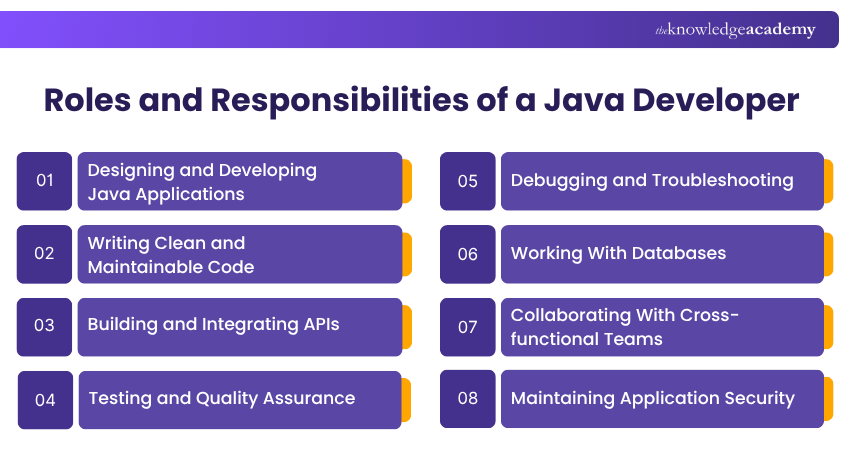
1) Designing and Developing Java Applications
Java Developers turn business and technical requirements into functional applications or components. Depending on the project, they may develop backend services, enterprise systems or web applications while considering maintainability and future changes.
2) Writing Clean and Maintainable Code
Java Developers follow coding standards and suitable object-oriented principles to create readable and maintainable code. They also participate in code reviews to identify defects, maintain quality and share knowledge across the development team.
3) Building and Integrating APIs
Java Developers build and consume Application Programming Interfaces (APIs) that enable applications and services to communicate. This can include creating RESTful endpoints, integrating external APIs, handling requests and responses, and implementing authentication, validation and testing where required.
4) Testing and Quality Assurance
Java Developers test applications to verify functionality, reliability and expected behaviour. They may use tools such as JUnit and Mockito for unit and integration testing, fix identified defects and create regression tests to prevent issues from recurring.
Pro Tip
Don’t leave testing until development is complete. Testing smaller changes as you build can make defects easier to identify and fix before they affect other parts of the application.
5) Debugging and Troubleshooting
Java Developers identify and resolve application issues by analysing logs, stack traces and application behaviour. They use debugging and problem-solving techniques to find underlying causes and help prevent similar problems from recurring.
6) Working With Databases
Java Developers work with databases such as MySQL, Oracle Database and PostgreSQL to store and retrieve application data. They may write queries, integrate application code with databases and troubleshoot data-access issues using technologies such as JDBC.
7) Collaborating With Cross-functional Teams
Java Developers collaborate with Developers, Testers, Designers and Project Managers to support successful project delivery. This can involve discussing requirements, reviewing technical solutions, resolving dependencies and participating in Agile activities.
8) Maintaining Application Security
Java Developers help protect applications and data by applying secure development practices. This can include input validation, access control, secure handling of credentials and sensitive information, dependency management and addressing security findings.
Turn your first lines of code into interactive experiences with the JavaScript For Beginners Training – Join now!
Essential Skills for a Java Developer
Performing these responsibilities requires both technical expertise and strong professional skills. Here are five essential skills in each category:
1) Technical Skills
Technical skills give Java Developers the practical knowledge needed to build, test and maintain applications effectively. It includes:
a) Core Java: A strong understanding of Java syntax, Object-oriented Programming, collections, exception handling and other core concepts is essential for developing reliable applications.
b) Frameworks: Knowledge of frameworks such as Spring and Spring Boot helps Developers build modern Java applications and backend services efficiently.
c) APIs and Web Technologies: Understanding REST APIs, HTTP, JSON and application integration is important, particularly for backend Java Development.
d) Databases and SQL: Java Developers should understand relational databases and SQL to store, retrieve and manage application data effectively.
e) Testing: Knowledge of automated testing helps Developers verify application behaviour and identify defects. Tools such as JUnit and Mockito are commonly used in Java projects.
Trainer’s Insight
Don’t rush into learning every framework and tool. A strong foundation in Core Java, OOP and problem-solving makes it easier to adapt to new technologies as projects change.
2) Soft Skills
Soft skills help Java Developers solve problems, communicate clearly and work effectively with others. It includes:
a) Problem-solving: Java Developers need to analyse technical challenges, troubleshoot issues and develop effective solutions.
b) Communication: Clear communication helps Developers understand requirements, explain technical concepts and collaborate with stakeholders.
c) Teamwork and Collaboration: Developers must work effectively with other Developers, Testers, Designers and Project Managers throughout Software Development.
d) Analytical Thinking: Strong analytical skills help Developers break down complex problems, investigate defects and evaluate suitable solutions.
e) Adaptability and Continuous Learning: Staying current with Java, frameworks and development practices helps Developers adapt to evolving technologies and project requirements.
Tools and Technologies Used by Java Developers
Java Developers use various tools and technologies to build, test and deliver applications efficiently. The exact tools depend on the project and development environment. Some key ones are:
a) Java and the JDK: The Java Development Kit (JDK) provides the essential tools for developing, compiling and running Java applications. Developers use a JDK version that meets their project's compatibility and support requirements.
b) Spring and Spring Boot: Spring supports Java application development, while Spring Boot simplifies the setup and configuration of Spring-based applications, APIs and backend services.
c) Integrated Development Environments (IDEs): IDEs such as IntelliJ IDEA and Eclipse help Developers write, navigate, refactor and debug Java code.
d) Build and Dependency Management Tools: Maven and Gradle automate Java builds and manage project dependencies, helping Developers maintain consistent development and build processes.
e) Testing Frameworks: JUnit supports automated testing, while Mockito helps Developers mock dependencies and test application components in isolation.
f) Databases: Java Developers use databases such as MySQL, Oracle Database and PostgreSQL to store, retrieve and manage application data using SQL and suitable data-access technologies.
g) Version Control: Git helps Developers track code changes, manage branches and collaborate with team members on shared codebases.
h) CI/CD and Deployment Tools: CI/CD tools such as Jenkins automate parts of building, testing and deploying Java applications, supporting consistent software delivery.
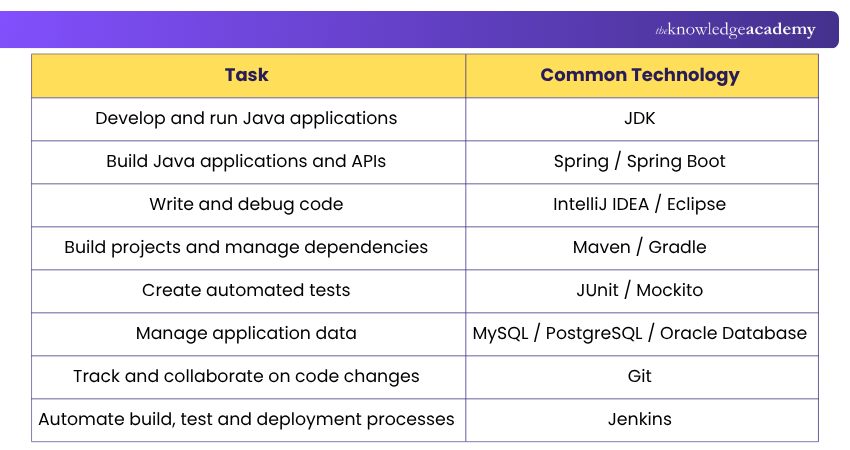
Which Technology Supports Which Task?
Turn logic into applications and ideas into code! Build your development skills with the Java Programming Training – Sign up now!

Nilotpal Sarmah is a Senior Content Writer with 11+ years of overall experience spanning engineering, operations and content development. His technical knowledge and extensive writing experience enable him to simplify specialised topics across IT and Tech, Business Skills, Project Management, Health and Safety, and ISO and Compliance.
View Detail

 If you wish to make any changes to your course, please


